Article updated on August 14, 2026
Text: Claire Lessiau & Marcella van Alphen
Photographs: Claire Lessiau
Do you know how to recognize a real paella from the ones that are sold to most tourists throughout Barcelona, or Spain for that matter? Do you know that there are 28 different protected Spanish cheeses recognized over the world? That gazpacho is traditionally a cold soup made by farmers with left over vegetables? That the delicious crema Catalana has a world-famous French younger sister? Join us for this tasty experience in the booming El Born medieval and historical district of Barcelona!
Pin it for later!
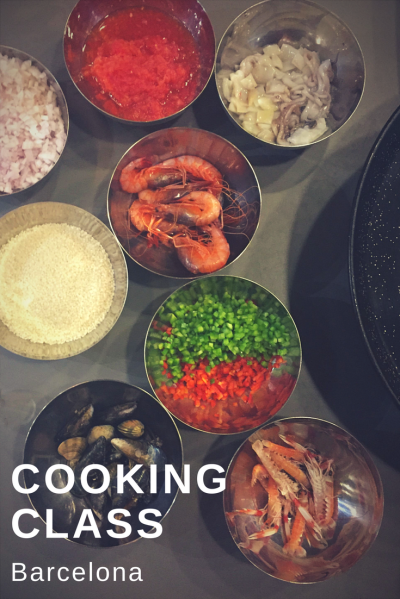
Market Tour
Ingredients are key to any good recipe. Before starting to cut, peel, and cook, Chef Patsy proudly takes us through the neat stalls of the Santa Caterina market in the historical heart of Barcelona. A good alternative to the very touristic La Boqueria on Las Ramblas, this 1848 market has been renovated in 1997 with a colorful rooftop, a metaphoric sea of fruits and vegetables. One of the most vibrant markets of Barcelona, local elderlies roam the alleys to do their groceries, undisturbed by a few tourists marveling at the colorful fruit and vegetable stalls, fresh seafood on ice, or Spanish cold cuts hanging. An old lady drags her trolley behind her while she hand-picks some colorful Spanish tomatoes taking many shades of the light spectrum from green to dark red. “The tomatoes that are both red and green are the best ones”, Chef Patsy explains as we taste some. They are delicious. Each tomato has its own specific structure and sweetness, a true treat compared to their family members grown in greenhouses or off-ground.


The young Catalan chef motions towards the cured ham and cheese section. Proud of the Spanish cheeses and cold cuts, she warns us about extensive farming that seems to be taking over. Iberian pigs should be raised in meadows and fed with oaks for the best taste. The butcher presents slices of chorizo to us, in which various meats were carefully marinated with garlic and pepper to produce the best quality chorizo, not spicy to not overpower the high quality meat. The smiling vendor hands a wooden board to Chef Patsy whose eyes light up: “This is my favorite! This is paleta: while ham is cut from the back leg of the pig, paleta is from the front leg shoulder. It is not a marketed, but so delicious.” And as we taste the paleta, we notice immediately its rich and intense flavors due to the fact that the meat is closer to the bone than on a jamón.
Across the alley way, a wide variety of freshly caught fish, crabs, oysters, lobsters, shrimps, cuttlefish and many more seafood is displayed. Chef Patsy buys the key ingredients for the main dish we will be cooking: cuttlefish, as her team has already sourced and prepared the cooking class waiting for us a stone’s throw away in a narrow street of the El Born medieval district.
Cooking Class
We enter the vast and professional kitchen of Born to Cook, in a stunning vaulted stone and brick traditional house. “The house used to be owned by Christopher Columbus, ” Chef Patsy announces as she pours us a glass of wine to accompany more of the tasting from the market.


While sipping our wine with local goat cheese and aged manchego, Chef Patsy details the menu we are about to prepare together: gazpacho, patatas bravas, baked onion carpaccio, seafood paella, and a Catalan cream. Before we know it, we find ourselves, blending, sautéing, frying, stirring, measuring and chopping the ingredients with great smoothness thanks to Patsy’s tips and tricks.
Patatas Bravas
Chef Patsy starts peeling a large potato she cherry picked at the market. Not every specie is equal, and for the most popular Spanish tapa, patatas bravas, a, floury kind such as Maris Piper is best.
Instead of cutting it in cubes, she inserts her knife and then, lets the fibers of the root vegetable dictate the cut she does by breaking it by hand. “This is how the potato will release most of its starch, giving us the crispest possible bravas,” she says as she is already rinsing the potato pieces thoroughly.


Next, she dips them in sunflower oil to poach them for about 15 minutes. “Later, right before having them, we’ll fry them at 180°C for a few more minutes: that’s how they get crispy,” the chef explains.
Our task for the bravas is the sauce. Olive oil, minced garlic, a few hot chili peppers sliced and a few sliced onions in a pan on medium heat, mixed with skinned graded tomatoes simmers before being blended together. In a few seconds, Patsy will also emulsify an aioli for the perfect side of patatas bravas!
Baked Onion Carpaccio with Xató Sauce
In the meantime, sun-dried pepper paste, a good splash of sherry vinegar, a “little bit” of olive oil (this in Spain, means probably the triple of what you have in mind!), almonds, hazelnuts, pepper, and salt are blended with the juice of the oven-baked sweet onions. The Catalan Xató sauce is in the making.
This is tapa is more about plating: the soft sweet onions as a base, topped off with the sauce, a few drops of black olive tapenade, and a salty anchovy to balance the flavors.


Traditional Seafood Paella
Originating in Valencia, paella dates back to the cultivation of rice by the Moors during their occupation of Spain, and blended centuries later with the patella dish brought by the Romans. The name of the most famous Spanish dish comes from this ustensil, while the myth attributes it to an Arabic word meaning “leftover rice”.


A mix of mouth-watering smells fill the former house of Christopher Columbus. In one of the largest pans we have ever cooked with, Chef Patsy dumps the shrimp heads and shells, fries and crushes them to release flavorful shrimp fat and juices that will become the umami-rich base for our paella. In this shrimp oil infusion, the seafood paella is gradually taking shape: the onions are nicely caramelized and de-glazed with white wine, the cuttlefish has obtained the right texture after 40 minutes of cooking, diced peppers have been added and cooked until soft, and topped off by the tomatoes. Saffron is added to the dish, and a fish fumet is regularly poured on when the paella becomes to dry. Once the peppers are soft, it is time to add the round rice and let it cook in the dish.
As Patsy seems quite satisfied with the beautiful caramel taint of the dish, she explains: “Careful! A real paella is never yellow! Unfortunately you see many yellow paellas as cheap turmeric is used to replace the expensive saffron, and they are just cooked quickly, and not properly caramelized. It is a very common tourist trap here in Spain, and the places to avoid, they most likely advertise for sangria to go with! Sangria is something we do not order as Spaniards!” The paella starts to sing. The last touch is to arrange the mussels and shrimps and lower the heat as they will be slowly steamed for the perfect textures and flavors.


Crema Catalana
Chef Patsy is proud of her Catalan Cream. While crème brûlée may be more famous, the French take on the protein-high dessert is about 300 years more recent. The vanilla that was discovered much later is not used in the crema Catalana, but instead local citruses.


After preparing a cinnamon-and-citrus-zest-infused custard, and making it thicker with some corn starch, the ramekins spend a couple of hours in the fridge. The very last step is spectacular! A glowing red iron is used to caramelize a generous spoonful of sugar, resulting in high flames!


***
With a glass of Catalan white wine, we savour the dishes we have just cooked at a nicely set table in this medieval house. The tasteful local ingredients release a whole range of flavors. The paella itself tastes very differently from the yellow paellas, and is delicious with its deep umami and seafood savors.
While the recipes and techniques are not the most complex ones, it is the advice and expertise of the chef that truly makes a difference and that make this experience a must-do in Barcelona!


Travel tips:
- To explore the Spanish gastronomy to the fullest, check out the cooking school Born to Cook and make sure to book ahead!
- Check out this interactive map for the specific details to help you plan your trip, and more articles and photographs (zoom out) about the area!
For more in Barcelona & Spain, click on these images:





Oh yes, ingredients are extremely important. And when we lived in Amsterdam, we always buy from the Spanish grocer at the Albert cuyp market!
Oh yes, you really don’t want those Dutch tomatoes 😱 😉
That’s true, but they do have specific use too. Such as the local stampot dish.
A very mouth-watering post! 😉 And thank you for showing us how to recognise an authentic plate of Paella.
Thanks Len 🙂
What a fantastic article! Great pictures. Spain is an eventual destination for us, and it’s pieces like this that speeds up the timetable. Had no idea about cheap paella, great tip. Thanks for sharing!
Thank you very much girls! Hope you make it very soon to Spain!