Text: Marcella van Alphen
Photographs: Marcella van Alphen & Claire Lessiau
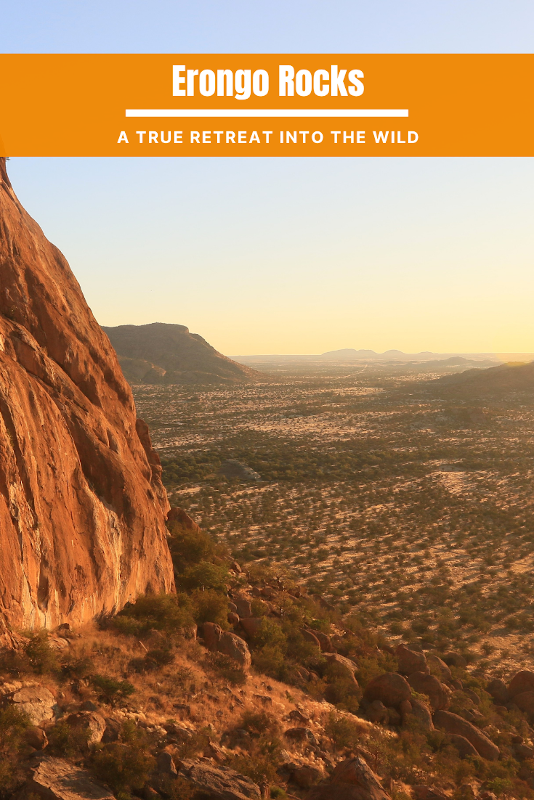
As if taken straight from the opening scene of The Lion King, a spectacular landscape that sprawls beneath what is called pride rock is teeming with wildlife. The acacia tree tops below the cliff that I have made myself comfortable on dot the landscape for as far as my eyes can see. There is no other person in sight nor nearby. I sit still and take in the beauty of Erongo Rocks, in the heart of Namibia’s Erongo Region while around me tens of thousands of rocks, from fist-sized stones to giant granite boulders, take on the warm colours of the setting sun, turning the landscape in an unusual spectacular red colour for a moment. Bird songs slowly fade. Klipspringers silently emerge on the rocks, staring towards the horizon along with me. Young dassies chase each other across slabs of granite. From this secluded viewpoint, I try to imagine which of these large rocks once provided shelter to our hunter-gather ancestors who roamed here for thousands of years and which of these rocks have become their canvases here in Namibia’s hotspot for rock art.
Pin it for later!
***
The birds go quiet for the night as the last sunrays have disappeared behind the horizon. Darkness falls quickly, as it does in this part of the world, and I reluctantly leave my contemplative viewpoint. Focused on what gets lit by the beam of my headlamp, I scan the trail for snakes, scorpions and other nocturnal creatures, my senses sharpen as I scramble down the rocks and follow the well-indicated path back to our secluded camp rapidly.
There are no lights to guide me. No neighbouring campers chatting around a fire. No music drifting across the bush. No humming of generators or other engines. It is just the crunch of my footsteps, an occasional rustle in the grass and my breathing that accompany me in this wild landscape.
This feeling of being alone in the wilderness and reconnecting with all senses is precisely what Erongo Rocks is about, even if it has not always been this way.
From Cattle Farm to Nature Sanctuary
The Rust family once farmed Karakul sheep and later cattle on this rugged land, where rainfall is unreliable and agriculture has never been easy. When Diethelm “Didi” Rust inherited the farm at only 28, he gradually began steering it in a radically different direction in his spare time. Instead of keeping wildlife out, he wanted to let it back in.
Fences that had divided the property and could trap or kill wild animals were progressively dismantled. Old traps were removed one by one. The farmhouse was rented as self-catering accommodation while Didi worked as a guide throughout southern Africa, and over the years the former livestock farm slowly evolved into a nature sanctuary.
The change was part of something larger. Erongo Rocks became one of the founding members of the Erongo Mountain Nature Sanctuary, a vast conservation initiative created by neighbouring private landowners. Across much of the sanctuary, internal fences have been removed, allowing wildlife to move through the mountains again. Species historically occurring here, including giraffe, impala and critically endangered black rhino, have been reintroduced, while anti-poaching efforts help protect them.
Then, in 2018, Didi met Terry while guiding in Botswana. Love struck and she joined him on the farm in late 2019. Only a few months later, the world stopped. With tourism brought to a standstill by the Covid pandemic, Didi and Terry suddenly had plenty of time and no visitors. They used it to work on the land: clearing and marking hiking trails, opening tracks and gradually creating secluded campsites among the rocks. Today there are eight of them, and their isolation is the utmost luxury.
Solitude in Nature
Luxury in the African wilderness often evokes images of large canvas tents with design furniture, well-maintained game drive vehicles, plunge pools, white tablecloths and someone appearing with a gin and tonic just as the setting sun is about the dip behind the horizon.
Erongo Rocks goes in almost the opposite direction.
Upon arrival, we are shown our secluded patch of wilderness, camp KykNet, surrounded by granite boulders. There is a firepit, a simple kitchen area and an outdoor bathroom which structure is almost entirely composed of the naturally occurring granite boulders. While it remains a camp, the way it is merged with nature and the attention to details to make it comfortable.
Didi, who has been roaming these lands since he was a toddler, has cherry-picked the locations among boulders, trees and viewpoints far enough apart that we neither see nor hear other guests. The privacy completely changes our relationship with the place. Instead of feeling that we are staying at an establishment from which we venture into nature, we truly feel that we have become part of the landscape.
On Foot Through the Erongo Mountains
Didi has designed an extensive network of trails across the property, and they are exceptionally well marked and maintained without feeling overly manicured. He has reserved 2 hectares for hiking and 3 additional hectares for wildlife, even though animals can roam wherever they want.
It is early morning as we approach the Mountain View Trail and we notice several bolted routes. where rock climbers can explore the crags.
We walk through increasingly open terrain, occasionally scrambling across enormous granite slabs which rough surface provides good grip. The walking is playful: up a slab, between two boulders, around an outcrop, then suddenly onto an exposed section where the mountains unfold in front of us. White-browed sparrow-weavers dart between thorn trees. Their untidy communal nests hang from branches, with different chambers and entrances providing the birds with escape routes when predators come investigating. A Terminalia catches our attention too, one of the many plants whose usefulness has long been understood by people living in these dry landscapes.
When we reach the highest point and take our time to take in the incredible landscape, we notice a pair of Verreaux’s eagles circling above as they nest in the cliffs rising from the trail.
Yet some of the most interesting places here require us to look elsewhere than towards the horizon, or up in the sky… instead what remains hidden underneath the rocks and overhangs reveals another world.
Messages Under the Overhangs
The granite that created this unique landscape has also created shelter. Across the Erongo Mountains, millions of years of erosion has formed caves and shallow overhangs that protected generations of hunter-gatherers from the sun, wind and rain. They are long gone but their presence remains visible on the rock walls.
Erongo is one of Namibia’s great rock-art regions, alongside the Brandberg and Twyfelfontein. The “Pope of Prehistory” himself, Abbé Henri Breuil (1877–1961), a renowned French priest, archaeologist and prehistorian stayed on the Rust farm in 1947 as Breuil was travelling to Namibia to study the local rock paintings, and the famous “White Lady”. He brought international attention to the region’s extraordinary San rock art heritage. On Erongo Rocks alone, dozens of painting sites have been identified, and we explore some of them with a guide. At Elephant Shelter, we have a closer look at the surface of the rock. Animals emerge from the granite in red ochre: giraffe, oryx and elephant.
At another site, the painted animal kingdom experienced by the San show us what other wildlife roamed here thousands of years ago. Some images are vivid, others have faded until they almost dissolve into the granite. I identify more kudus, warthogs, ostriches, giraffes and elephants. Apart from the elephants they all roam here again today. What strikes me is how accurate their depictions are, and what puzzles me is why our ancestors left these paintings. Different colours and styles overlap, hinting at people returning to these natural rock shelters over long periods.
Some interpretations tend to see them almost as illustrated inventories of animals available to hunters at the time of painting. Modern archaeological interpretations are more cautious. Southern African rock art can encode hunting knowledge, but researchers have also connected imagery elsewhere to ritual, trance, storytelling, social identity and spiritual beliefs. Looking at these walls today, it is tempting to construct a simple explanation for them but their creators are no longer here to confirm it.
Stone tools provide another physical link with those who lived here long before us. Simple but ingenious tools were created and used for hunting and butchering animals in a world where survival depended on understanding every detail of the landscape and animal behaviour. The farmhouse has a wide collection of these tools that have been found on these lands.
Back to the Fire
Around sunset hour, it feels that the animals from the rock paintings come alive again.
The elusive kudus move almost silently between the vegetation. Giraffes appear where moments earlier I could have sworn there was nothing. Klipspringers, the ballerinas of the bush, stand impossibly still on steep rocks, their compact silhouettes outlined against the sky. Dassies absorb the last heat of the granite before disappearing into cracks and find shelter for the cold night.
Later, we sit quietly by the fire, listening to it crackling. Beyond its glow, darkness takes over completely.
An entirely different shift of nocturnal creatures begins moving through the landscape, announced by the howling sounds of a black-backed jackal nearby and another responding in the distance.
There is something profoundly restorative about a place where very little is expected of us. No game drives, or white table cloths, small-talk with other guests, no sun-downers at a given time, no alarm clock… We can hike for hours, scramble over granite, search for birds, settle down in the hide by the waterhole, take in unobstructed views stretching to the horizon for hours, study ancient paintings beneath overhangs or climb rock faces. We can drive to the farmhouse for coffee and cake and a swim when solitude becomes a little too much, which it does not.
The longer we stay, the harder it gets to leave as the silence and rhythm of the day feels more soothing by the hour. We connect with the landscapes, the animals, the present moment and reconnect with ourselves as a result.
The sun will return tomorrow and turn the granite gold again. For now, I add another log to the fire and listen to the jackals, the crickets, the crackling of the fire. Familiar constellations dot the sky before the milky way appears in all its glory.
Travel tips:
- Erongo Rocks is popular by the people in the know. Make sure to book ahead to secure one of the campsites at Erongo Rocks.
- To make it more comfortable, the “Comfy Camping” consists of a simple dome tent set up at one of the campsites with a thick mattress and proper linen.
- A 4×4 is recommended to reach Erongo Rocks. For navigation, regular apps do not cut it, and rely on Tracks4Africa.
- Check out this interactive map for the specific details to help you plan your trip and more articles (zoom out) about the area:
For more in Namibia, click on these images: