Text: Marcella van Alphen
Photographs: Claire Lessiau
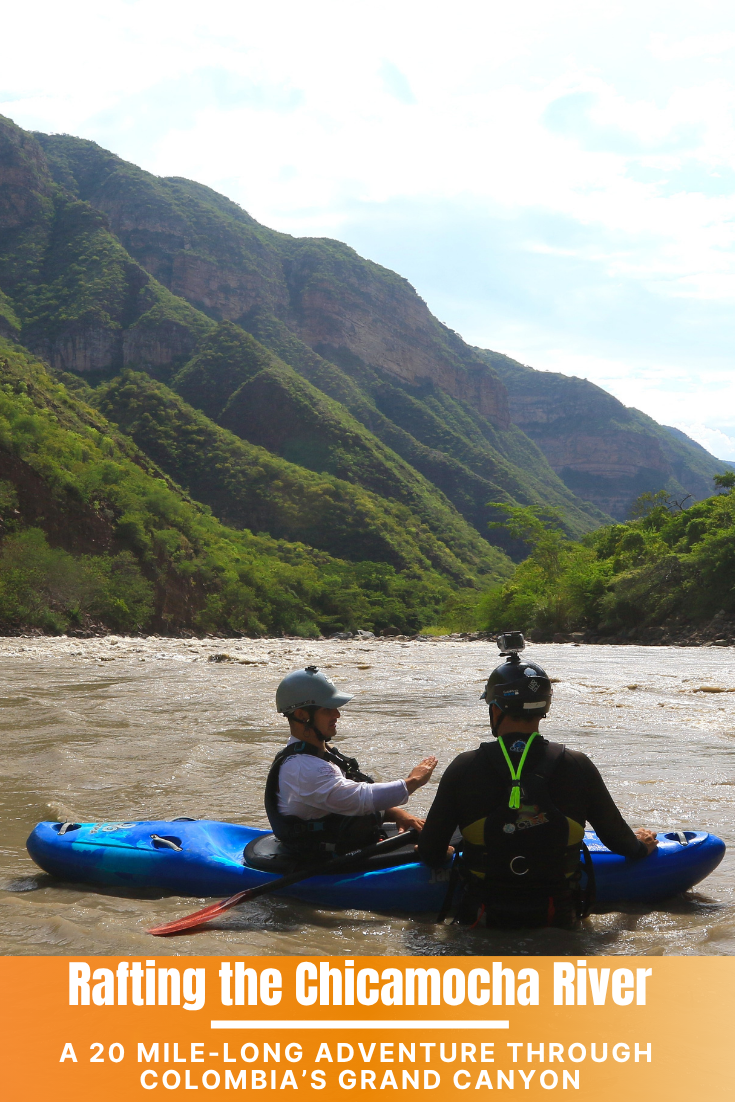
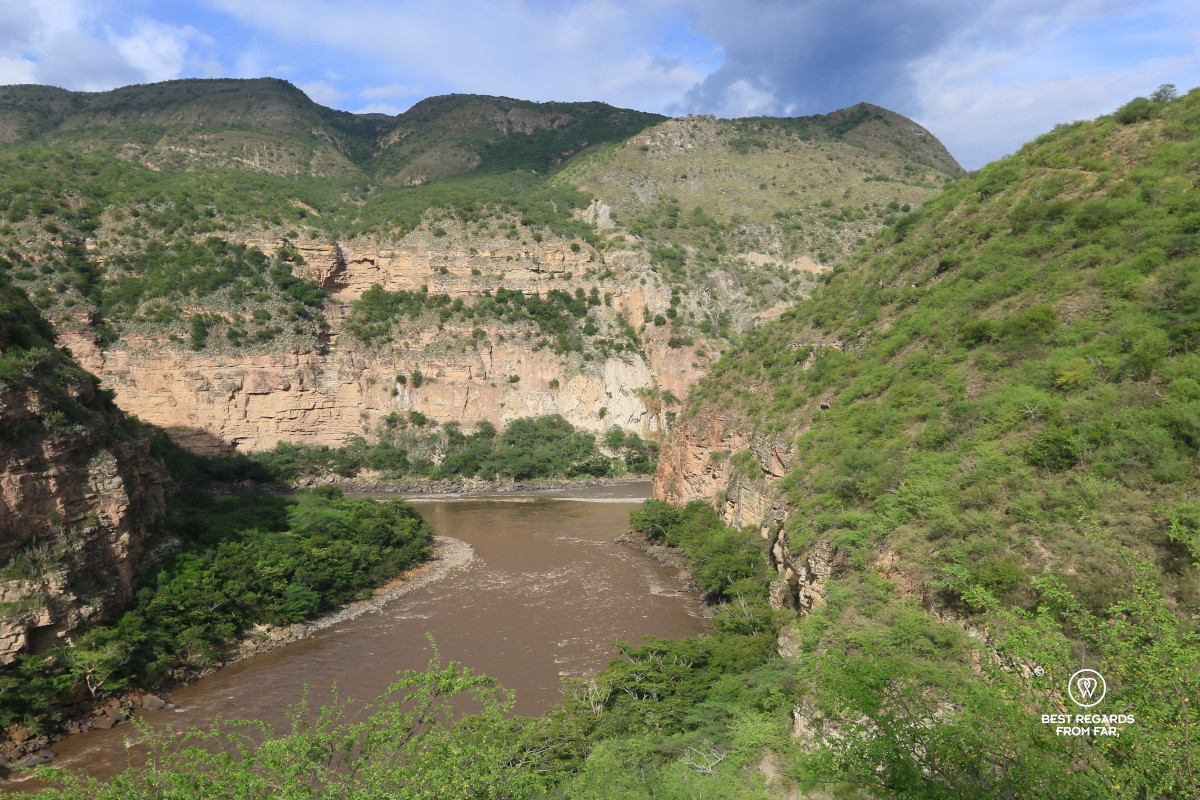
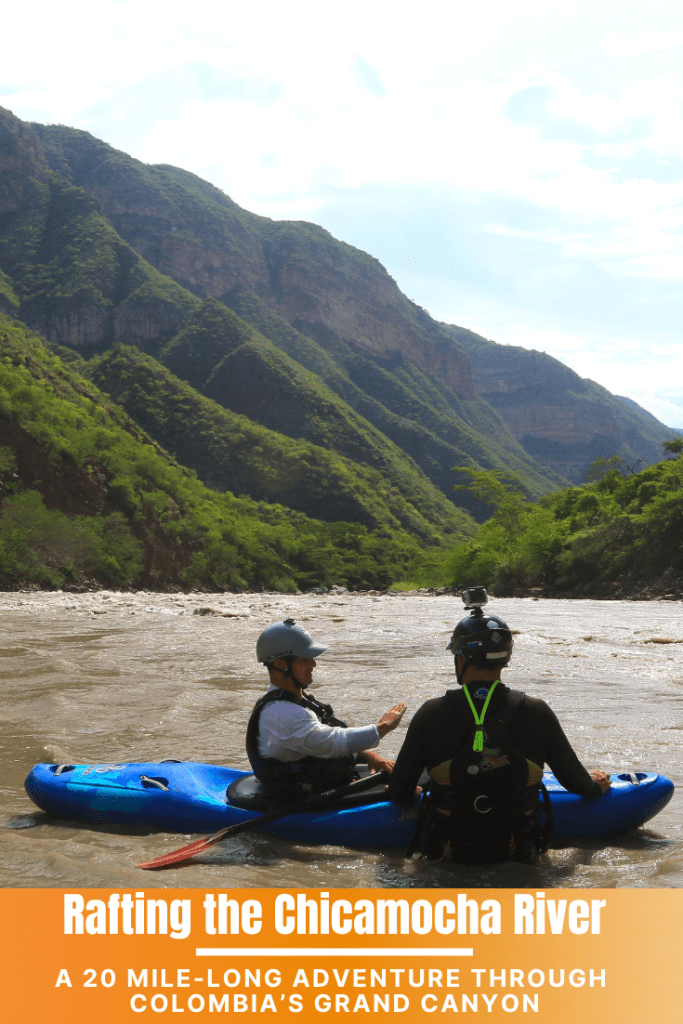
The Chicamocha Canyon that stretches for an impressive 227 kilometers (141 miles) through the heart of Colombia’s province of Santander is one of Earth’s largest and deepest canyons. With a maximum depth of no less than 2,000 meters (6,562ft—as a reference, the Grand Canyon’s maximum depth is around 1,857m (6,093ft)), the spectacular gorge is one of Colombia’s natural wonders. To take it in, many simply stop at viewpoints, some paraglide over in a tandem flight to peek inside its deepest secrets, and only a few truly experience the depth of the majestic canyon by embarking on a raft on the Chicamocha River that has dug its canyon over the last millions of years. Join us on a rafting expedition on the Chicamocha River in the heart of one of Colombia’s most beloved National Parks!
Like it, pin it!
It is still early morning when the Toyota Land Cruiser with the bright blue raft on its rooftop leaves San Gil, the outdoor capital of Colombia. The loaded 4×4 crawls its way up and rolls down along a winding road lined with a lush tropical vegetation. It approaches the La Plazuela station of the 6.3-kilometer long (3.9 miles) gondola that crosses the Chicamocha Canyon, but instead of stopping at one of the touristic viewpoints in the Parque Nacional del Chicamocha, the Land Cruiser takes a turn and slowly drops down a 1,000 vertical meters (3,280ft) to the river. I am taking in the majestic view through the half open window and gradually feel the temperature rise. The green landscape is making way for a dry tropical forest where agaves, bromeliads and thorny shrubs grow and cacti compete with acacia trees.
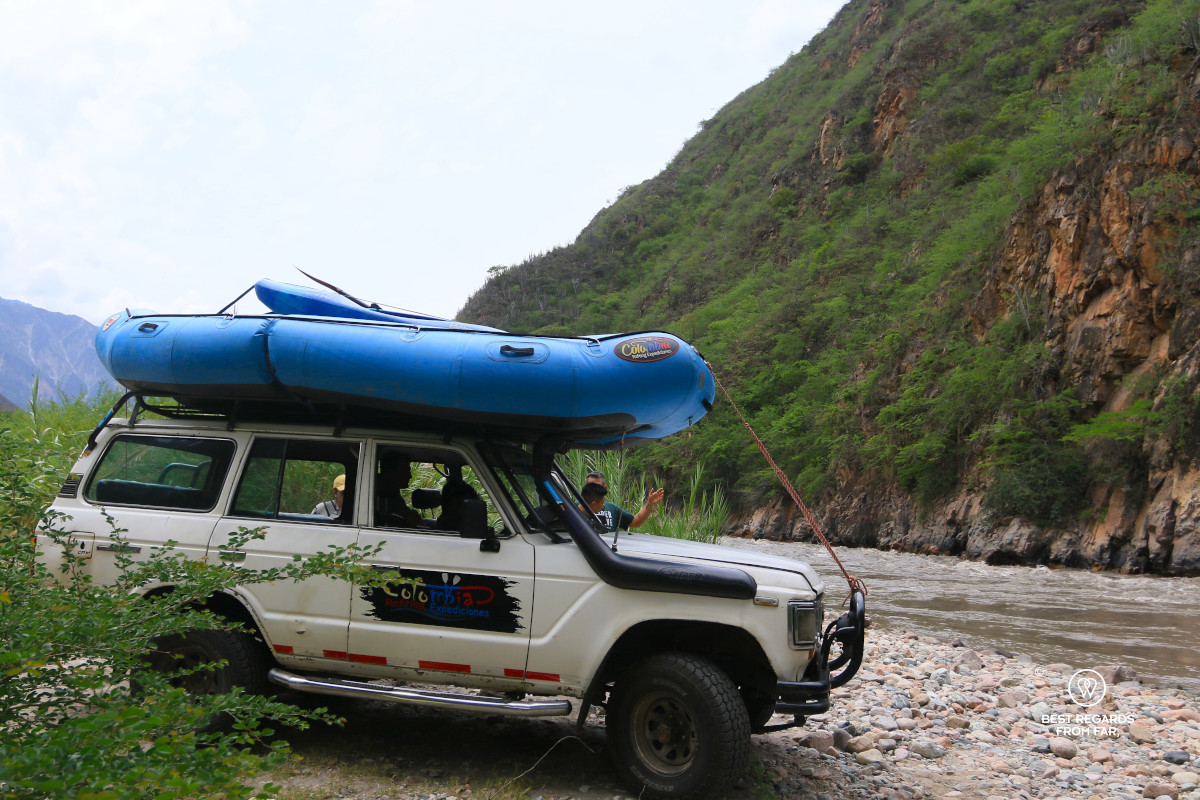
Once by the river bank our instructor starts his safety briefing. Even if it was only yesterday that we successfully conquered the wild Suarez River with its Class IV and V rapids without capsizing nor losing any of the crew into the torrent—an achievement we are not the least proud of—I can tell by the serious tone of our captain that today’s remote and significantly longer adventure through the Chicamocha Canyon requires full focus and even more dedication from all on board.
Unlike the more popular Suarez River just a stone’s throw away from San Gil where we went down with three rafts, we are the only raft in this canyon today. Yesterday’s adrenaline packed adventure was exhilarating and fun but there were moments to relax on the quieter sections that allowed us breathe a bit and to take in the lush tropical vegetation, flowers, birdlife, and even enjoy a swim in the warm waters next to the raft. Today is a different story: we have 32 kilometers (20 miles) to cover and the current is strong after last night’s heavy rain, the rapids long, and some quite technical, all the more that they are not navigated frequently.
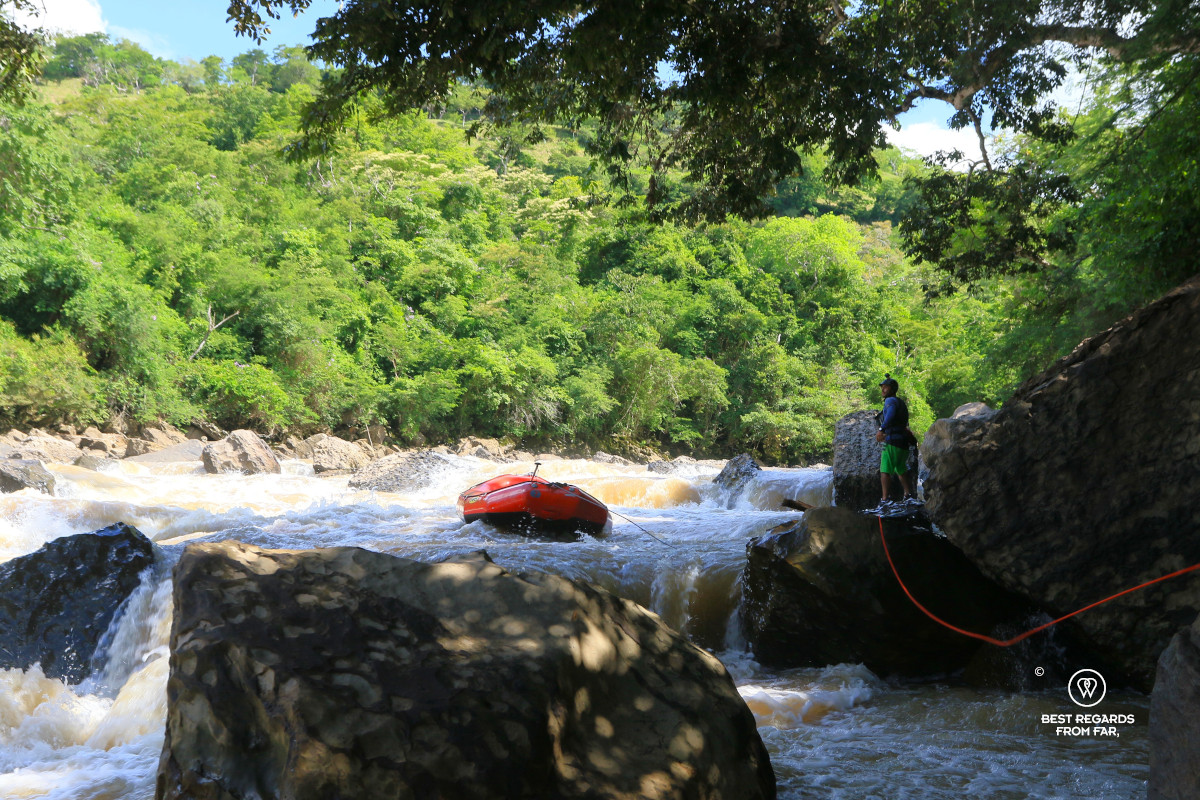
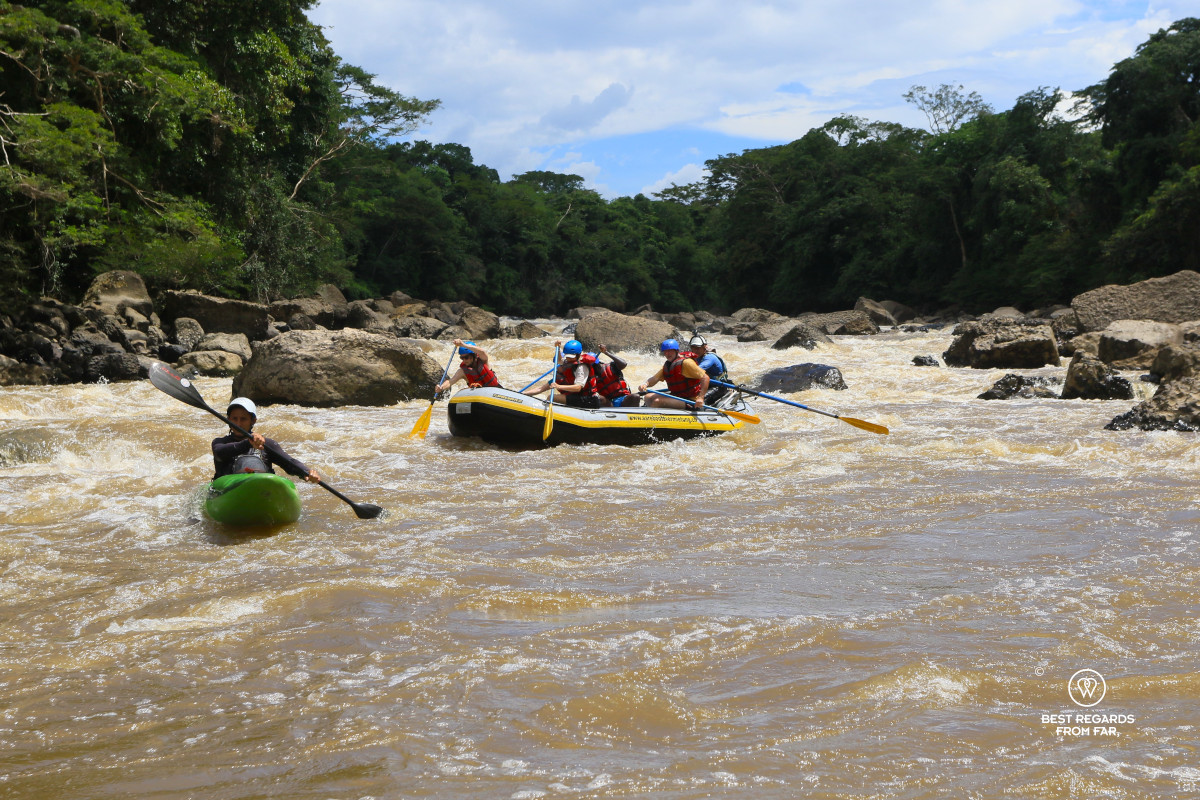
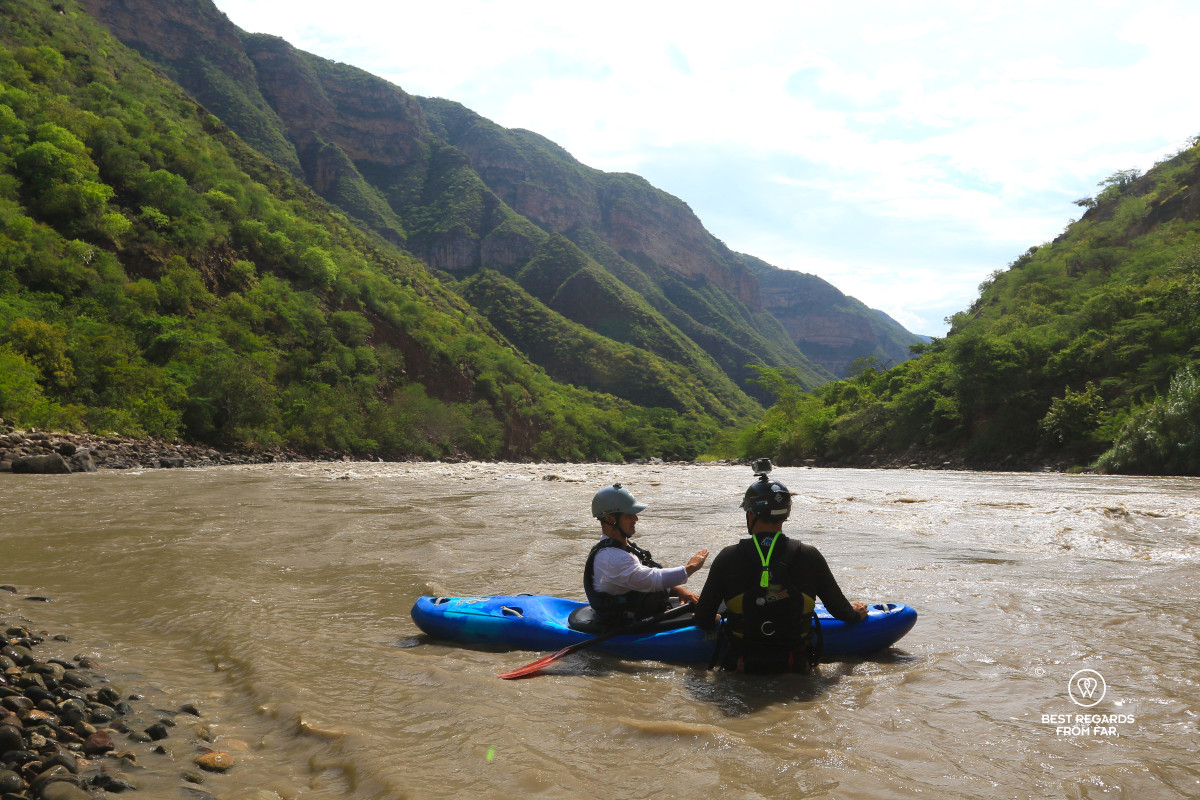
Once we have our life jackets tightly strapped around us and our helmets on, we eagerly take a seat in the front of the raft and secure our feet tightly underneath the rubber straps. Behind us two other experienced rafters take their position, and at the back our two guides. While only one instructs the whole crew, the experience of both instructors is key to ensure safety while a safety kayaker scouts the river downstream as the rapids change every day with the fluctuating water level.
We head out and paddle on a calm wide section of the river with small rapids that is bordered by cacti and agave. It is the perfect moment to practice and for our captain to gauge our response time to his instructions.
Soon the current takes us past tobacco and yucca plants while cacti dot the higher slopes. Some cables over the river allow small-scale farmers to transport their crops across but soon the walls of the canyon get higher and with no sign of human presence the steep mountain flanks are covered in pristine forest where howler monkeys swing from tree to tree. The canyon is also home to the famous Colombian Baobab (Cavanillesia chicamochae), a pot-bellied tree endemic to the Chicamocha Canyon. Technically not a baobab, it resembles the African baobab so much that it is called as such. While looking at the extremely rare specimen I notice the raft picking up speed.
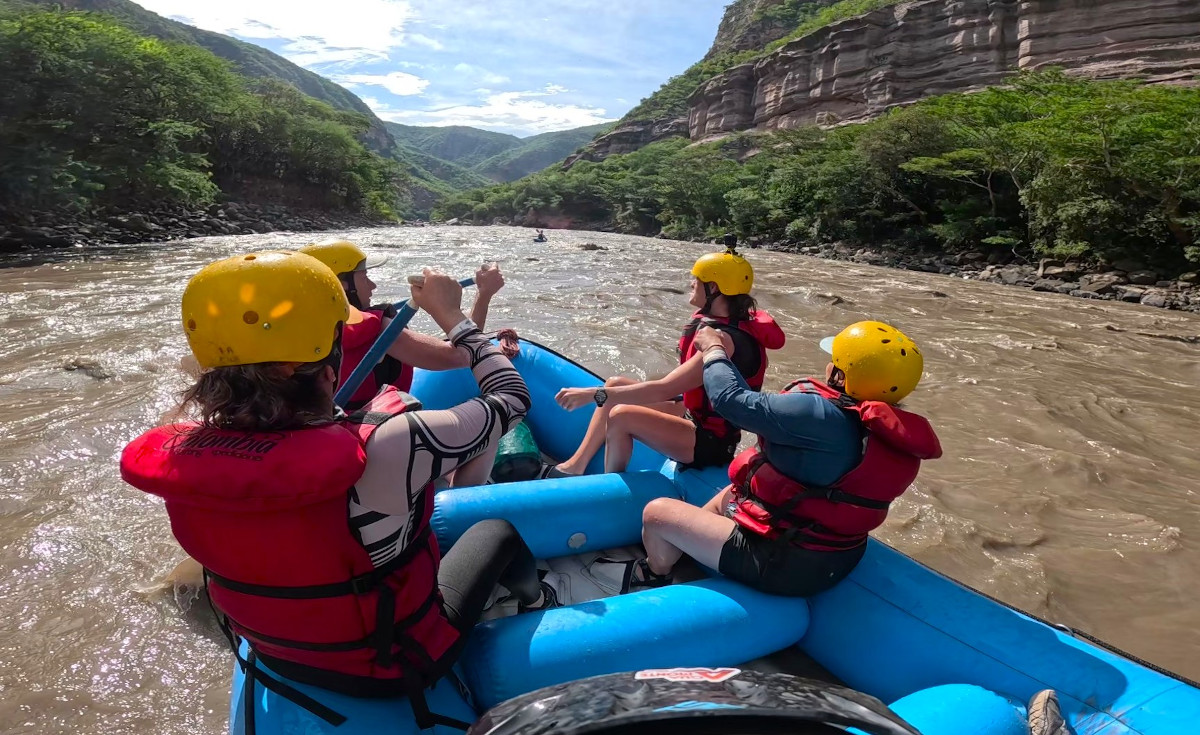
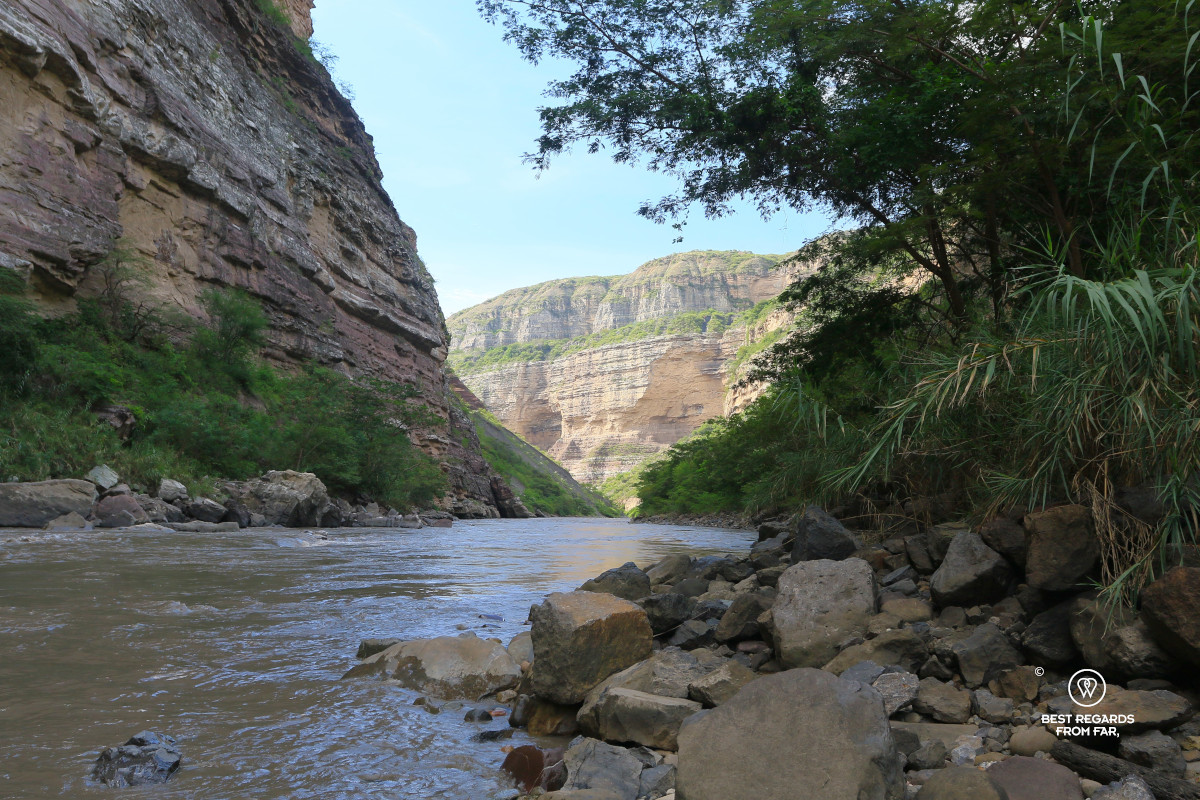
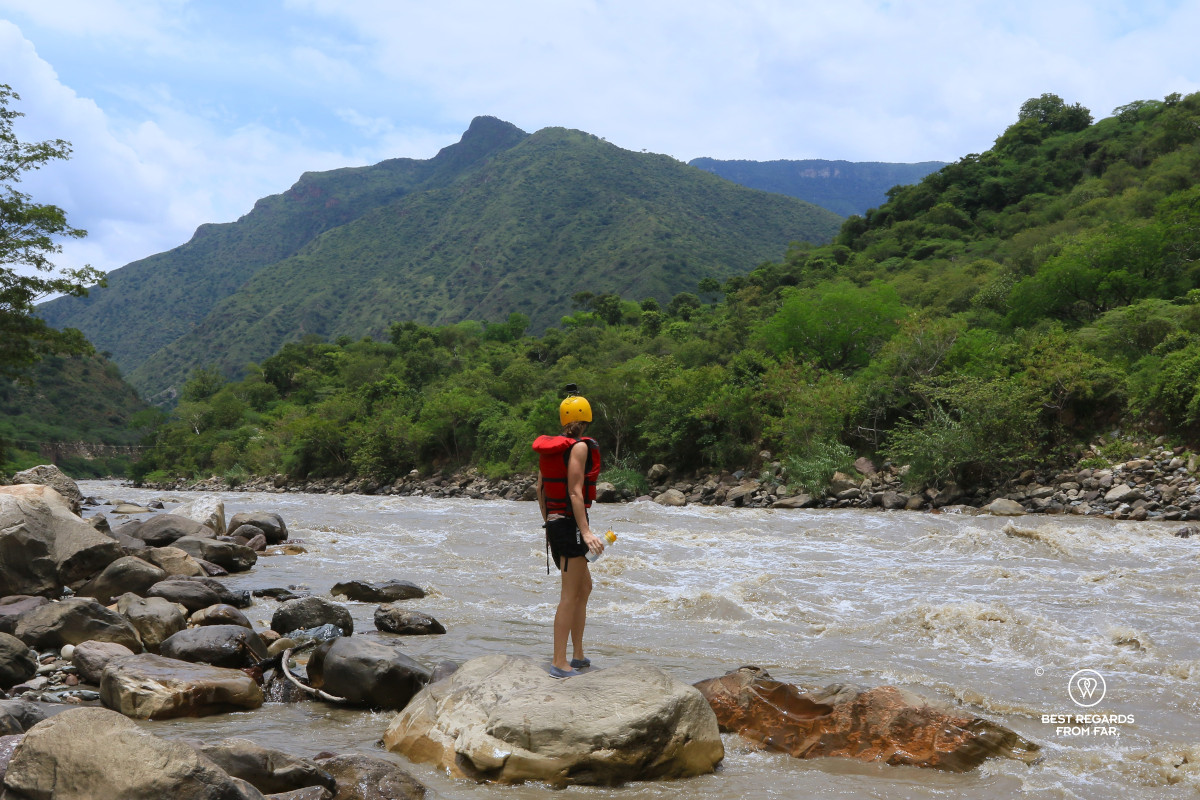
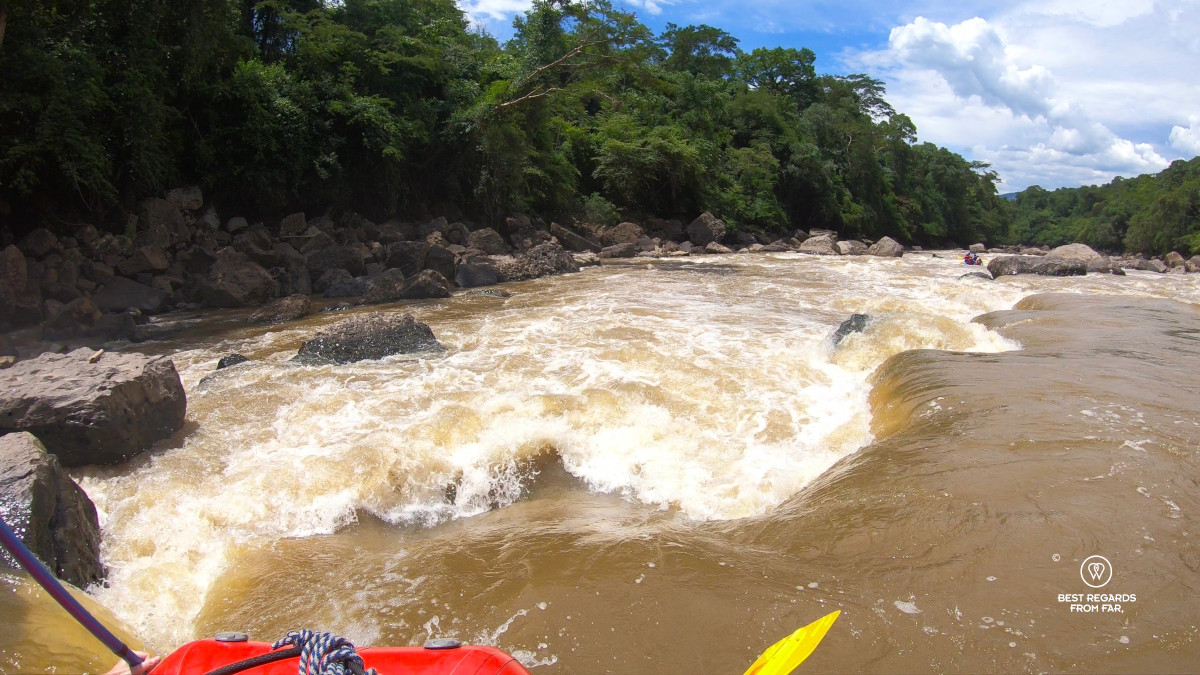
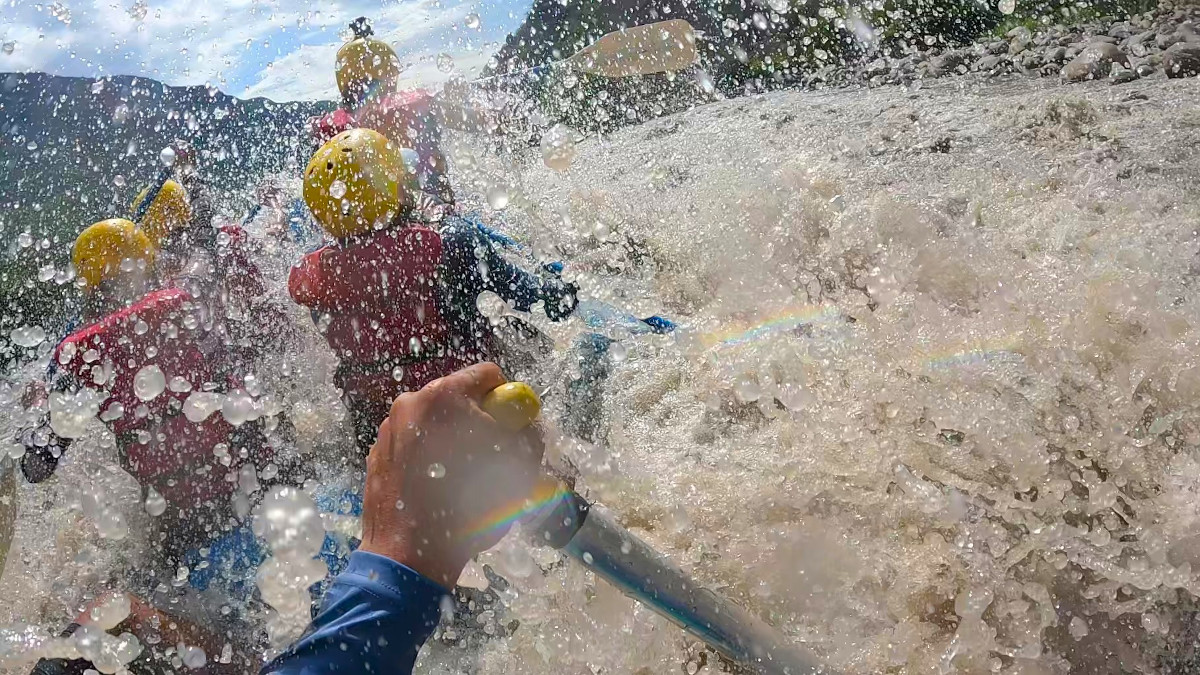
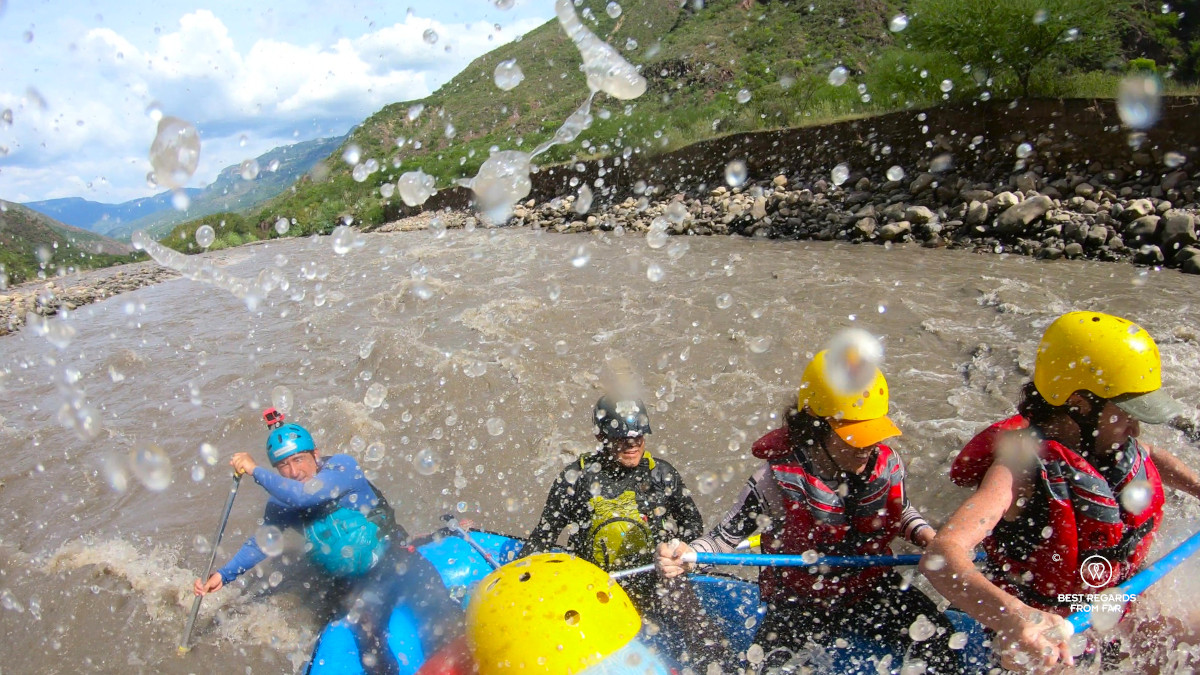
“Forward! Forward! Forward! Left back, left back! Stop! Inside! Inside!!” The voice of our instructor is loud, focused, and firm. After paddling as hard as I can, with my right hand, I quickly reach for the grab rope while hastily moving my bum from the tube of the raft to its floor. We approach a wall of water fast and I feel the pressure of the rapid pushing the bow straight up. Blinded by the water that splashes my face, our captain screams new instructions. “Position! Position! Forward! Forward! Duro!” The rafts drifts fasts towards what looks like a chaotic whirlpool of water in what now turns out to be a class IV rapid that violently pushes the port of the raft upwards. For a split second I feel that the raft is about to flip over my head while my upper body is almost horizontal to the river. With one foot still tightly secured in the foot cup and the other under the thwart, I feel a force pushing on my legs and abs while I try to not tumble over backwards. Suddenly, the raft flips back into some sort of normal position. Claire locks eyes with me fast and I notice how in a reflex she reached over to help prevent me from falling out grabbing my leg. I look behind me, and understand the unspoken question in her glance as I notice an empty spot behind me… We have just lost one of our crew!
We all scan the raging rapids next to the raft for any sign of her. She surfaces grasping for air in what felt like long seconds. When I see her I instinctively stick my paddle into the water for her to grab, foolishly ignoring the captain’s instructions “Forward! Forward!” he screams, and indeed she is too far and I quickly get back to my senses and obey the orders giving it my all. With his loud and determined voice, he knows precisely how to maneuver the raft to keep us all in safety while he blows his whistle to alert the safety kayaker. In a matter of seconds, the kayaker has swiftly turned around in the midst of the chaotic rapids and is already approaching our crew member. We are still drifting at full speed and our teammate is floating along, feet downstream, her eyes focused on the kayaker. She has got the perfect reflex and implements the procedure given during our safety briefing to the letter. As the kayak reaches her feet, she hugs its bow and with a few powerful strokes our kayaker pushes her against the side of the raft where our second instructor pulls her back into the safety of our raft, well tucked between the thwarts.
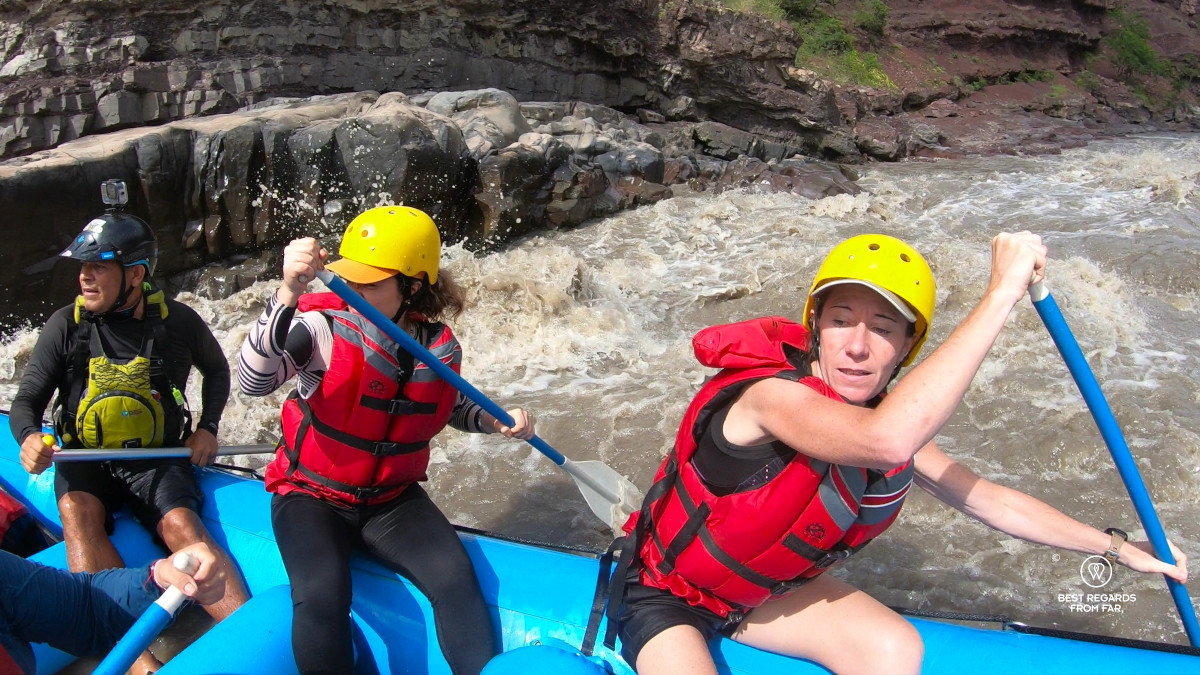
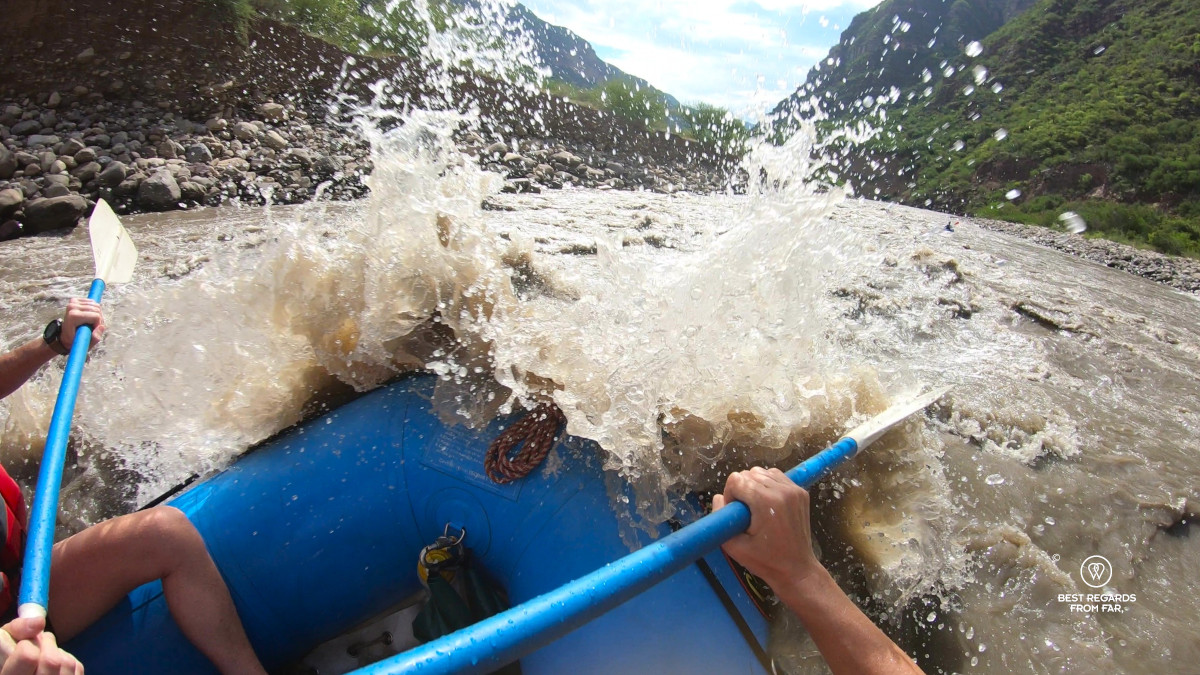
We are still in the midst of the rapid, and all still paddle like maniacs following our captain’s orders to keep the control. No time to talk, we need to get out of this rapid first and after what seems like an eternity we get into calmer waters and I turn to her. She is back in position, she smiles and exclaims “I am OK!” Relieved, we all put our paddles up in a celebratory high five.
We conquer more rapids while our guide follows the kayaker’s directions: he braves the rapids first and scouts to point out the best way of negotiating the white waters. Despite the distance and roaring of the torrent, both experts manage to understand each other very clearly with only a few hand and paddle signals.
Ahead of us, a bridge appears above the Chicamocha River: we are about to land the raft in Jordan, a small village and our half-way point. We get off our embarkation underneath the Lengerke Bridge, named after the German engineer and trader Geo Von Lengerke (1827-1882) who restored the ancient paths connecting the Caribbean Coast to the rest of the country. Initially built by the Pre-Columbian Guane people, the network of stone paths was later used by the Spaniards and named Camino Real or “royal path”. Jordan used to be a trading hub as goods transited on their way to or from the Magdalena River which flows into the Caribbean Sea allowing trade with Europe after the conquest.
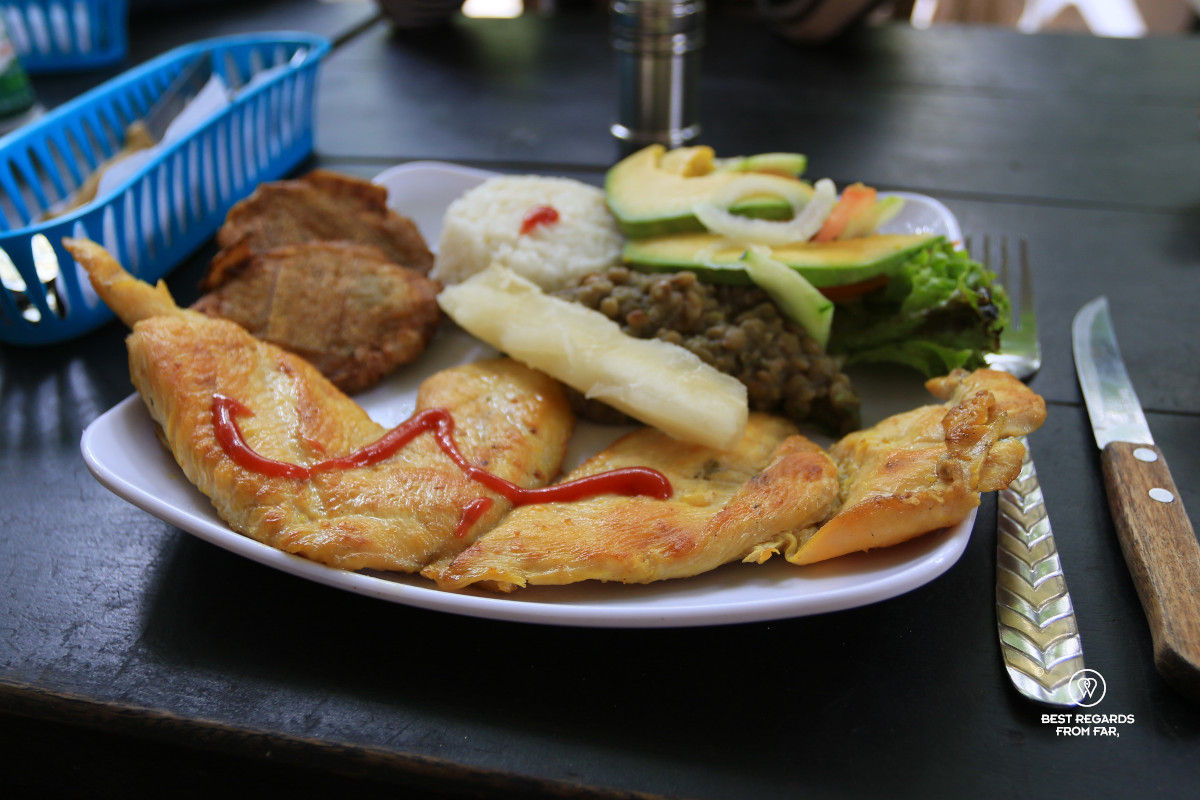
Soaking wet we climb the steep bank to end up on the terrace of a low-key riverside restaurant, triggereing puzzled looks of local men enjoying their lunch. The waiters have seen this before and welcome us warmly and prepare our food while we get rid of our helmets and life jackets. We take a seat and enjoy a generous Colombian lunch of grilled chicken breast with rice and beans, yucca and avocado, patacones—flattened fried plantains—and salad. I stare at the roaring torrent while sipping my coffee after the hearty meal. The warm air has almost dried my shorts and T-shirt and it is time to get back into the raft for the second part. “Now comes the most tricky part”, our captain describes. “Coming up is a long stretch of roughly 1.5 kilometers (1 mile) of continuous technical rapids. I need you all to be very focused, follow my instructions to the letter, and paddle with your utmost dedication!” Thinking it was already pretty tricky before the lunch break I notice a mix of curiosity, healthy fear, and excitement amongst all crew members.
Not long after we start paddling, the river drags our bright blue raft into its torrent, and we paddle for dear life. “FORWARD!! FORWARD!!” The raft bounces and at one point rotates in a perfect 360-degree circle before being catapulted into an exhilarating current between the narrow canyon walls. I barely have time to take in the landscape with the constant bucket loads of water hitting my face. The raft rebounds on the white waters, and the air seems cooler with the canyon walls towering over us. We keep making progress fast, our occasional screams barely overpowering the sound of the roaring Chicamocha.
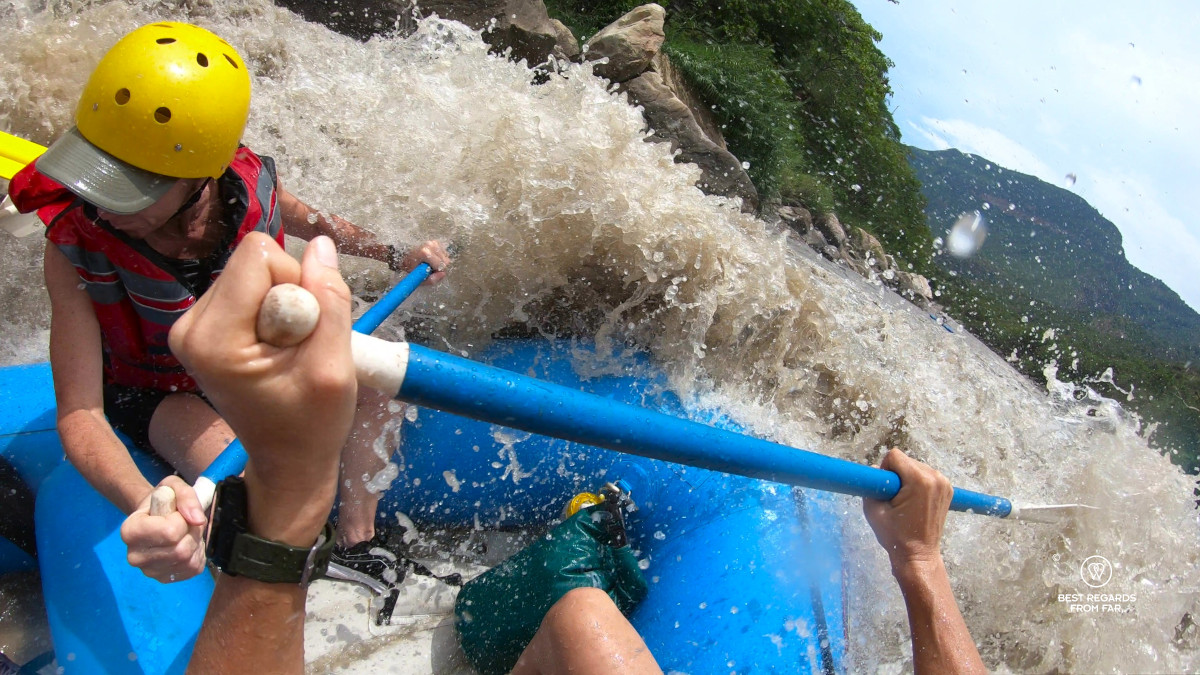
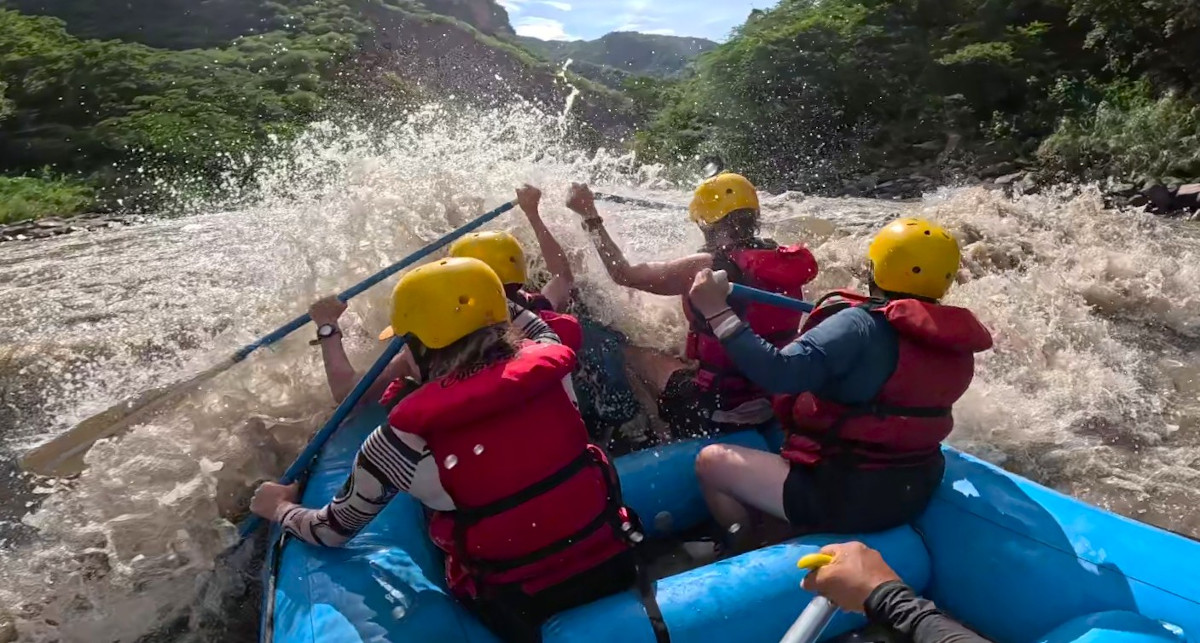
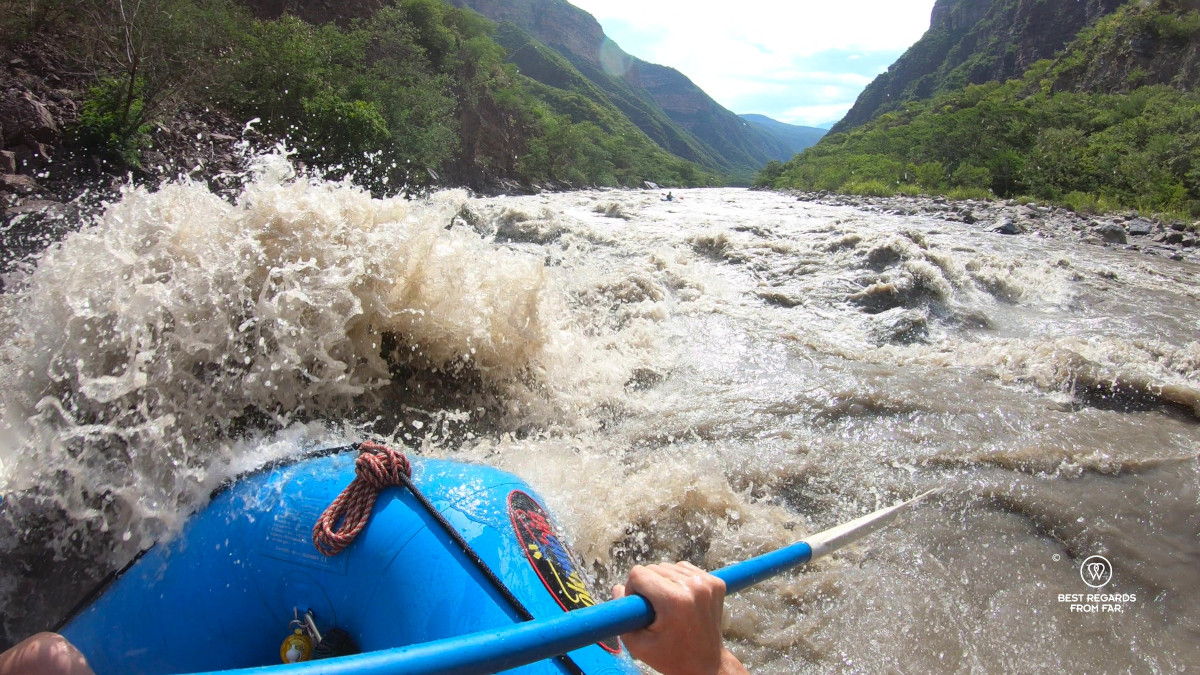
Suddenly it all gets quiet again and as the canyon widens. I cannot believe what I see in front of me. I glance at Claire and from her face I can read that she sees it too. Three distinct circular mountains have emerged above the horizon. Their cylindrical walls bare the color of sand while their triangular shaped tops are covered in trees… for a few confusing seconds it seems like we are paddling down the Blyde River Canyon in South Africa. Even if the vegetation is different and the Chicamocha Canyon is much larger the resemblance is striking. Surprised by the ever changing breathtaking landscape along this stretch of the Chicamocha River, we keep taking in beautiful scenery on the less engaging sections.

After about another two hours of white water fun, we arrive at the confluence with the Suarez River at an altitude of 330 meters (1,082ft). Over this 32-kilometer (20 miles) stretch, we have dropped 210 vertical meters (689ft) since our starting point. The confluence marks the end of the Chicamocha River that from here onwards is named the Sogamoso River before it merges with the Magdalena River and ends up in the Caribbean Sea near Barranquilla about 500 kilometers (310 miles) further north as the crow flies.
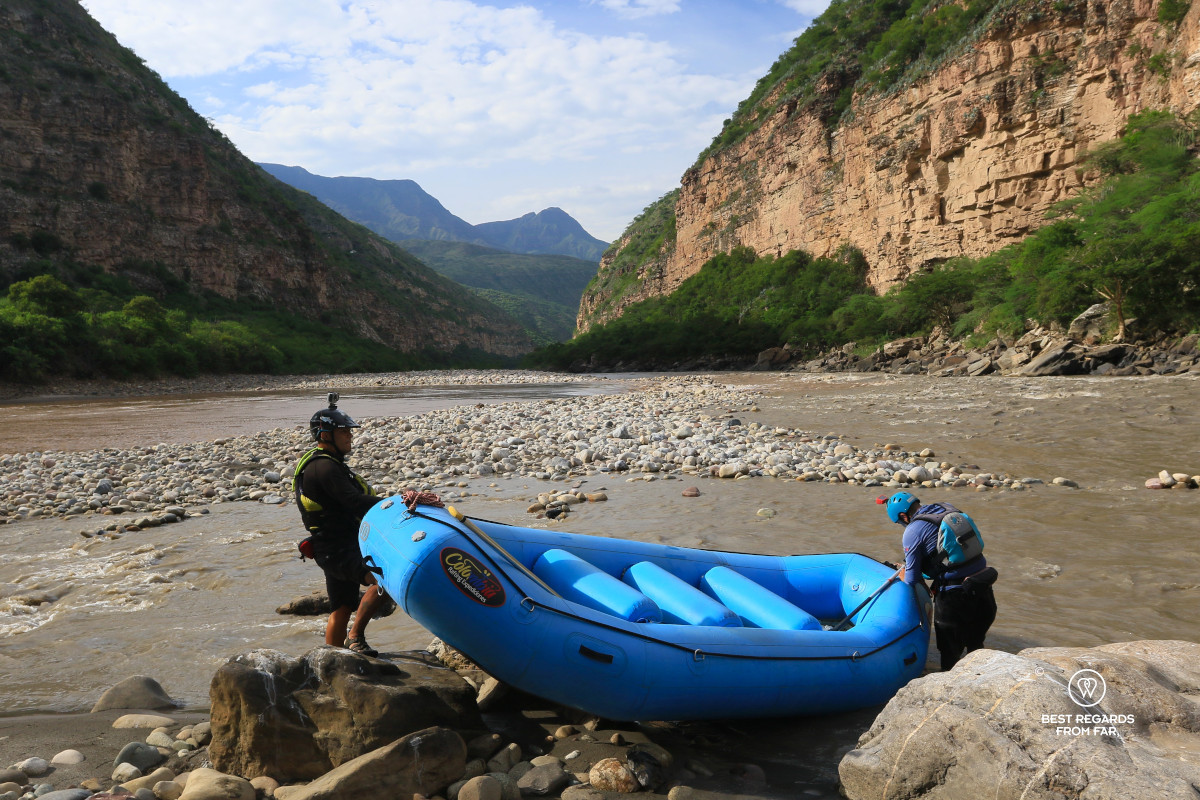
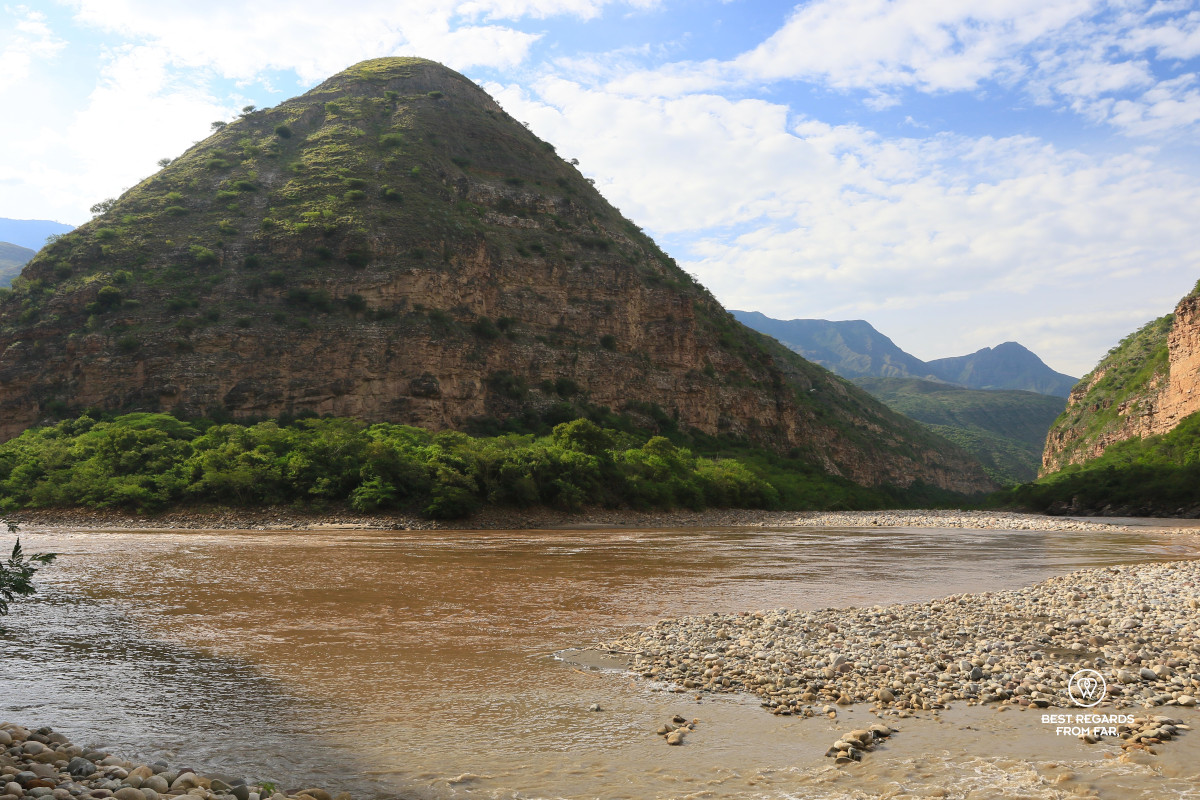
After a demanding hike up, we meet our driver, the only person we have encountered during day apart from our somewhere surreal lunch break. After loading all the gear, the 4×4 slowly makes its way up as it has to gain about a 1,000 vertical meters (3,280ft) to get out of the canyon and back to San Gil. I gradually feel the air cooling down as we leave the arid landscape and warm temperatures of the canyon behind as the Land Cruiser slowly creeps up the rugged dirt road. Cacti and acacias have now lost their battle again and are replaced by lush greenery. As we are welcomed with the cool mist of the Eastern Andean Mountains, it is time to put on an extra layer of clothing.
For one last time I peek over my shoulder to the Chicamocha Canyon bathed in a warm sunset light. No cable car, flight over or viewpoint could beat the experience of rafting through the deepest parts of Colombia’s Grand Canyon.
Travel tips:
- To live this experience, reach out to Colombia Rafting Expediciones based out of San Gil. Other options such as the Suarez River are possible too.
- To recover in style stay at the exquisite Casa Yahri in picturesque Barichara, Colombia’s most beautiful village.
- Check out this interactive map for the specific details to help you plan your trip and more articles (zoom out) about the area!
For more in Colombia, click on these images:


This was such a great read! I especially liked the way you explained rafting. Excited to see more from you.
Thanks! Very happy you enjoyed it 🙂 And thanks for the follow!!
Th