Text: Claire Lessiau & Henri Gernaey*
Photographs: Claire Lessiau & Marcella van Alphen
* Henri Gernaey is a Belgian energy engineer and inventor, with a degree from the Polytechnic School of UCLouvain. He co-founded Sunslice, a company specializing in ultra-portable solar chargers. Henri began developing the concept for Sunslice while still a student, spending three years perfecting the design before launching the company. Today, he leads the R&D team at Sunslice, continually innovating to create superior energy solutions for outdoor enthusiasts.
As outdoor enthusiasts who rely on electronics for navigation, writing, and photography, many of our readers have asked for our insights on solar technology. We have only been testing and using various solar panels and brands since 2020, as the technology needed to evolve to be robust, lightweight, and efficient enough for outdoor adventures and travels.
Since 2022, solar panels and power banks have accompanied us on every remote expedition, and solar batteries have been part of every trip. This article aims to shed some sunlight (pun intended) on the available solar technologies, offering simple guidance on selecting the right gear for your specific needs, along with tips on proper maintenance to maximize performance.

1. Available Solar Technologies
In a nutshell, there are three main types of photovoltaic technologies currently in use, each with its own advantages and drawbacks:
- Polycrystalline Silicon: Its only advantage over others is its price. Brittle with a very low efficiency, it is not adapted to portable solar technology, despite its prevalence in cheaper panels.
- Monocrystalline Silicon: This is the most common technology used in high-quality solar chargers. With efficiency rates up to 21% (nearly double that of polycrystalline silicon), it provides an acceptable portable solution for outdoor use—a good value for money.
- Flexible CIGS (Copper Indium Gallium Selenide): This technology allows much better flexibility for a slightly lower efficiency (17%), meaning the panels have to be a little larger to produce the same power output, but remain much lighter nonetheless. Its sensitivity to low light—such as early mornings or late evenings—compensates for its lower efficiency compared to the monocrystalline silicon panels. Additionally, CIGS panels are highly robust and water-resistant, making them ideal for outdoor adventures.
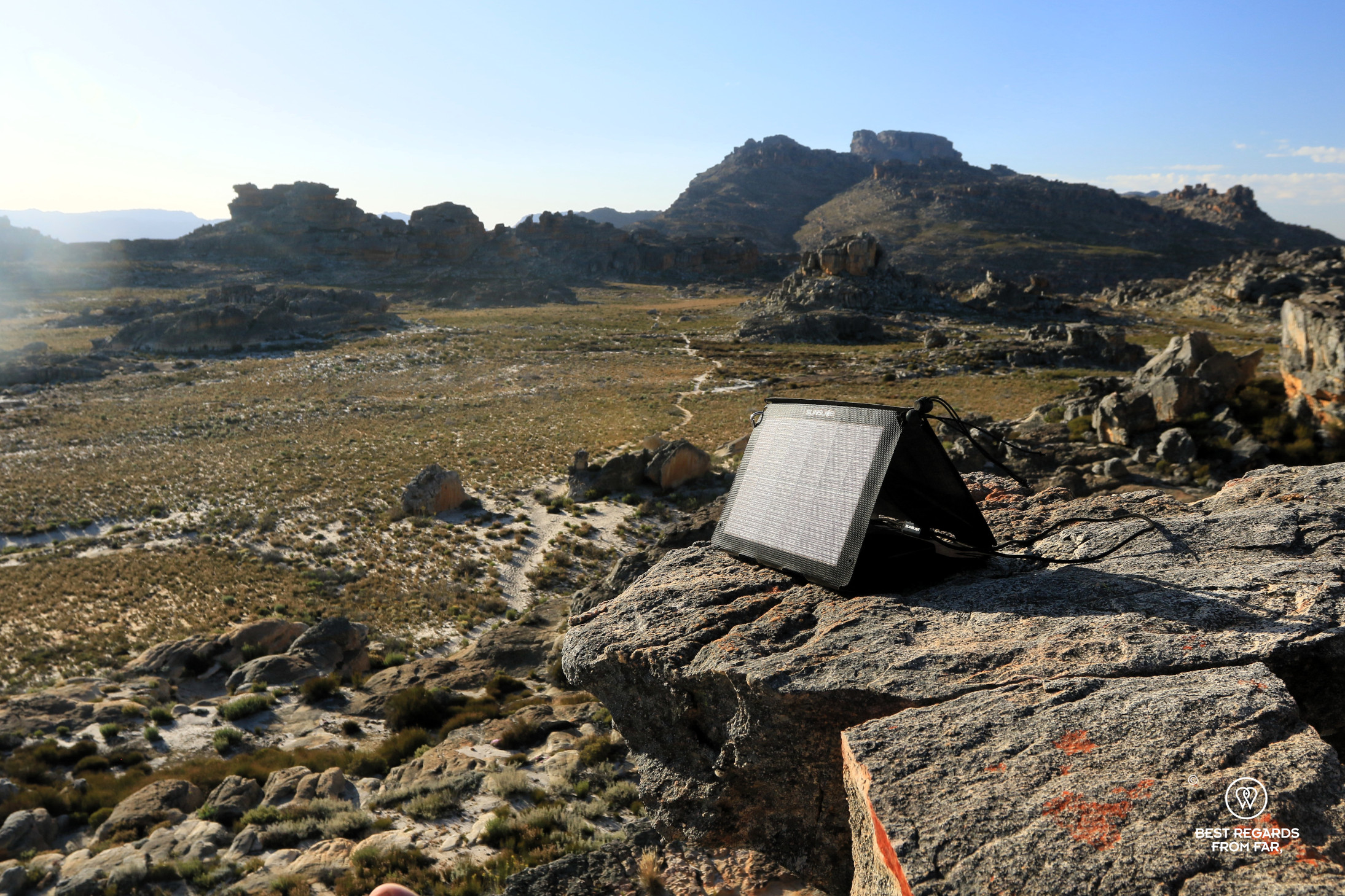
After ruling out polycrystalline silicon, we tested various brands using the other two technologies during demanding multi-day expeditions across the globe. We found the CIGS to be the most suited to our needs, striking the perfect balance between efficient charging, lightweight, and durability. Since 2022, we have relied on products from Sunslice, the award-winning Belgian company, as our go-to solar solution. The Fusion Flex solar panel series relies on the CIGS technology while the cheaper Fusion Core solar panels exploit the monocrystalline silicon technology.


2. How To Choose The Power-Bank
When selecting a power bank, key factors to consider include charging speed, the number of charges required for your devices, and the size, weight, and price of the system.
2.1. Quick Summary of Units
To better understand electricity, it is helpful to think of it as a flow analogy, similar to water flowing through a hose:
- Voltage is like water pressure.
- Current is like the size of the hose (the larger the diameter, the more flow can go through).
- Resistance is like a restriction in the hose that limits the flow.
- Electric power is the water flow rate at a given time.
- The battery is like a pump that would move the water (or electricity).
With this analogy in mind, here are some important units that are used to size solar panels and batteries that are essential to understand when you are about to buy solar technology or power-banks:
- Watt peak [Wp] measures the peak power or the maximum electrical power that a solar panel can provide under ideal lab conditions (1,000W/m², at 25°C or 77°F). This is the value that shows when selling a solar product.
- Watt [W] measures the actual electrical power output from the solar panel, which fluctuates depending on factors like temperature and light intensity. It is also the measure of input or output for a power bank.
- Watt-hour [Wh] measures the total capacity of the battery (in our water analogy, our pump is fed by a tank, and the Wh is equivalent to the total amount of water the pump can deliver). It can also indicate the time during which the battery can provide a given power output.
For example, a power-bank with a 74Wh capacity can charge a device for 74/18=4.1 hours (or 4 hours and 6 minutes) with 18W of output power, or for 74/10=7.4 hours with 10W of output power. - Milliampere hour [mAh] is another way to measure battery capacity that is often used for power-banks. It can be converted to Wh.
To convert mAh to Wh, knowing the voltage across the battery is key. It is indicated on the power-bank (e.g. 12V – 100Ah battery) or implied: for the majority of electronic devices running on lithium batteries, the average operating voltage is 3.7V. As long as you are comparing power-banks running on a single 3.7V lithium cell, the mAh measurement is sufficient. When comparing devices running on different power sources, the Wh base is key:
P= U x I where P is power [W], U is voltage [V], and I is current [A], and:
P x t=(U x I) x t to get [Watt x hour] = [Volt x [Ampere x hour]]
For example, the Sunslice Gravity 5, a 5,000mAh lithium solar battery has a capacity in Wh of3.7 × 5,000 mAh = 18.5 Wh.

2.2. What Capacity [mAh] Should my Power-Bank Have for my Need?
To determine the right capacity for your power bank, follow these simple steps:
- Find out the capacity of the device you want to recharge with the power bank.
- Define how many times you want to charge your device using the power bank.
To calculate the required capacity of your power bank, use this formula:
Capacity of the power-bank = capacity of your electronic device × number of recharges × 1.25
The 1.25 factor accounts for internal resistances and conversion losses, which means the actual capacity of a battery is lower than the indicated nominal capacity.
For example, in the case of a smartphone battery, an iPhone 16 Pro has a 3,582 mAh battery capacity, and you want your power-bank to charge it at least twice. The capacity you need is 3,582 × 2 × 1.25 = 8,955 mAh. Among the Sunslice products, a Gravity 10 (10,000mAh) or above will do the job.
The other way around, if you want to know how many times your power-bank can recharge your smartphone:
Number of charges the power-bank can do = Capacity of power-bank / (capacity of the smartphone × 1.25)
A Sunslice Gravity 20 (capacity of 20,000mAh) power-bank can charge an iPhone 16 Pro 20,000 / (3,582 x 1.25) = 4.5 times.
2.3. The Devil is in the Details
It is essential to check the available ports on both your devices and the power bank to ensure compatibility. Most power banks come with USB-A ports, which are the most common for charging. Modern smartphones and laptops also use USB-C ports for charging, so having a power bank with USB-C output can be particularly useful. Simply check the type of cable you use to charge your device and make sure you could use it with the chosen power-bank.
The power bank’s circuit capabilities are also crucial. Some USB-A ports only provide 5V/1A (5 watts) output, which by today’s standards is considered slow charging. If fast charging is important to you, look for a power bank with higher output capabilities (e.g., 5V/3A, 9V/2A, 12V/1.5A, or 18W).
Some power banks are also able to supply much higher voltage and current levels (up to 20V/5A—100W output) which is necessary if you want a power bank capable of charging your laptop.

3. How to Choose the Solar Panel [Solar Power-Bank Charging Time]
3.1. Computing the Minimum Charging Time
Since the peak power of a solar panel is typically listed in its specifications, the minimum time needed to charge a power bank can be calculated with the following formula:
Time needed to charge [h] = power-bank capacity [Wh] / solar panel power [W]
However, additional factors like the power output of the charging ports come into play. For example, the Sunslice Fusion Flex 18’s USB ports are rated at 5V/2.7A (13.5W max). So, the correct calculation for charging a Gravity 20 (20,000mAh) is: 3.7 x 20,000 /1000 / (5 x 2.7) = 5.48 hours (5 hours 29 minutes). In real-life conditions, it takes almost 6 hours for a full charge in our experience.
The Sunslice Electron solar power-bank (an 8-Watt solar panel integrated to the 10,000mAh lithium power-bank) will take 3.7 × 10,000 mAh / 1000 / 8= 4.6 hours to recharge itself in the lab. In real-life conditions with the Electron attached to a backpack while walking for instance, it takes almost 7 hours to fully recharge the Electron.

3.2. Actual Charging Time
- For solar panels, the main factor affecting their charging time is the received light intensity, which depends on geographic location, time of day, weather conditions, orientation of the panel relative to the sun… The performance of solar panels decreases as temperature increases (light intensity it receives, the ambient temperature…). Other factors such as dust on the panel, hardware quality, and internal resistance losses also affect their performances.
- For power-banks, there are two primary losses that affect charging or discharging times. To be compatible with USB protocols, a power-bank charges with a voltage of 5V (even if recently higher voltages such as 9V and 12V can be used). However, the lithium cell requires a voltage around 3.7V to avoid damage. This means the 5V must be lowered to 3.7V through a conversion circuit (and this is reversed during discharges or when your electronic device is charged by the power-bank). This conversion leads to energy loss, and the degree of loss depends on the quality of the control circuitry, which is often dictated by the price of the gear.
The speed of charging is also a factor to take into account: the faster the battery discharges, the greater its output current, which implies greater internal losses, hence less available power. - The quality of your cables is just as important as having a good solar panel or power bank. Cheap cables have fewer copper wires inside, which increases electrical resistance and can significantly affect charging times.
Assuming you are using high-quality gear (solar panel, battery, and cable), the only variable you can control is the light exposure on the solar panels. Here are some guidelines to estimate the actual charging time:
| Solar panel Conditions | Actual charging time |
|---|---|
| Solar panel exposed at 30° from perpendicular to the Sun: | 1.2x minimum theoretical time |
| Solar panel exposed at 60° from perpendicular to the Sun: | 2x minimum theoretical time |
| Slightly cloudy day: | 2x minimum theoretical time |
| Completely overcast but still bright luminous clouds: | 10x minimum theoretical time |
4. Solar Gear Configuration
4.1. Solar Panel & External Power-Banks vs. Portable Solar Batteries
Now that you have defined the specs to meet your needs, it is time to choose between two configurations: a solar panel paired with an external power bank or a portable solar battery that integrates both the solar panel and the power bank in one unit.
In our experience, a foldable solar panel used in combination with an external battery offers greater flexibility to ensure power autonomy in the outdoors. Depending on your adventure’s location—whether it is mostly sunny or cloudy, with short or long daylight hours, and in warm or cold conditions—the length of time you will be away from a power grid (sometimes just a fully charged power bank may suffice for a few days of trekking), and the types and number of electronics you need to keep charged (smartphones, headlamps, drones, etc.), you can select the ideal solar panel and power bank configuration.
Solar batteries are particularly well-suited for urban environments. They are compact, discreet, and can easily be set up to charge in the sun—whether on a lunch table or a park bench during a rest, or even charged on the grid when needed.


4.2. Real Life Examples in the Outdoors & While Traveling
For example, while trekking the GR 20 in Corsica for two weeks during the summer with long, sunny days, we found that the combination of a Sunslice Fusion Flex 12 (12W, 240g or 0.53lb) and Gravity 10 power-bank (220 gram or 0.49lb) worked perfectly to keep two smartphones—constantly used for navigation, tracking, shooting short videos, and taking notes—charged at all times, along with an ozone water filter.
On the other hand, trekking for a week around the stunning Cirques of Réunion Island in the rainy season, where the days are shorter closer to the Equator, we opted for a Fusion Flex 18 and a Gravity 20 power bank (400g or 0.88lb). The Fusion Flex 18 (390g or 0.86lb) is lightweight and provides a large surface area when unfolded, allowing the power bank to charge quickly throughout the day. Given the potential for cloudy conditions, the 20,000mAh Gravity 20 was a safer choice to ensure enough power to charge two smartphones. Alternatively, carrying two Gravity 10 Extreme power banks would also have been a good option, allowing us to use one while the other was charging.
4.3. Charging Laptops
While traveling, we often need to charge our laptops as well. The key challenge with laptop charging is ensuring the power-bank has sufficient charging speed (Watts) and voltage (Volt) as well as sufficient capacity (mAh) to fully charge the device.
Most laptops require between 35W and 85W, so we carry a Gravity 100 or a Gravity 27 power-bank, both with a capacity of 26,800mAh (99Wh). These power banks can deliver up to 100W, which is enough to charge a laptop twice on average.
These are also the highest-capacity power banks allowed on flights, as their capacity is under the 100Wh limit. To avoid bulky, laptop-specific chargers, we rely on an Emperion by Sunslice and a few versatile cables to handle all our charging needs.
4.4. Why an External Power-Bank?
The sun provides a variable power input to the solar panel, influenced by factors like cloud cover, orientation of the panel, shade in forested areas… While a power bank includes a regulation system that can handle these irregular charges, smartphones may not be so forgiving. They often block irregular charges to protect their expensive and sometimes irreplaceable batteries.
4.5. Power Bank Maintenance
To extend the lifespan of your power-banks, be sure to:
- Charge and discharge the battery regularly. If you do not use it often, make sure to charge it fully at least once every three months.
- Store it at a temperature ranging between 10°C and 45°C (50°F and 113°F).
- Keep the cables unplugged from the USB outlets when not in use.
- Avoid physical shocks that could damage the power bank.

 Best regards from far,