Text: Claire Lessiau & Marcella van Alphen
Photographs: Claire Lessiau & Marcella van Alphen
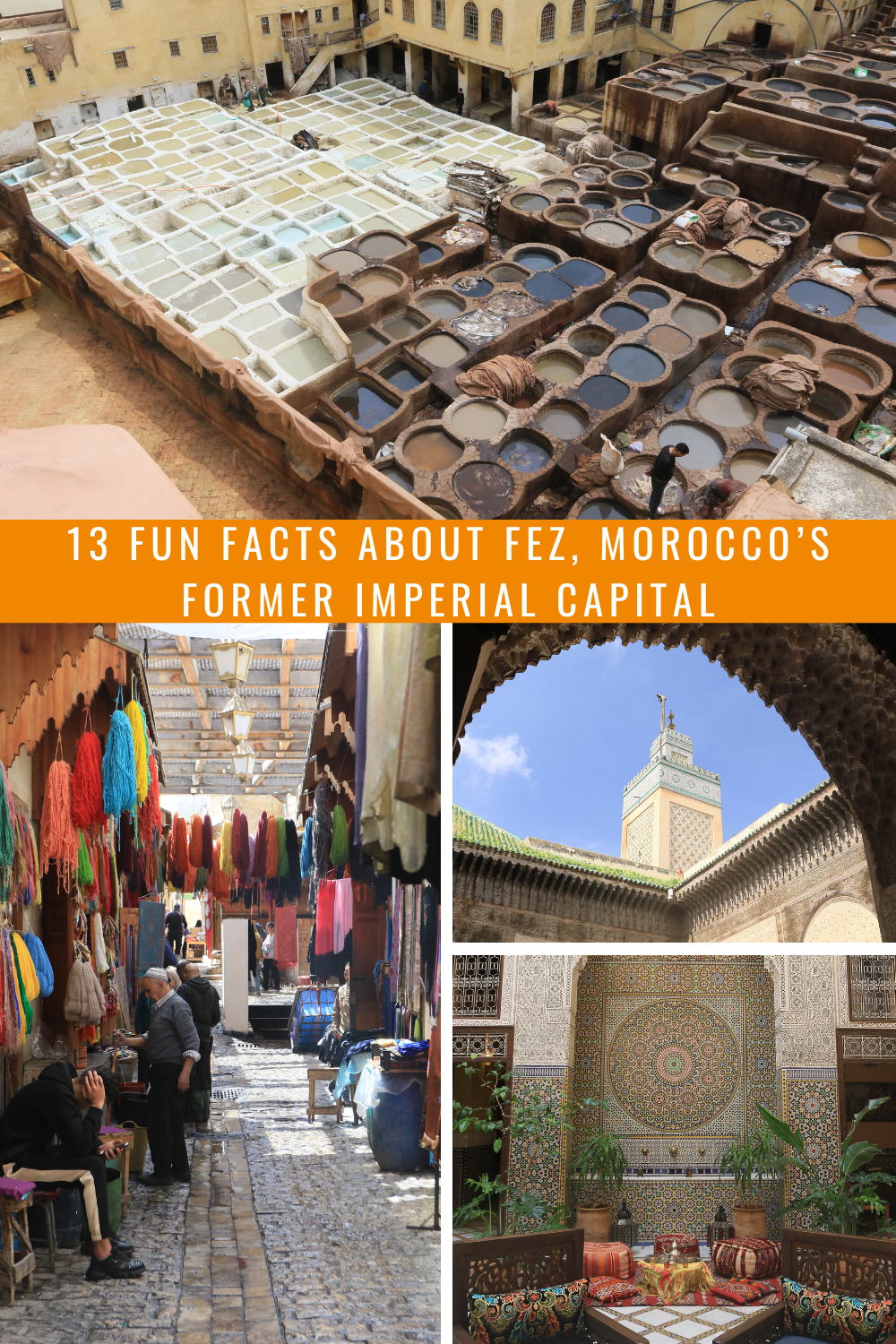
Pin it for later!
1. The chairman comes from Fez, as well as your graduation outfit!
In the very heart of the Medina of Fez stands the oldest continuously operating university in the world.
Created in 859 by Fatima al-Fihri, a woman from Kairouan in today’s Tunisia who wanted to erect the greatest mosque of Fez, her project got hijacked and the first theology discussions and classes were held. To this day, theology still taught at the University of Al-Qarawiyyin. Under the impulsion of King Hassan II (1929-1999) who wanted the imam to be open to the world, currently about 120 students including 75 foreigners learn not only about religion but also study Arabic, French, English, Hebrew, and Latin to graduate with a master in theology after five years. Even though some women teach, only male students are allowed. To get in, one needs to know the Quran by heart, and be able to explain the holy text.
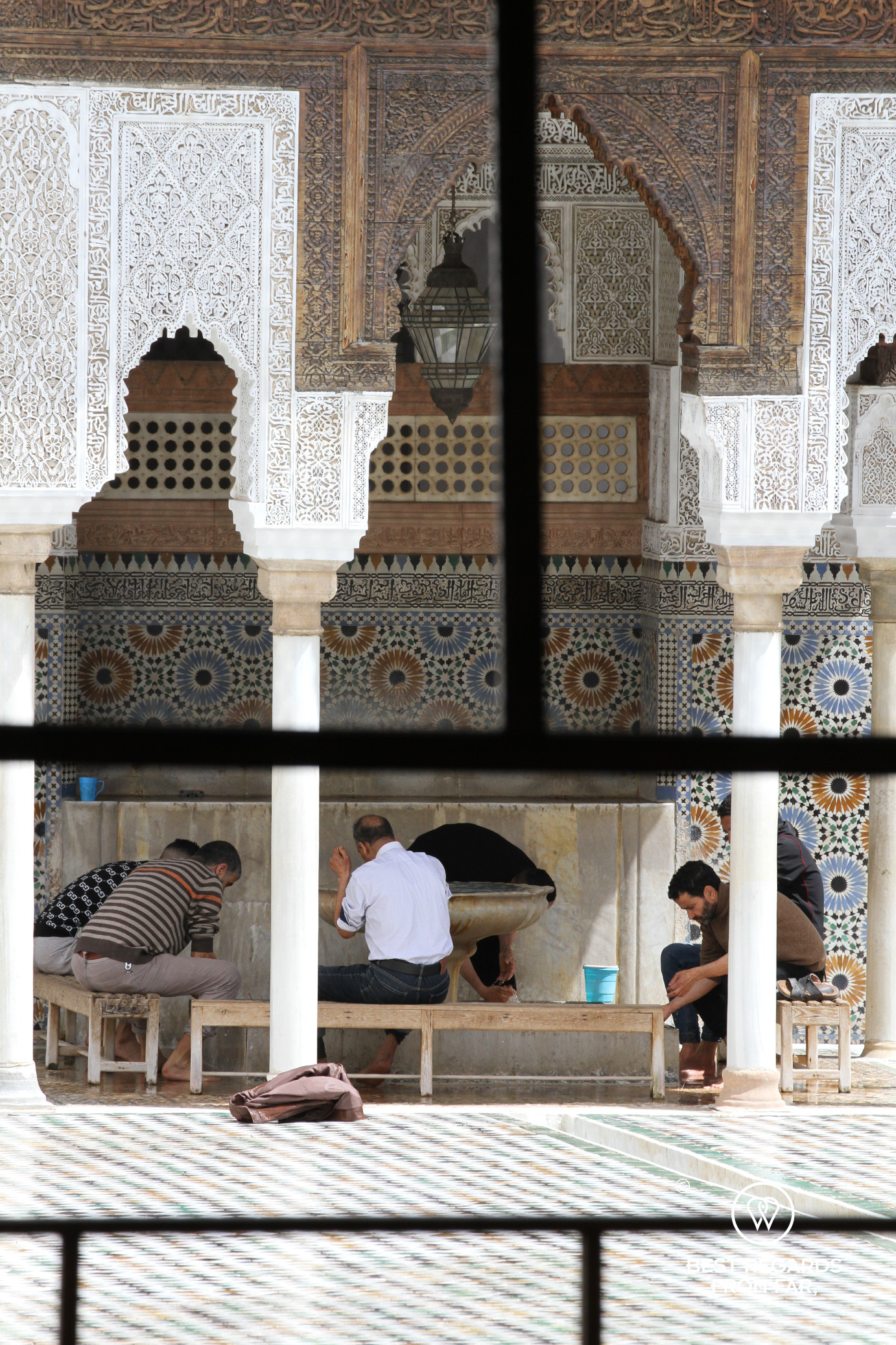

In the 10th century, math and philosophy were added to the curriculum while astronomy made its way in a century later as the science matured. In 1207, the first degree of medicine of the University of Al-Qarawiyyin was granted, and the deer parchment is still showcased here at the university library that used to house about 32,000 books during its golden age including some very precious millennium-old religious texts.
While in the 1960’s modern universities were built in the new town of Fez, the old Al-Qarawiyyin University remains the heart and soul of the medina. As the early city grew, everything else developed around it, such as guilds still present today and madrasas (centers of religious learning that helped spread Sunni teachings) to provide housing for foreign students especially during the 13th and 14th centuries when Muslim rulers governed from Morocco to western China.
The 1271 Seffarine Madrasa is the oldest in Morocco and is still running. Along with the beautiful 14th century Bou Inania Madrasa, they are the only two madrasas of Fez to contain a minaret. Despite the fact that most of their students were poor—their tuition, housing, and food were funded by the power in place—, these ancient madrasas were taking student housing to the next level with their intricate architecture, made of beautiful cedar wood or stucco muqarnas, carved Arabic calligraphy, and convoluted zellige mosaic.
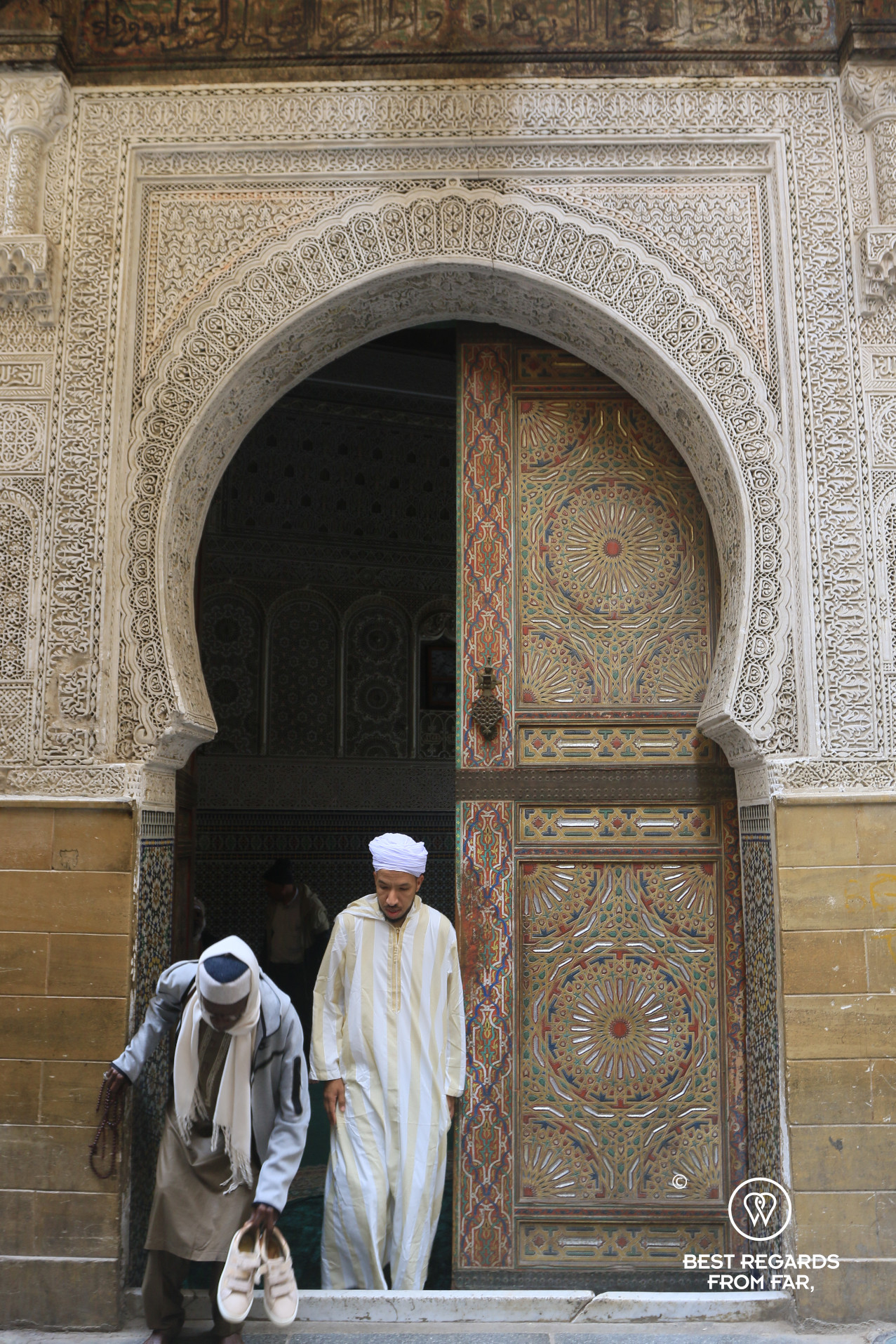

Back in the old times, at Al-Qarawiyyin University and in other educational institutions, students used to be seated on the ground while the teacher was seated on a chair. He became the chairman… When it comes to the origin of today’s graduation attire that is a bit obscure, it is crystal-clear to our guide Chakib Kabbaj president of the Moroccan guide association for over 10 years and so renowned that he has guided numerous TV hosts through the narrow alleys of the medina of his beloved city of birth. Students from all over the known world flocked to study in the best universities of the time, and used to dress in Muslim robes back home to show they had graduated from a Muslim university. Beyond the graduation gown worn today, the graduate cap derives from the flat hats of the scholars who celebrated their graduation by resting the Quran flat on their heads to symbolize its prevalence over the intellect. The tassel at the back of the mortarboard was for bookmarking the pages of the holly book.
2. Fez hosts world’s largest pedestrian medina.
Today, about 100,000 inhabitants live in the largest pedestrian medina in the world that extends on 300 hectares (741 acres) in a maze of 9,500 alleys!
While Fez was an imperial city for over a millennium, and remains the cultural capital of Morocco attracting many tourists, the kingdom’s second largest city has managed to keep its authenticity and craftsmanship. Yes, there are many souvenir stores, but the Medina of Fez is not a souk or simple market. Looking beyond the objects on display, one can see stone carvers, carpenters, wood painters, weavers, textile dyers, coppersmiths, leather tanners, etc. at work in their small shops, often reproducing gestures that have been carried out in the same district for centuries.
3. Look out for street plates: they’ll help to not get (too) lost!
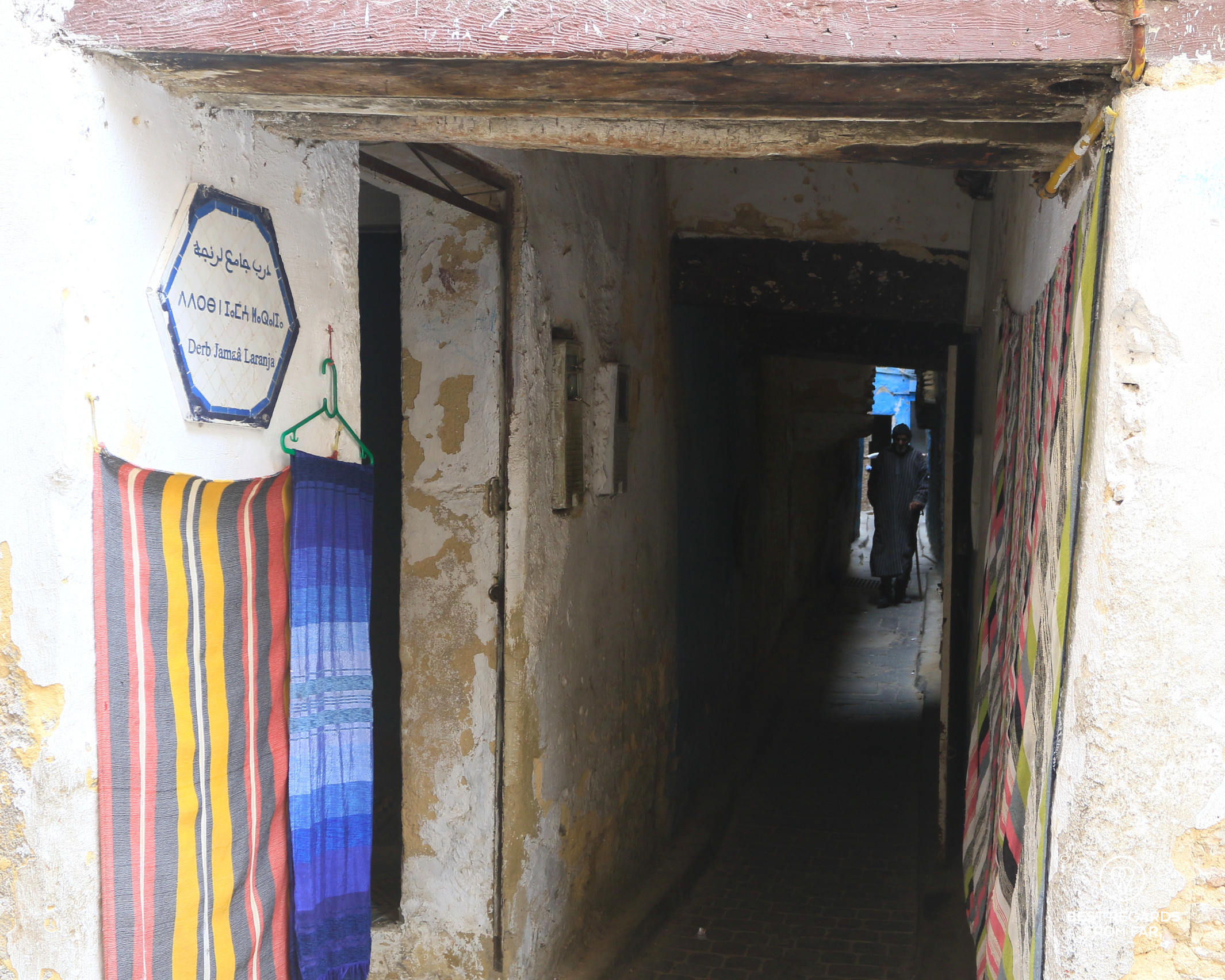
While the 9,500 alleys of the medina of Fez are a real maze, there is an easy code to remember to not get completely lost: the hexagonal plates marking street names indicate dead-end alleys while the square or rectangular ones mean it is a through street. This may help you to not get fooled by the many young men who try to lure you into the wrong direction to then help you find your way back for some Moroccan dirhams!
4. And you think you stayed in a riad? Most likely, not!
While many accommodation use the name riad to sound more authentically Moroccan, only very few actually are. To be referred to as a riad, a house has to have a garden (in Arabic, riad means garden). The ones who could afford it wanted to recreate paradise on earth, based on the Garden of Eden, and their house would lead to a beautiful garden. As a side note, this is also where the name of the capital of Saudi Arabia originates from.
When there is no garden, a house in Morocco, even luxurious, is called a dar
However, in the old times, there was absolutely no way of knowing what type of habitation was hidden behind the front door in the narrow alleys of Fez. A dar, a riad, or maybe even a palace? Wealthy and poor were living in the same streets in the medina. Out of respect, humility, and to avoid jealousy, front doors were often unassuming and would never give on the patio but on a small hallway leading to the center of the building.
Out of the same principles, from a distance, it was impossible to differentiate men by their outfits. The white djellaba, red hat, and yellow babouche that was the traditional clothing in Fez was worn by men of all classes. It was only by getting much closer that the refinement of the fabrics and the quality of the leather could be assessed. In a nutshell, the beauty resides inside, in the heart, for houses just like for people.
Both riads and dars are conceived in the same way when it comes to light, the symbol of life and god that has to come from the top. Structurally, they are both built around a light shaft that also provides natural ventilation. Water was also essential, and the water distribution system of Fez dates back to the 12th century, as well as the sewage system. Beautiful fountains covered in zellige decorate the ground floors of riads, dars, and palaces.
5. People from Fez can recognize each other by their last names wherever in the world.
People originally from Fez are called Fassi, and they are very proud of their roots. With the economic and political powers moving respectively to Casablanca and Rabat, only about ten percent of Fassis still live in the medina. Yet, wherever they live in the world, a Fassi will recognize another Fassi simply by their family name: only 250 families can pretend to this appellation.


6. The slave market took place in the medina until well into the 1920s.
Between 1912 and 1956, most of the Kingdom of Morocco was a French protectorate. While France had banned the slave trade centuries prior, it is only in 1923 that the French authorities put an official end to the slave trade in Morocco and closed the slave markets.
Fez was a bustling city with two caravan routes crossing in its medina, the one going through the Sahara Desert and the one heading toward the Atlantic Ocean. Merchants from all over used to stay in one of the 115 fondouks—hotels—and caravanserais—hotels for travelers, merchants, and caravans—of the city. Goods such as gold, ivory, and slaves were extremely precious and traded daily.
Yet, despite the trade being forbidden, it is estimated that private households continued to use slaves for another two decades.
7. Do you know about vegan silk?
The weaving tradition is still going strong in Morocco. Beyond cotton and wool, Moroccan silk is also in high demand. Instead of the regular silk obtained by killing the silkworms in order to leverage the material their cocoons are made of, the silky fibers of the agave plant are used.
In the medina, in a 13th century caravanserai, Mohammed is the fourth generation of weavers. Passionate about his trade, he proudly and patiently shows how his loom is set up and allows him to weave different patterns. While the flying shuttle keeps going back and forth, adding layers to the colorful textile Mohammed is crafting, he explains about the vegetable silk, and also the natural pigments that he uses as dyes such as poppy flowers for red and pomegranate skin and curcuma for yellow.


As Mohamed swiftly swirls a beautiful blue vegetable silk scarf on our heads into a turban as worn by the desert Berbers, the fabric feels stiffer than regular silk. While the term refers to similar appearance and texture, the vegetable silk is not as shiny nor as smooth as the silk obtained from the silkworms. Its thermal regulation properties are also poorer.
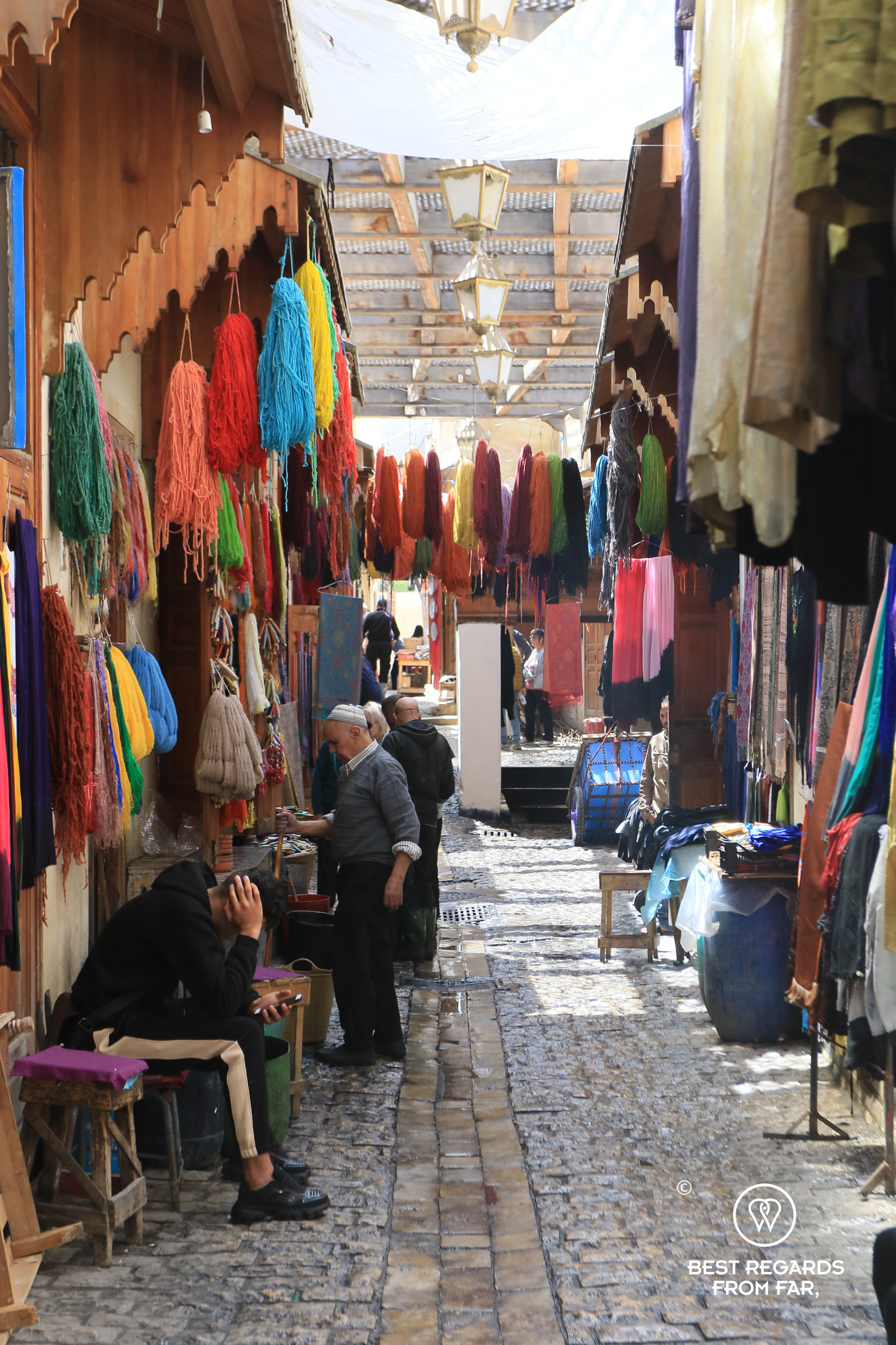
A bit lower down into the maze, in the dyeing district that is conveniently located in the center of the medina close to the river as they need large amounts of water, workers are busy. They plunge textiles in boiling water with pigments in their stores before cooling the fabrics down in cold water to start fixing the colors. The last bath of cold water and white vinegar finishes the job. The sabra—or agave vegetable silk—is left to dry, hanging above their guild’s narrow alley.
8. Visit the largest & oldest museum in Morocco—Morocco’s best!
The Dar Batha Museum or the Museum of Islamic Arts (Musée des Arts Islamiques) in Fez is the oldest and largest museum of Morocco. A stone’s throw away from the medina, it is set in a royal palace in which three Moroccan kings had lived. Its internal courtyard hosts a beautiful Andalusian garden partially shaded by a majestic 300-year old holm oak. Inside, the history of Morocco develops from the Phoenician times to today with a small and precious collection of art pieces representing every dynasty, making it unique in the kingdom for its historical bird’s eye view.


The delicate bronze artefacts unearthed from the relatively nearby city of Volubilis highlight the Roman presence. It quickly becomes evident that the strategic location of Morocco at the crossroads of the African, Mediterranean, and European worlds has made the kingdom a cultural center throughout time. Arts and crafts have continuously evolved with new influences, such as the one of Islam that reached today’s Morocco during the 7th century from Arabia. On display, the crafts are elevated to the art level from the woodwork of the century-old muqarnas (decorations made of series of niches integrated into an architectural structure and forming a geometric and symmetrical composition) and minbars (the pulpit in the mosque) beautifully inlaid with ivory, to the delicate zellige decorations, and from the stone art to traditional textiles including extremely refined brocades. The advances in sciences are also well represented with ancient astrolabes, just a fair tribute in a city where its university has been so paramount to its development.
9. The beautiful zellige walls in the dars & riads are not only decorative.
Moulay Idriss II decided to set up his city along the banks of a river. Contrary to other medinas in Morocco, the medina of Fez is built in a basin. This becomes very obvious when walking from the main gate of the medina towards its center where the University of Al-Qarawiyyin lays.
While the water is crucial for the city and many of its craftsmen, it also creates a humidity issue in houses. By capillarity, humidity traces can reach up to two meters (6ft). The wealthy would cover these unaesthetic marks with mosaics, and even better with the local zellige, a distinctive type of Moroccan glazed tile, adapted from the Roman mosaic.


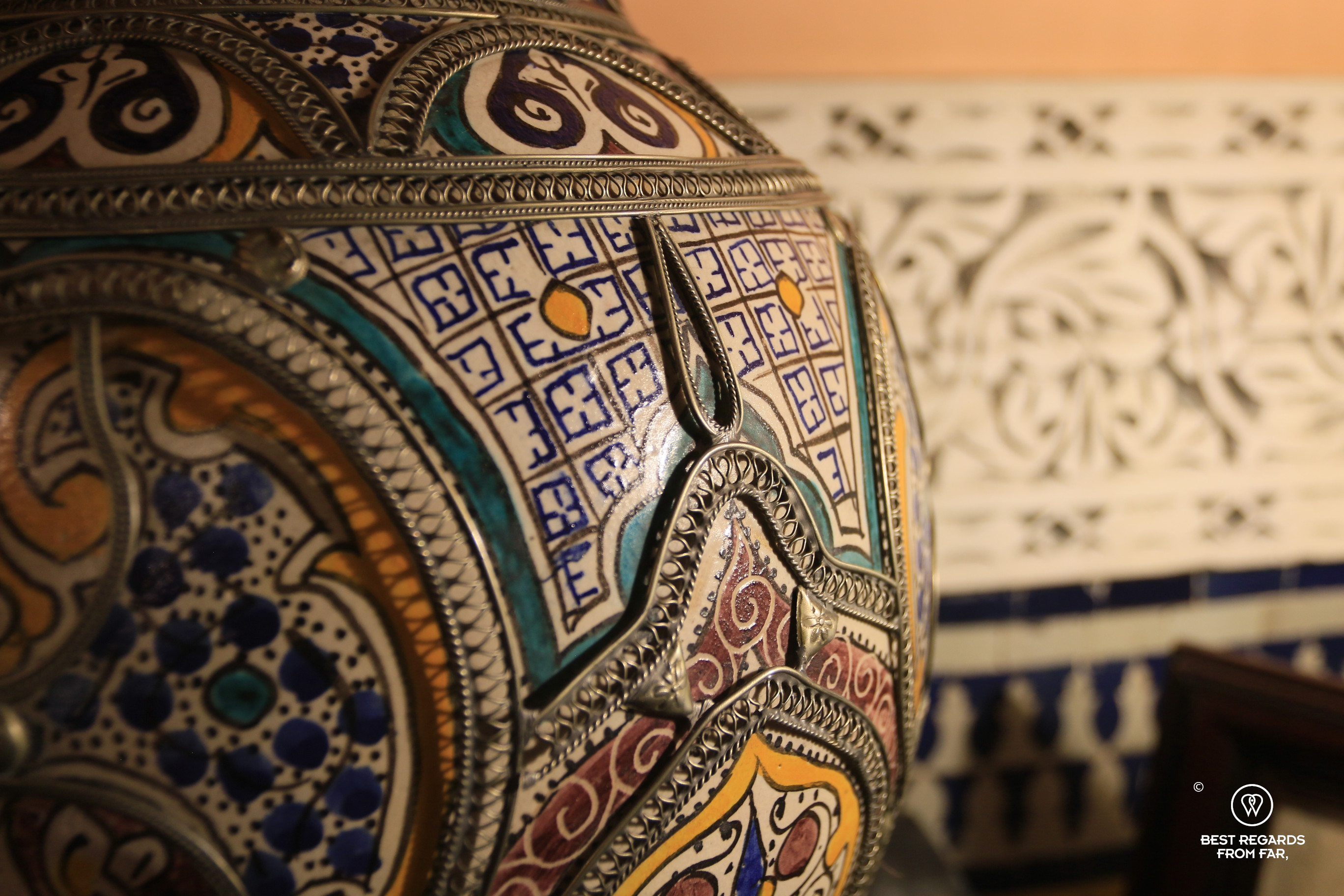
Originating in Fez in the 10th century, the UNESCO World Heritage medina is recognized as the cradle of the zellige industry in Morocco, distinguished by the quality and quantity of its productions since medieval times. The creation of a zellige pattern adheres to strict geometric and mathematical principles, following complex designs. Today a bit away from the medina, the ceramic workshops still manufacture not only the zellige, but also high-quality ceramic tiles, beautiful dishes and vases sometimes with relief work where part of the glazing is chipped away to show a motif, or a silver lining.
While most use red clay, it is only grey clay from the Rif Mountains that is used in Fez as it is more robust. After resting in water for a few days and being kneaded into a paste, the clay is shaped. It is dried at ambient temperature for about a week before being baked one first time at 1,200°C (2,192°F) for 8 hours. The clay changes to a biscuit color and is painted with natural pigments. The second baking at 900°C (1,652°F) lasts for 6 hours. The glazed tiles are broken in a specific geometric shape before being assembled upside down in the desired complex geometric pattern and kept in place with a mortar.

10. Please, leave your donkey out!
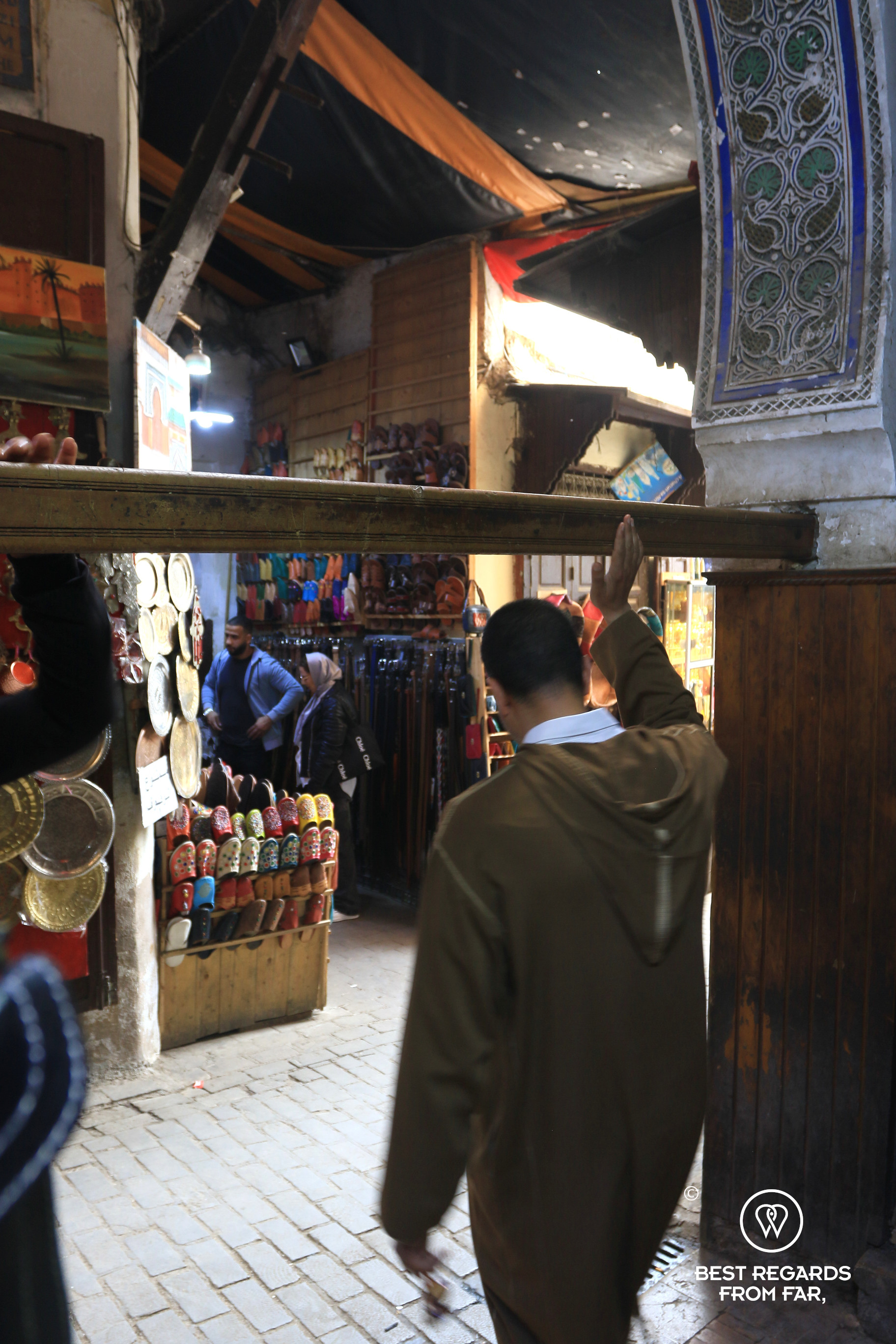
Towards the heart of the medina, tall visitors may be shocked, literally speaking! A roughly 1.5-meter-high wooden horizontal beam blocks the way for donkeys and horses (and the unfortunate tall people who are not looking in front of them).
This narrow alleyway lined up with shops selling everything from argan oil to nougat and from incense to textiles leads to a very sacred place: the mausoleum of Moulay Idriss II.
Back during the 8th century, while a change of ruling family was taking place in Arabia, the ones loyal to the Umayyad clan were chased by the new Abbasid calif of Bagdad. One of the few survivors of the battle of Fakhkh (786), Moulay Idriss crossed all of Northern Africa all the way to the Roman city of Volubilis, about an hour drive from today’s Fez. Descendant of the prophet Muhammad, he became Moulay Idriss I, the first king of Morocco, then a patchwork of Berber tribes.

The Bagdad rulers did not approve of this independent state in Maghreb and got Idriss I poisoned while one of his concubines was 7-month pregnant. At 11, the prince became Idriss II and founded Fez in 808 at the age of 16. To found his capital, he needed important water resources that Volubilis could not provide. Fez on the contrary was blessed with 40 natural springs, surrounded by hills to provide protection, and with access to the Mid-Atlas where most rivers of Morocco originate. The rot-proof cedar wood from the Atlas provided building material and extensive herding in the surroundings was a source of food, wool and leather.
Today, many Muslims flock to pray at the mausoleum of Moulay Idriss II, the founder of Fez, first capital of the kingdom and the oldest imperial city of Morocco.
11. Unlike many cities, the expensive real estate is at the edge of the old town.
While in many old cities, real estate gets more expensive as it is located closer to the historic center, the medina of Fez is a bit different. The habitations set up on the edge of the medina are still part of the UNESCO World Heritage perimeter and enclosed by the 12th century 15-kilometer (9.3 miles) wall surrounding the old town, and also enjoy access to the road while the ones in the center do not. Men pushing carts often deliver goods to these businesses or private home while donkeys are used for heavy loads, such as bricks, gas bottles, or drinks. This ease of access translates in very significant price differences that can go from simple to double in terms of real estate.


12. The leather tanning process in Fez has hardly changed for the past millennium.
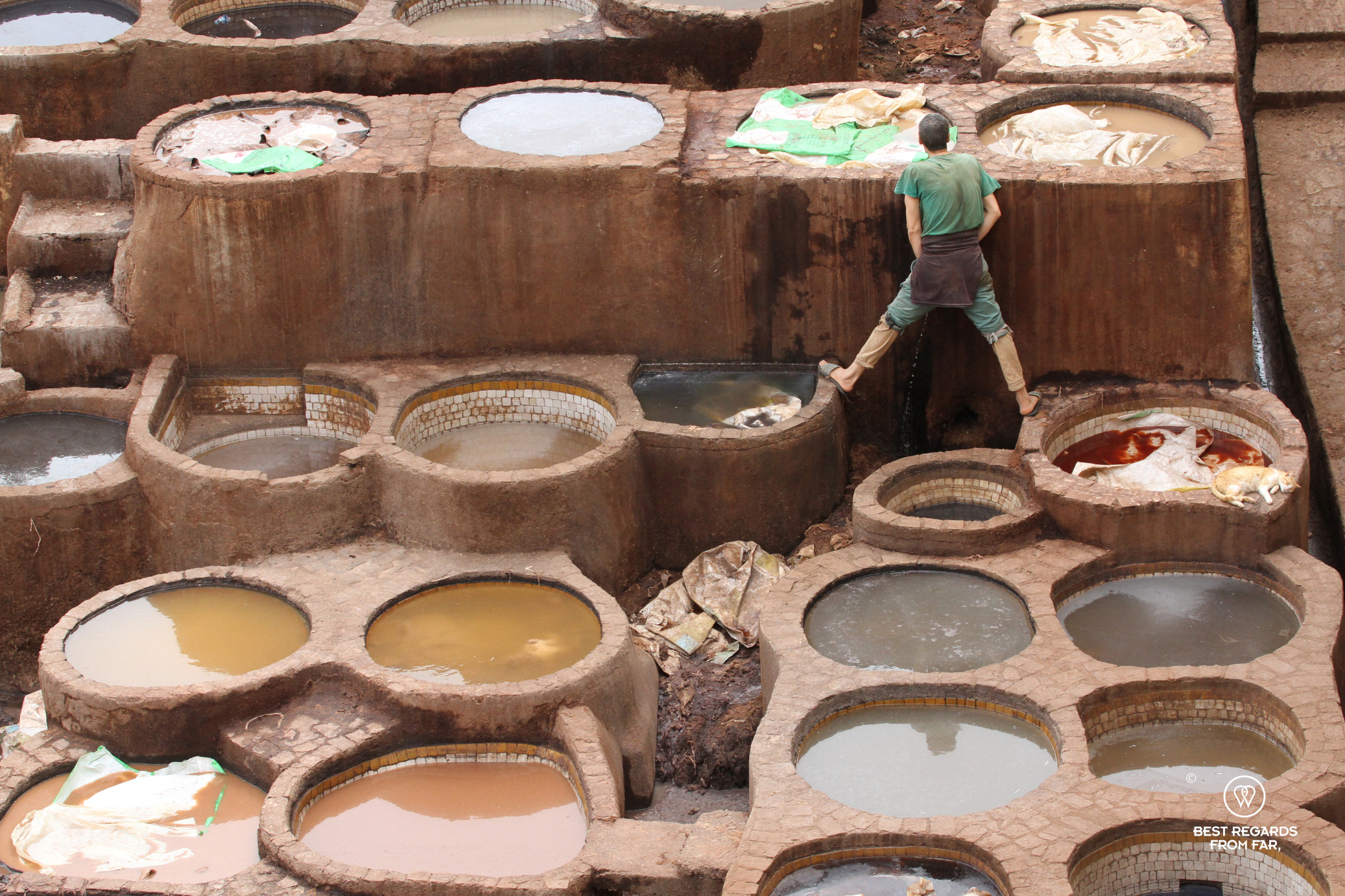
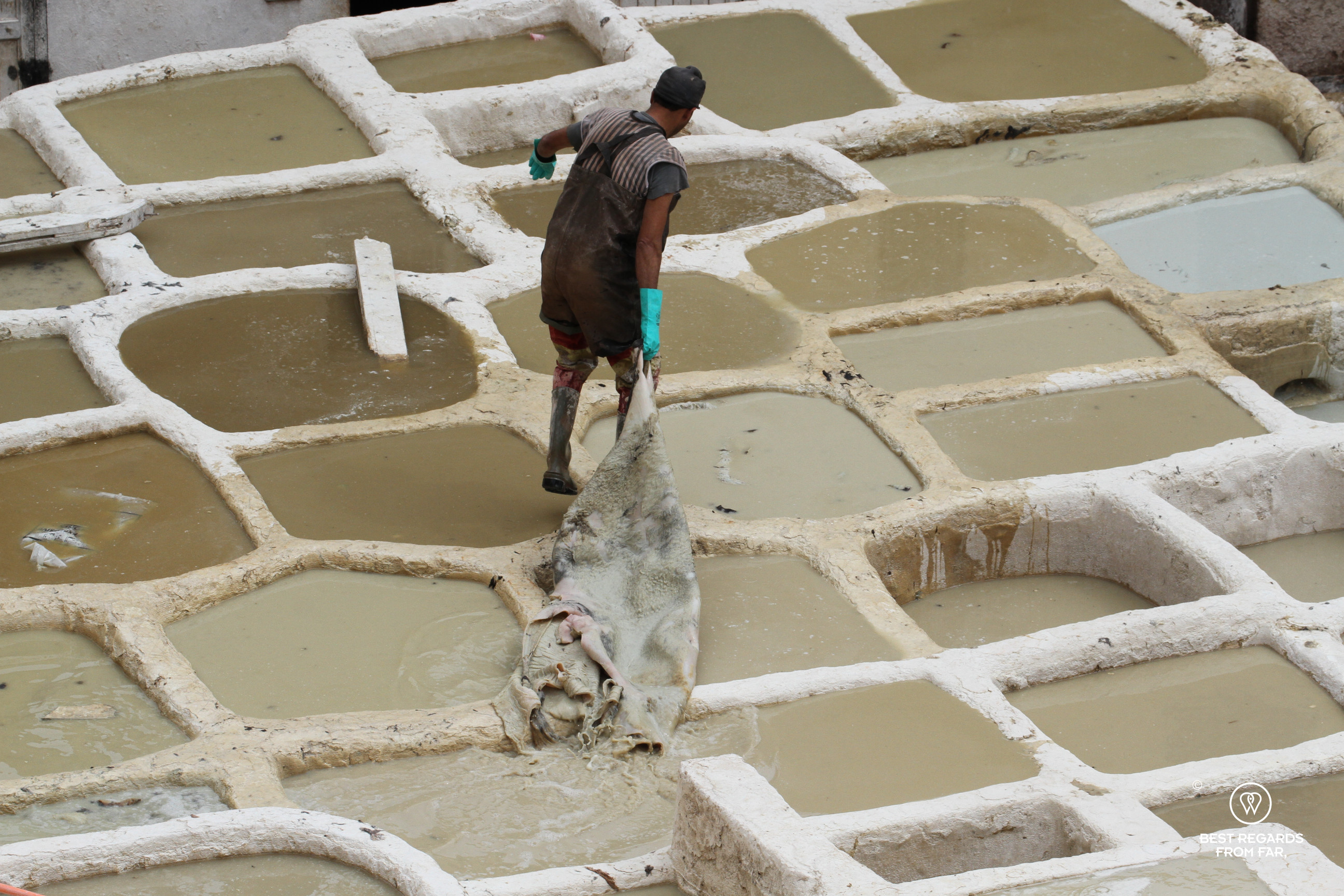
In the heart of the medina, the Chouara tanneries date back to the Middle-Ages and the way they operate has hardly changed, resulting in leathers of extraordinary quality.
The tanneries belong to the city of Fez, and leather-makers rent basins in which skins that have just been bought at the slaughterhouse are processed into camel, cow, sheep, or goat leathers.


For about two weeks, they are first immerged in a bath of quicklime mixed with pigeon droppings as it contains ammonia to separate the skin from the wool and hairs. The smell of decay barely covered by the mint we are sticking into our nostrils does not seem to bother the workers who are stepping onto the skins to make sure they are treated efficiently by the aggressive bath.
Some drag their heavy and soaked cow skins to a building where they are put in a huge barrel to wash off the quicklime. Others scrape off the grease that remained on the washed skins with a knife.
The skins are then soaked into a dye bath of natural pigments for about a week before being dried in the sun on the surrounding hills.
The last step is also done by hand as the skins are softened in the workshops set up around the baths before being auctioned off to the craftsmen of Fez, or sometimes not even hitting the auction as they have been preordered by some luxury brands.

13. Experiencing Moroccan hospitality & art de vivre.
Close to the edge of the medina, an unassuming dark wooden door opens on a narrow hallway. We are led to the central area of the dar where a beautiful fountain covered in original zellige mosaic is highlighted. As a symbolic gesture of welcoming, a meticulous prepared mint tea on a finely carved silver tray is presented to us. Our host and owner of the Riad Moulay Idriss & Giacomo, Batoul Sqali pours the tea in ample movements showing how welcomed we are—not lifting the teapot means that the guest is not welcomed—a true symbol of Moroccan hospitality and conviviality.


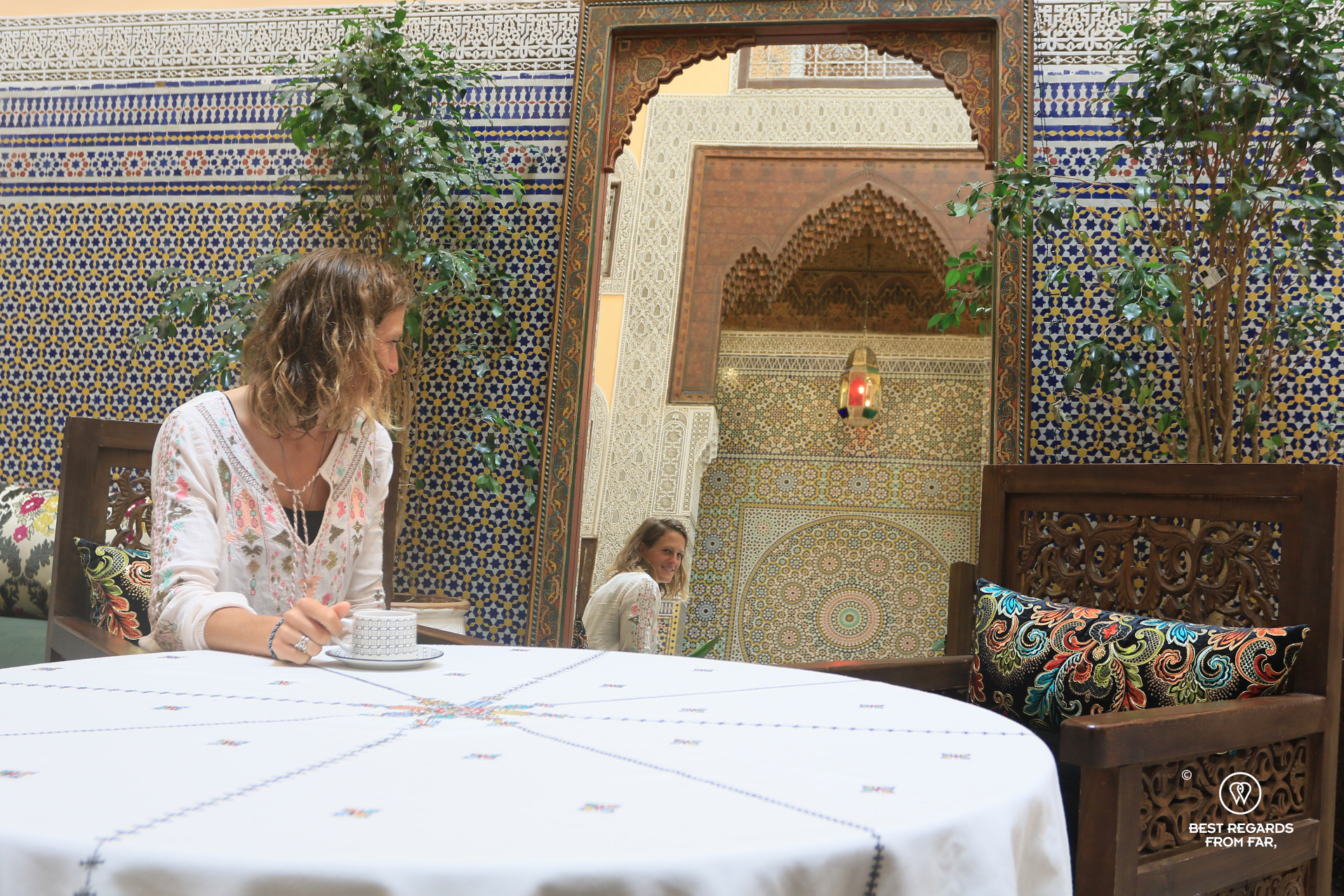
Above us, from the rooftop with commanding views of the medina of Fez and its surrounding green hills, the light penetrates the luxurious residence turned in a boutique hotel. The ground floor has kept its original purpose—to receive guests while living quarters used to be upstairs—as meals are served in this family home. From colorful Fez breakfasts with a bisara fava bean soup—a worker’s favorite upgraded here with cumin, olive oil plus a hint of chili—, freshly baked local flat breads, shakshuka, fruits, and homemade jams along spiced coffee with hints of cloves and cinnamon to festive dinners in which the set menu showcases Batoul’s grandmother’s recipes.
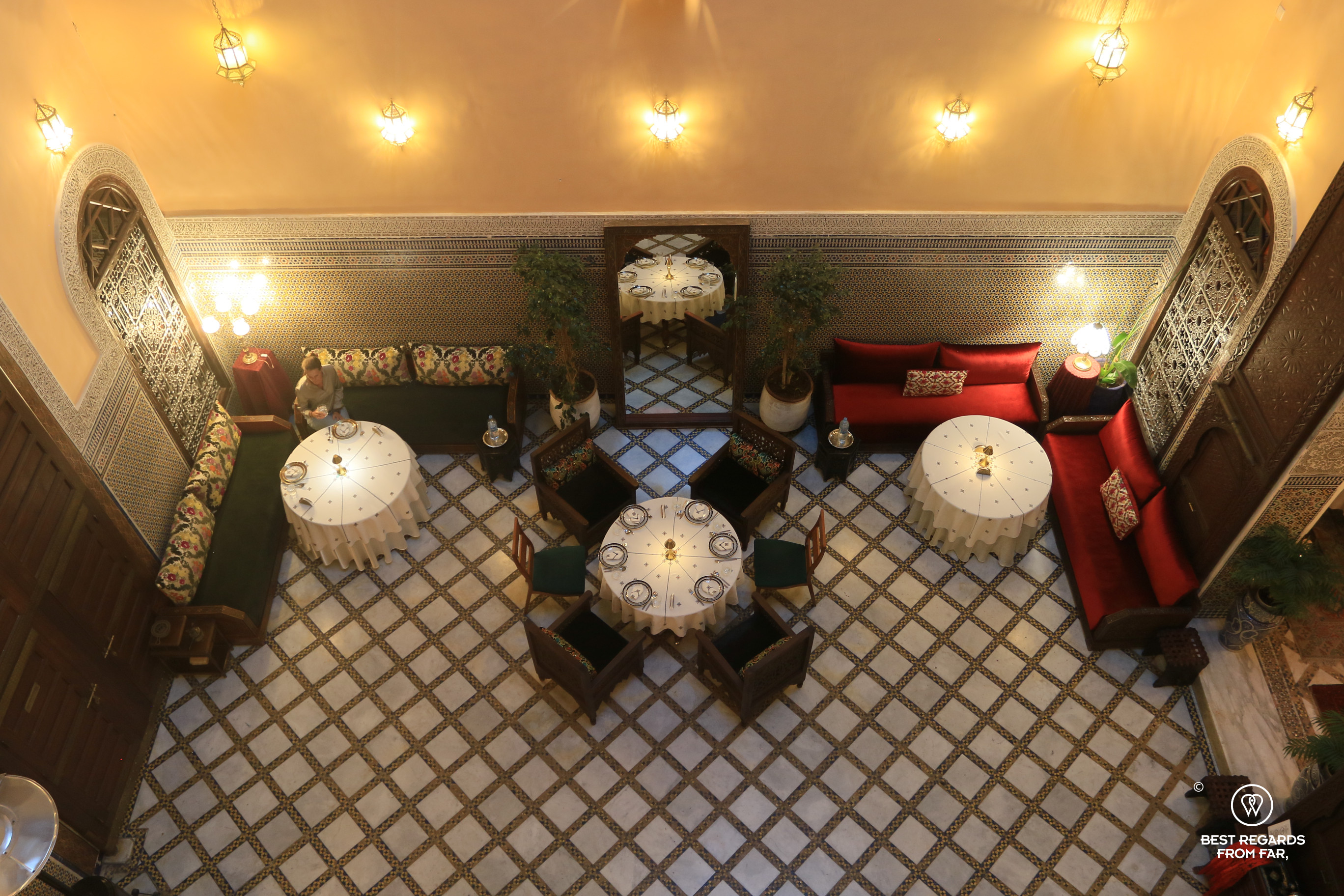

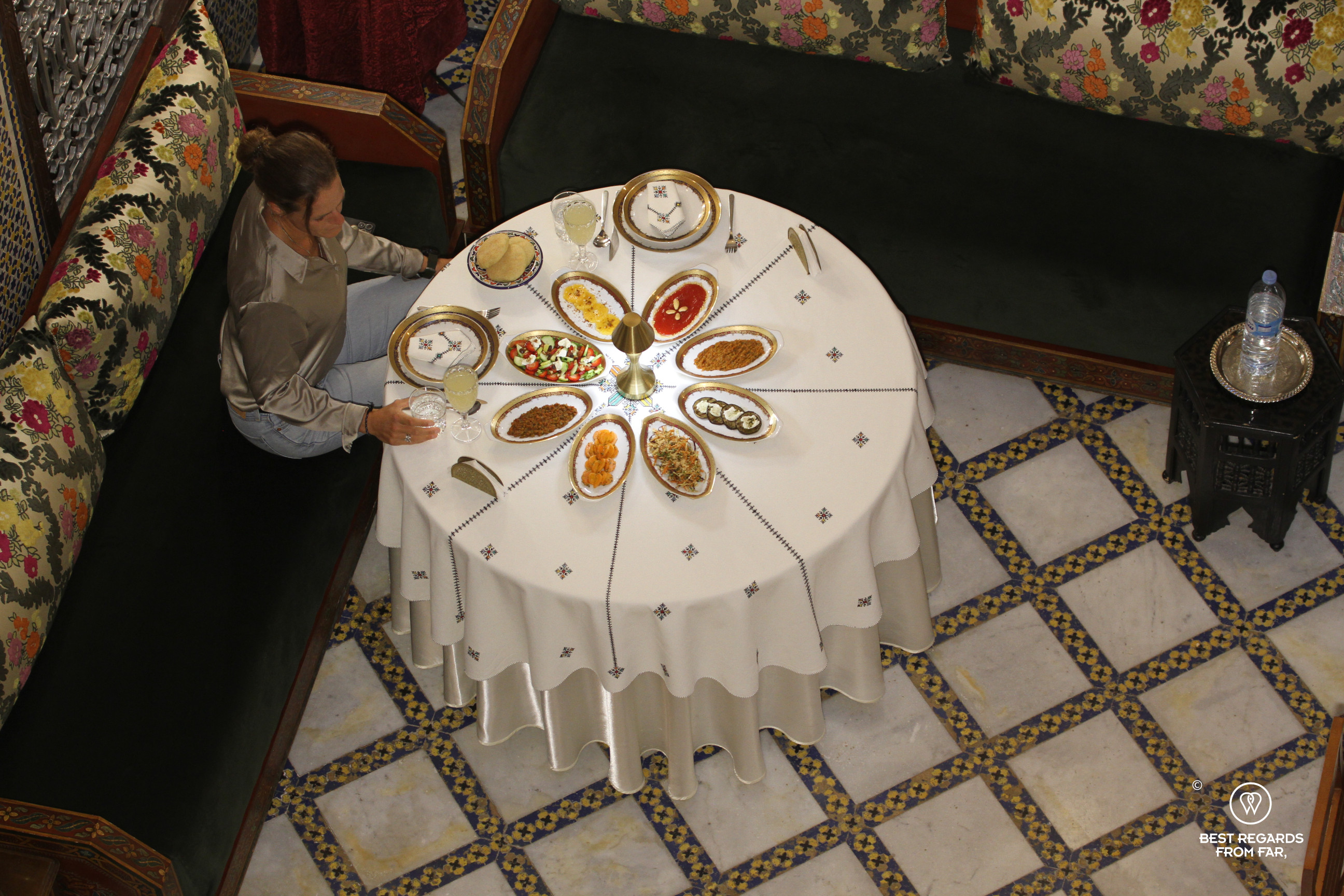
In the elegant patio, a party of eight dishes arrives on a couple of large copper trays. The starter is laid down by the waiters like the petals of a colorful flower. About half are traditional Moroccan specialties such as the delicious zaalouk (the most popular salad in Morocco with every family having its own twist to the cooked eggplant and tomato spread), an original take on garaa masala (where the caramelized tomato replaces the traditional squash), and the other half has a bit of an international vibe with fresh salads (think fresh orange salads with a slight kick or seasonal mixes of strawberries, apples, cucumbers, cherry tomatoes, and a soft local cheese). As a main, the beef tajine with dried prunes, figs, and apricots, served on a confit onion compote, and decorated with almonds and walnuts for the crunchiness is one of Batoul’s prides. Her chicken pastilla with confit onions, and flavored with cinnamon, a hint of orange blossom, and sugar is another one. From starters to desserts (think gazelle horns, homemade baklava with honey), Batoul’s signature is definitely how well balanced her dishes are, and her attention to details epitomizes the Moroccan hospitality.


Travel tips:
- Make sure to book a guide to visit the medina of Fez as not only will you enhance your experience greatly, but also, you will avoid getting lost! Chakib Kabbaj (+212 661 351 904) is recognized by all in Fez to be the best in town.
- Staying at Riad Moulay Idriss & Giacomo is an experience in itself with an excellent location, attentive staff, and very stylish interior decor.
- To stay connected and to avoid expensive roaming fees we used an eSim from Sim Local which made this trip through Morocco a whole lot easier!
- Check out our interactive map for more in the area (black pins lead to an article):
For more in Morocco, click on these images!


 Best regards from far,
One Comment Add yours