Text: Claire Lessiau
Photographs: Claire Lessiau & Marcella van Alphen
While many only take day trips to the blue city of Chefchaouen to snap a couple of selfies or photos, the surrounding nature of the green Rif Mountains of Morocco is definitely worth an in-depth exploration. Follow the goat trails and dirt tracks into the Talassemtane National Park amongst endemic trees and monkeys, along beautiful gorges dotted by natural rock pools and experience the Berber hospitality.
Pin it for later!

Day 1: Cedar of the Atlas and the Unique Fir of Morocco Forest
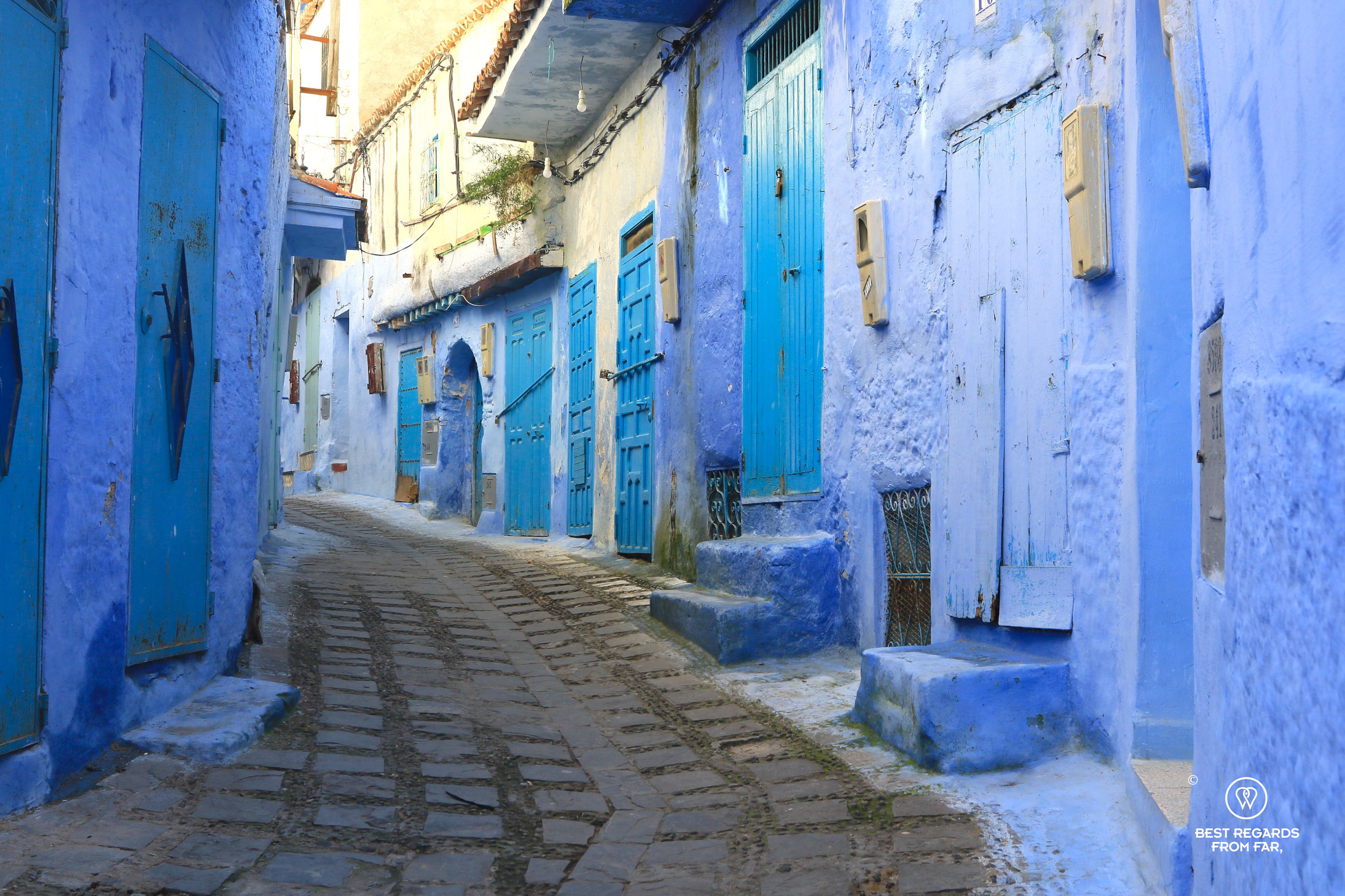
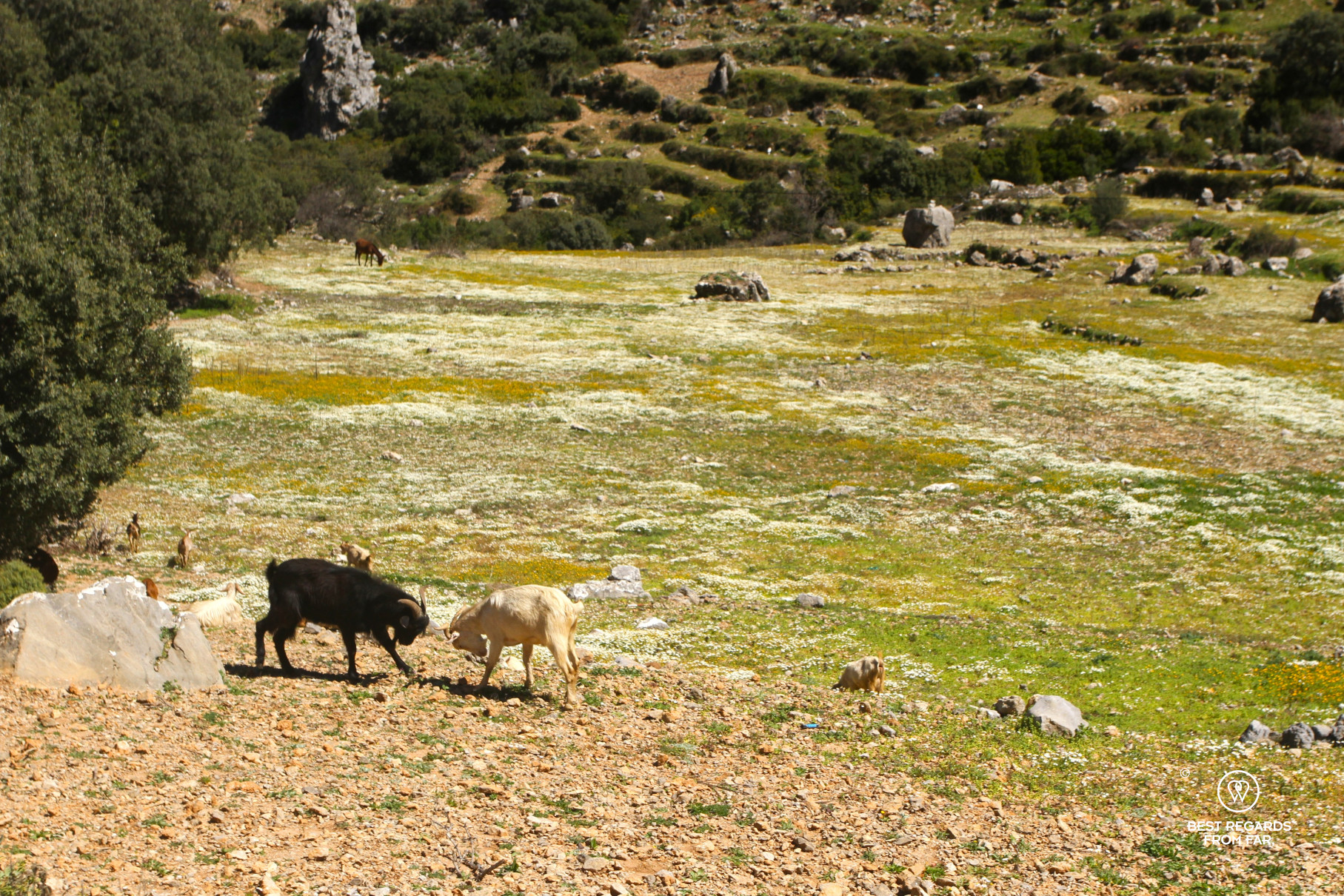
We are walking the narrow alleys of the blue city of Chefchaouen towards Ras El Ma where the roaring spring enters the photogenic town. The mineral water comes from higher up in the mountains of the Talassemtane National Park, and we follow a steep and rocky path towards where it sprouts. Precisely at the spring after losing sight of Chefchaouen our donkey and goat trail merges with a dirt track connecting the city to the Berber villages of Azilane and beyond.

The quiet dirt road allows us to make progress much faster and we continue climbing up to the mountain pass, home to a beautiful forest of majestic cedars of the Atlas and firs of Morocco. While both these trees are endemic to Northern Africa and can get older than 500 years, the latter is endemic to this very park. Amongst the close to 1,400 plant species that can be found in this national park, another 46 are endemic to Morocco.
During this early spring, snow patches dot the landscape while in the distance, lower mountains lead our eyes to the Mediterranean Sea in the background, and even further yet not that far, the coast of Spain. A few monkey tracks in the snow betray some of the wildlife that can be found such as boars, the elusive lynx, and an incredibly rich bird life as reminded by the couple of golden eagles circling the sky above us.

While some basic rural guesthouses can be found in Azilane, availability is limited during this month of Ramadan and a nice promontory overlooking its valley is the ideal location for our bivouac. We pitch our light Freetime Outdoor tent before attending a concert of bird songs and a spectacular sunset during which the warm colors of the sky contrast with the snow-capped peaks of Talassemtane.
Day 2: Spectacular Canyon & Fabulous Ecolodge
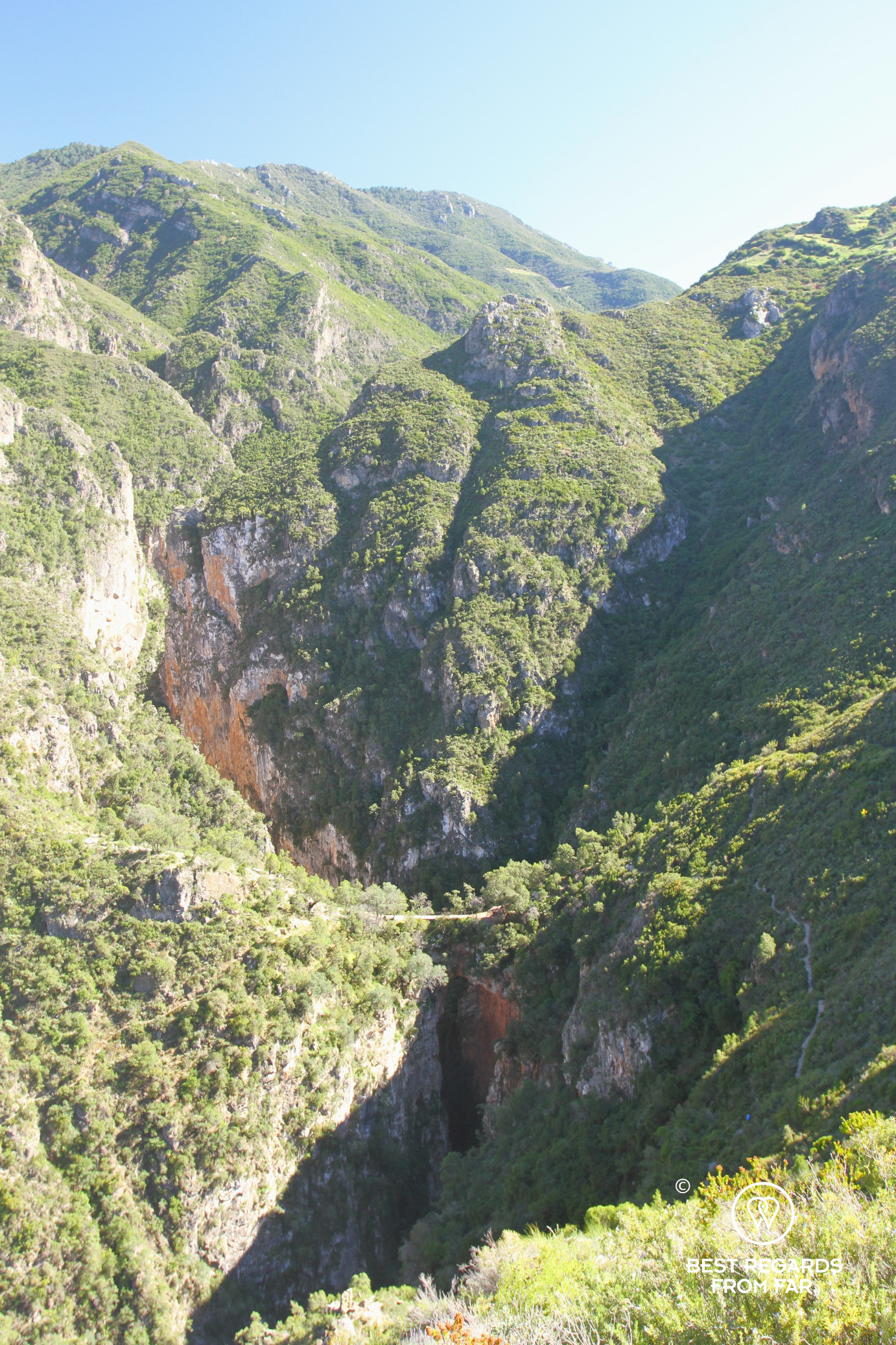
As we walk down into the valley towards Azilane, the Tissouka Peak, one of the highest in northern Morocco culminating at 2,118 meters (6,949ft) towers above us. Only a few motor-bikers pass us confidently riding their geared up dirt bikes on these treacherous dirt tracks. The small settlements of Azilane with its couple of “gîtes” or rural guesthouses and the tiny settlement of Afeska are very quiet. A patchwork of fields delimited by drystone walls, some carpets drying in the sun, and the trash that scatters the ground betray the human presence. The trail makes its way to Imizzar where mules welcome us as we enter the gorge formed by the Farda River. While some accesses to the water allow us to freshen up and refill our ÖKO water filter, the trail stays mostly up with beautiful views on the canyon with its waterholes all the way down.


As we approach Akchour after a good couple of hours, some simple houses dot the green terraced fields that the trail leaves to hug the mountain all the way down to God’s Bridge. The first sight of the bridge makes its name self-explanatory! The million-year-old erosion has sculpted this natural arch through the limestone into what locals call Pont de Dieu.
We keep hiking along the canyon to Akchour enjoying magnificent views, smelling wild lavender and wild rosemary that line the narrow trail. Soon Akchour appears down below watered by a succession of natural turquoise rock pools.

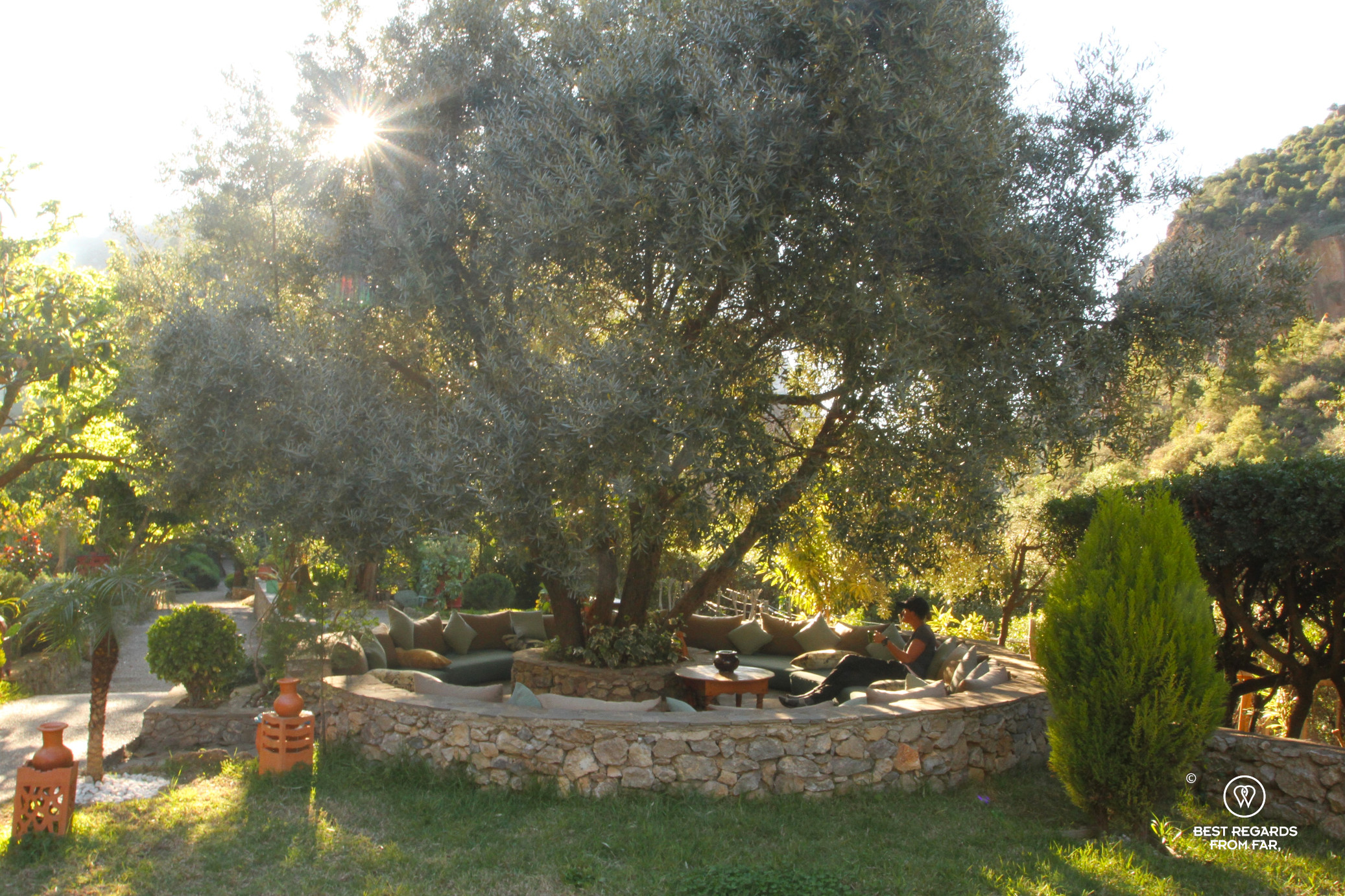
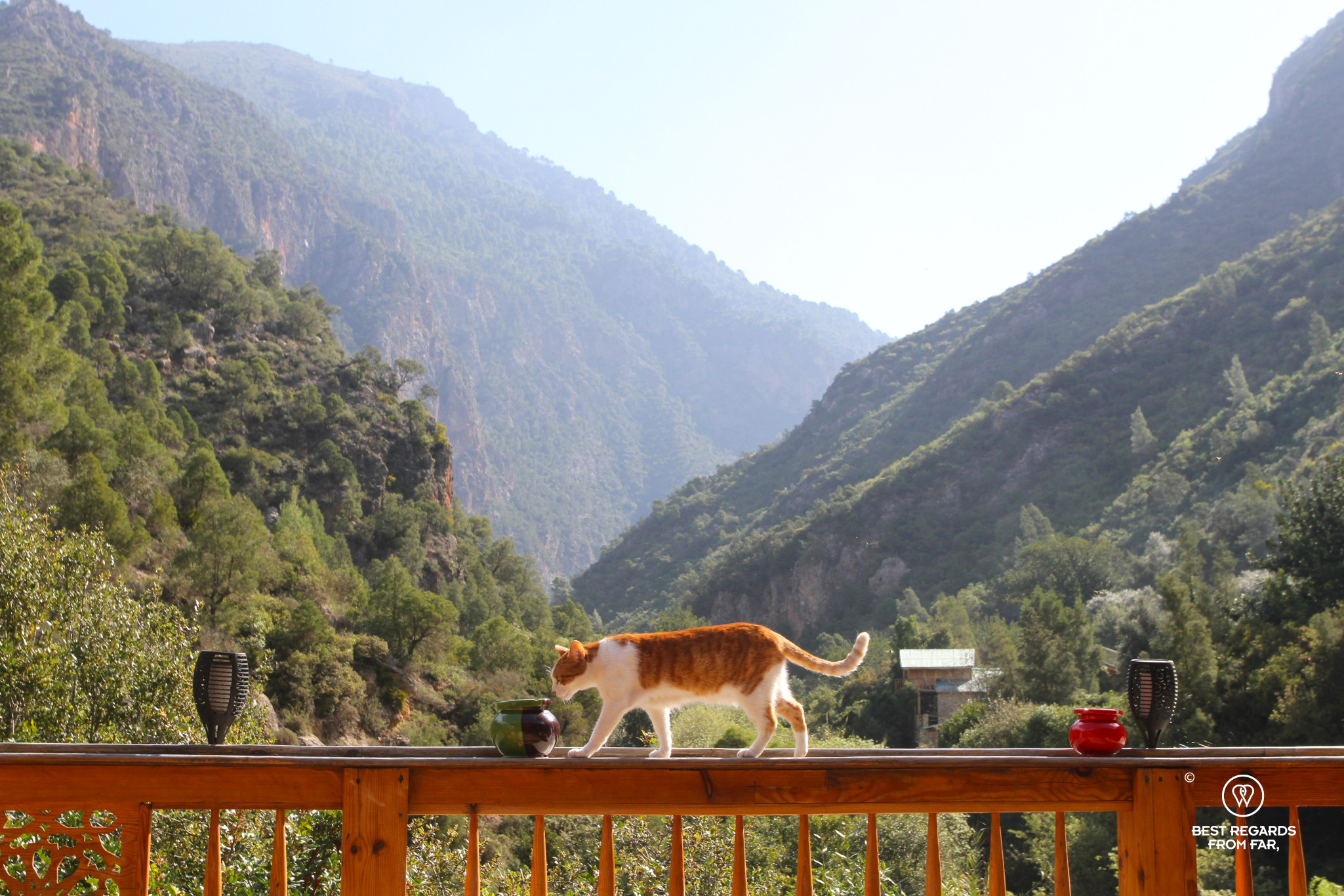
We eventually arrive at the Ermitage d’Akchour ecolodge for the night. Built along the Akchour River, our lovely and comfortable chalet is exactly what we needed for a good night rest before continuing the adventure. And of course a good Moroccan dinner!
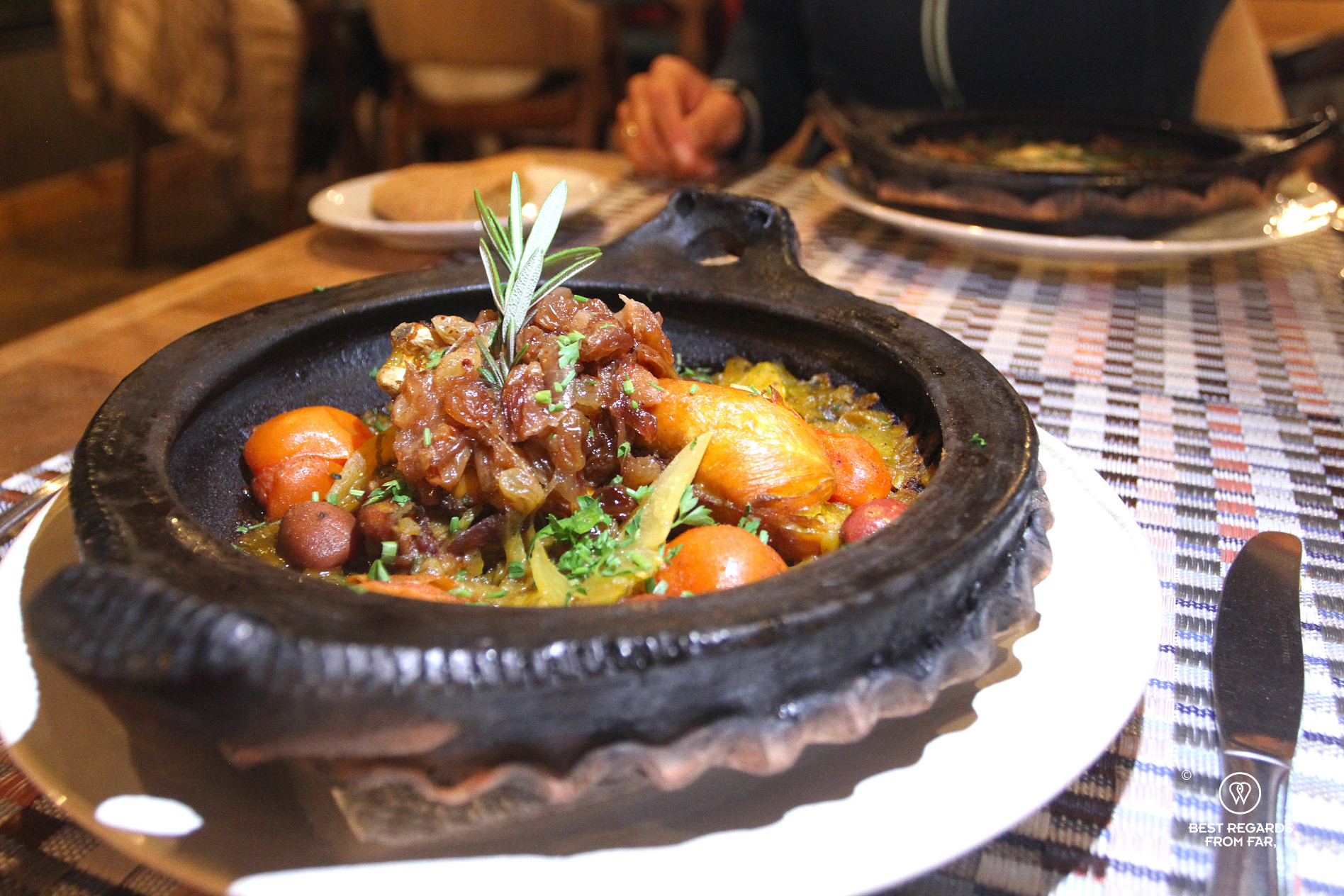
The cozy restaurant of the Ermitage focuses on local products. For instance, the fresh goat cheese baked in its clay dish with honey and thyme and topped with walnuts is supplied by the local cooperative and whets our appetite for more regional specialties. The chicken tajine cooked with confit lemons is full of flavors from the olives, cherry tomatoes, raisins, rosemary and soft spices. The Kabab Maghdour is another local’s favorite with finely cubed beef slowly cooked made of onions, soft spices, and herbs. An egg topping off the dish softens the aromas for an ideal balance. With the temperature outside dropping fast, the mains served in the traditional clay dishes from northern Morocco continue to simmer and keep us warm.

Day 3: The Waterfall of Akchour & Macaques
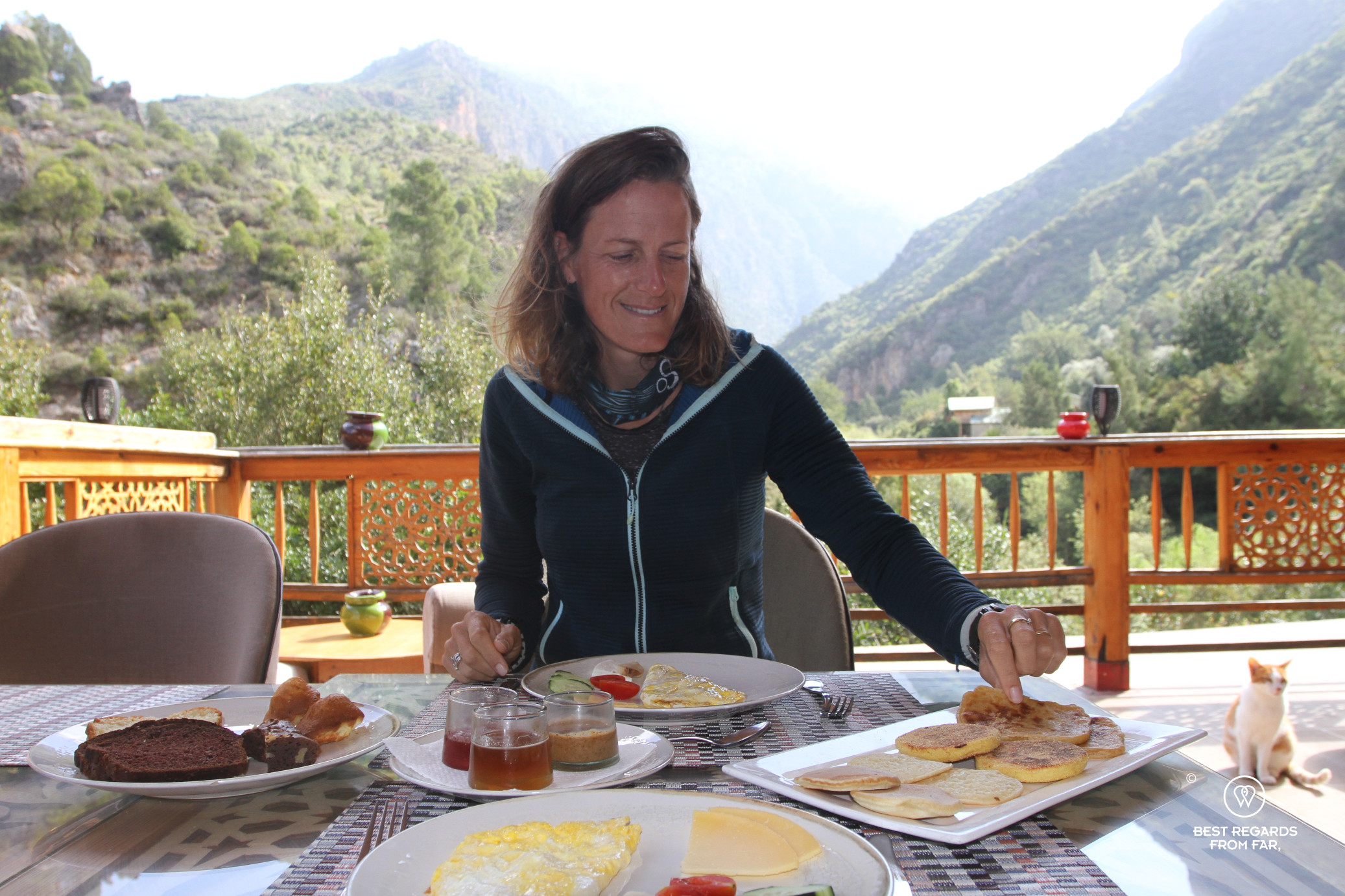
What a pleasure to wake up in such a comfortable bed after such a good night! And even better, our breakfast with a view is perfect to start the day and get some strength for what is coming.
This part of the hike is the most trodden one as many visitors to Akchour come for its waterfalls and turquoise rock pools along the path. Many shacks set up to sell food and drinks give an idea of how busy it can get.


The trail is fairly easy and flat with some nice shady patches, and some creative river crossings that require us to go barefooted or to heavily rely on our Vipole hiking poles to keep our feet dry.
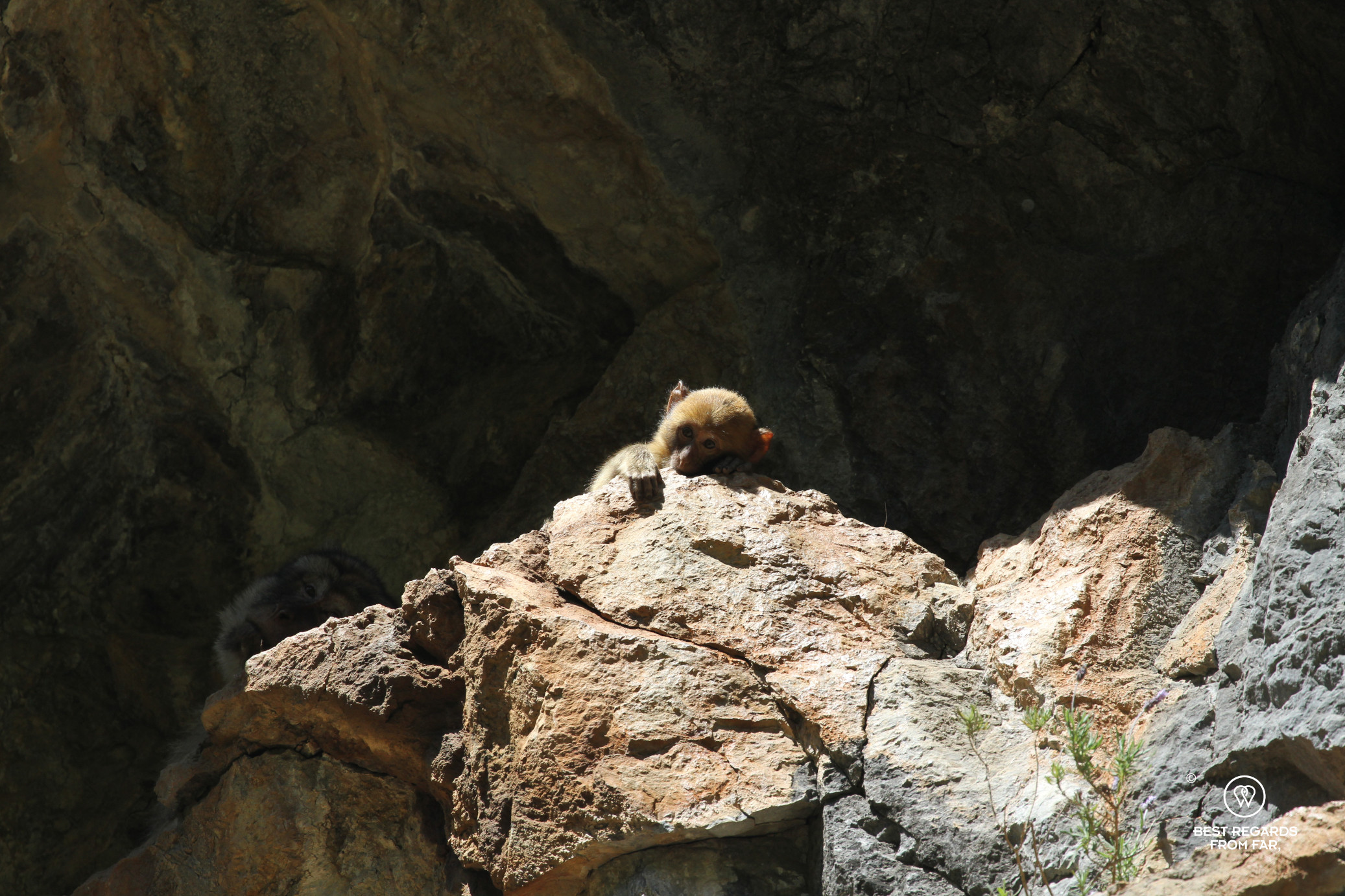
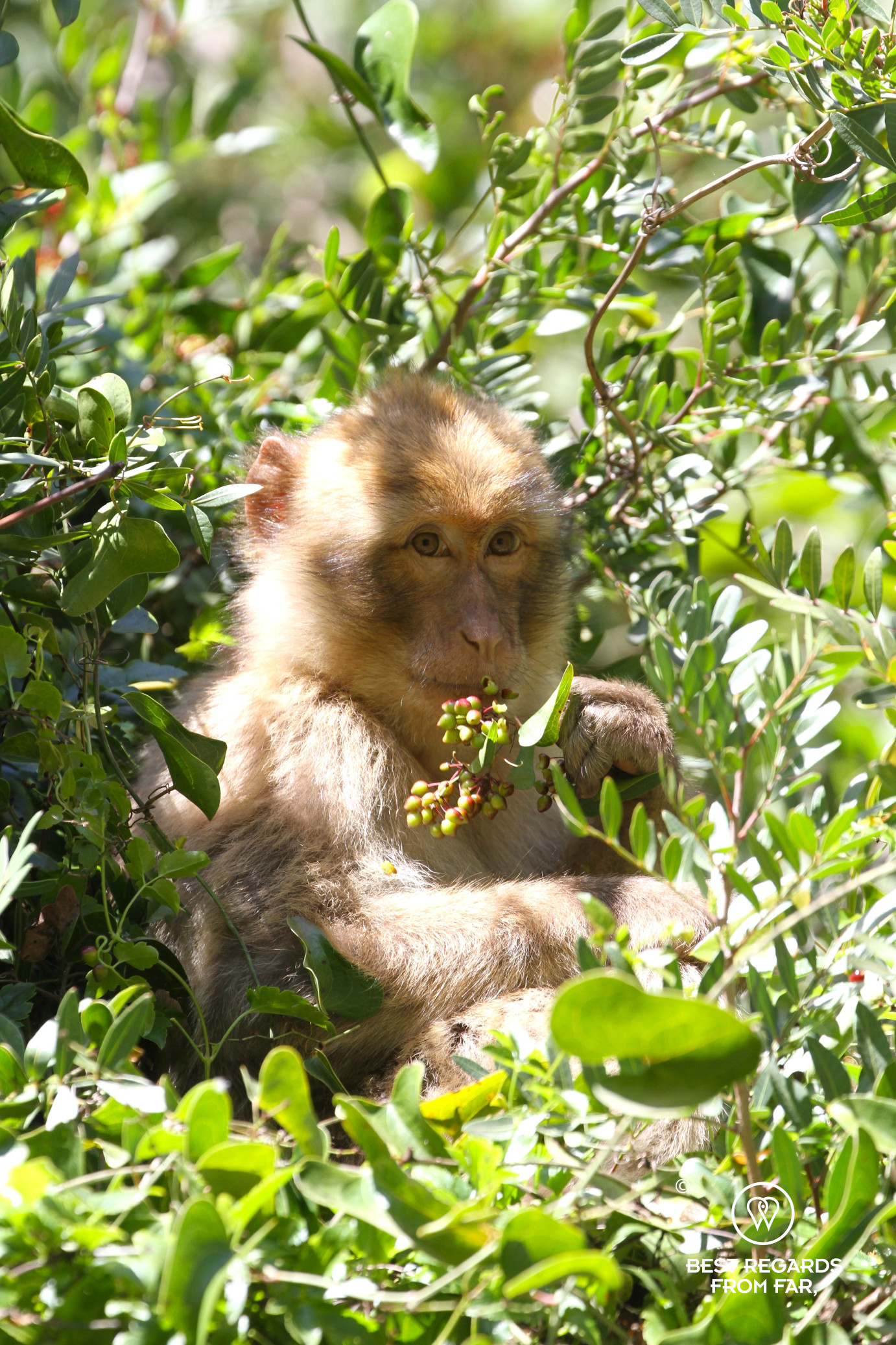
All of a sudden, we come across a troop of Barbary macaques, the only monkey species of Morocco. When most are concentrated in the cedar forest around Ifrane and fed by day visitors, these fluffy monkeys are wild, and relatively shy. Mothers and babies are crossing the water jumping from branch to branch, others are feeding on berries in the trees, and some are showing off their rock climbing skills on the limestone cliff face.
A few tricky river crossings later, we eventually reach the 70-meter tall (220ft) waterfall of Akchour which is indeed “grand” as its name states. And while for many it is the turning point, for us it is only a stop.
After six years of drought, the region has enjoyed rain for about three consecutive weeks. While the streams are full and the fields and mountains green, this has led to some landslides such as the one we need to climb to end up above the waterfall and to reach the Berber village of Taourarte. The challenge only equals the phenomenal views on the canyon we have just walked along and the surrounding mountains. Once up it is clear that going back down without a rope is not an option!


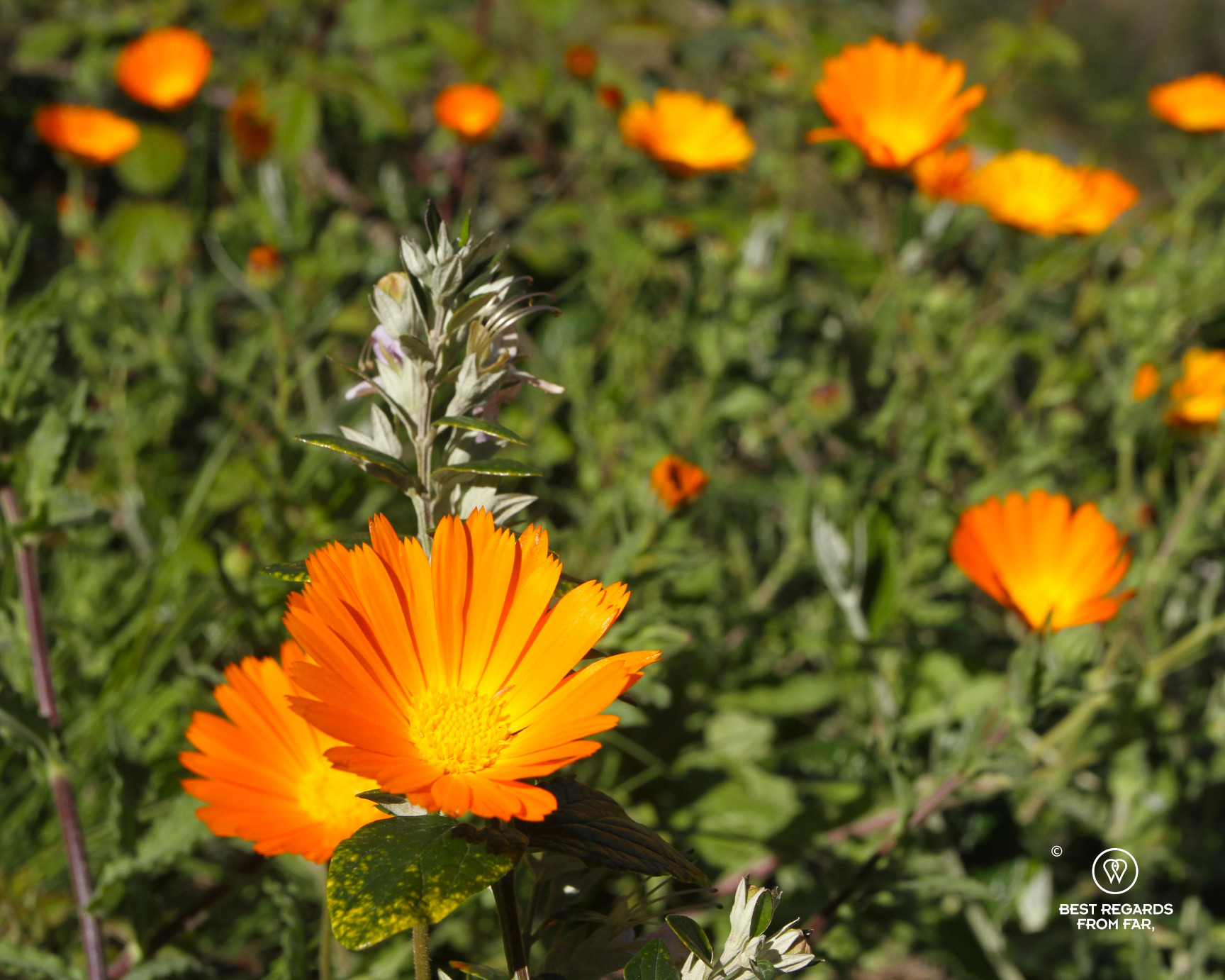
Some local medicinal herbs that we find along the path announce we are getting closer to the village—the whole area is known for growing cannabis, referred to as kif here (actually Morocco is one of world’s top producers of hashish, and was the world’s top supplier of cannabis in 2024) and the plants seem to naturally spread slightly beyond the fields.
Day 4: Jebel Lakraa, the Talassemtane NP’s Highest Peak (2,159m, 7,083ft)
After seeing a sea of clouds lift slowly before evaporating into thin air above the Canyon of Akchour, we head out.
The first couple of hours, we hike on a dirt road crossing a few villages such as Babnour where for the first time, boys come out screaming for money with insistence.
As we gain altitude and cross the 1,500-meter (4,921ft) line, we are rejoined with the majestic firs and cedars and prolific birdlife. The trail to the summit of Jebel Lakraa (2,159m; 7,083ft), one of the highest peaks of the Rif Mountains becomes even more interesting as during this early spring, it is still under a thick layer of snow! The trail markers, absent from most trails anyway, are nowhere to be seen and studying the map and elevation charts on Whympr to avoid bars of rocks, and following azimuths is the only way we manage to find the summit safely.


Reaching the tree line and tired of sinking knee-deep with every step, and even at times hip-deep, we ditch our heavy backpacks to get lighter on the snow cover as we are not geared up with snowshoes. We put on our gloves and add a layer as the wind is often strong on the barren summit. We plough through the heavy spring snow from which once in a while a young cedar of the Atlas peeps through. We eventually reach the summit by following the limestone ridge line. There, a spectacular 360-degree view awaits!
Once Jebel Lakraa is conquered, one can walk back to Chefchaouen via El Maouzil on a rather uninteresting dirt road with hardly any commodities, or stick to the park via Tissouka to enjoy more of these landscapes. Another option is to get a transport to Gîte Talassemtane for a rest day enjoying excellent food and experiencing the culture of northern Morocco before heading back into the blue city of Chefchaouen…
Day 5: Eco & Community-Based Tourism at Gîte Talassemtane
Choosing the last option, we arrive at a well-maintained blue house with its garden planted with rose trees, rosemary, and lemon trees that contrasts with most of the unassuming houses in the surrounding villages. There are no jobs here but for marijuana plantations, a grey area as the growing, medicinal, cosmetic and industrial uses have just been legalized while recreational use is still illegal. 2024 saw the first legal exports of marijuana from Morocco to Europe. It is easier to buy hashish proposed by some men hushing the word to us than to find a cup of coffee around these off-the-beaten path villages!
Our host Firdaous El Habti welcomes us warmly in proper Moroccan hospitality. Within minutes of our arrival, she brings us a mint tea served on a handmade copper tray with the traditional dates and sfouf—a local recipe also called sellou and that is popular during Ramadan, made of almonds, sesame seeds, anise, and cinnamon mixed together with butter and icing sugar—to spoon out.



Here at the rural guesthouse, activities range from helping out with distilling organic rosemary water or rose water in the season using the plants harvested in the garden, to cooking classes to learn how to prepare Firdaous’ amazing tajines, weaving workshops, or nature outings such as more hiking or birding with a guide.
The mouthwatering dinner prompts us to learn more about Moroccan gastronomy by cooking some of the recipes Firdaous has learnt from her mother and perfected. We start by making some Moroccan khobz bread that comes along tajine dishes and allows to soak up every drop of the delicious jus.
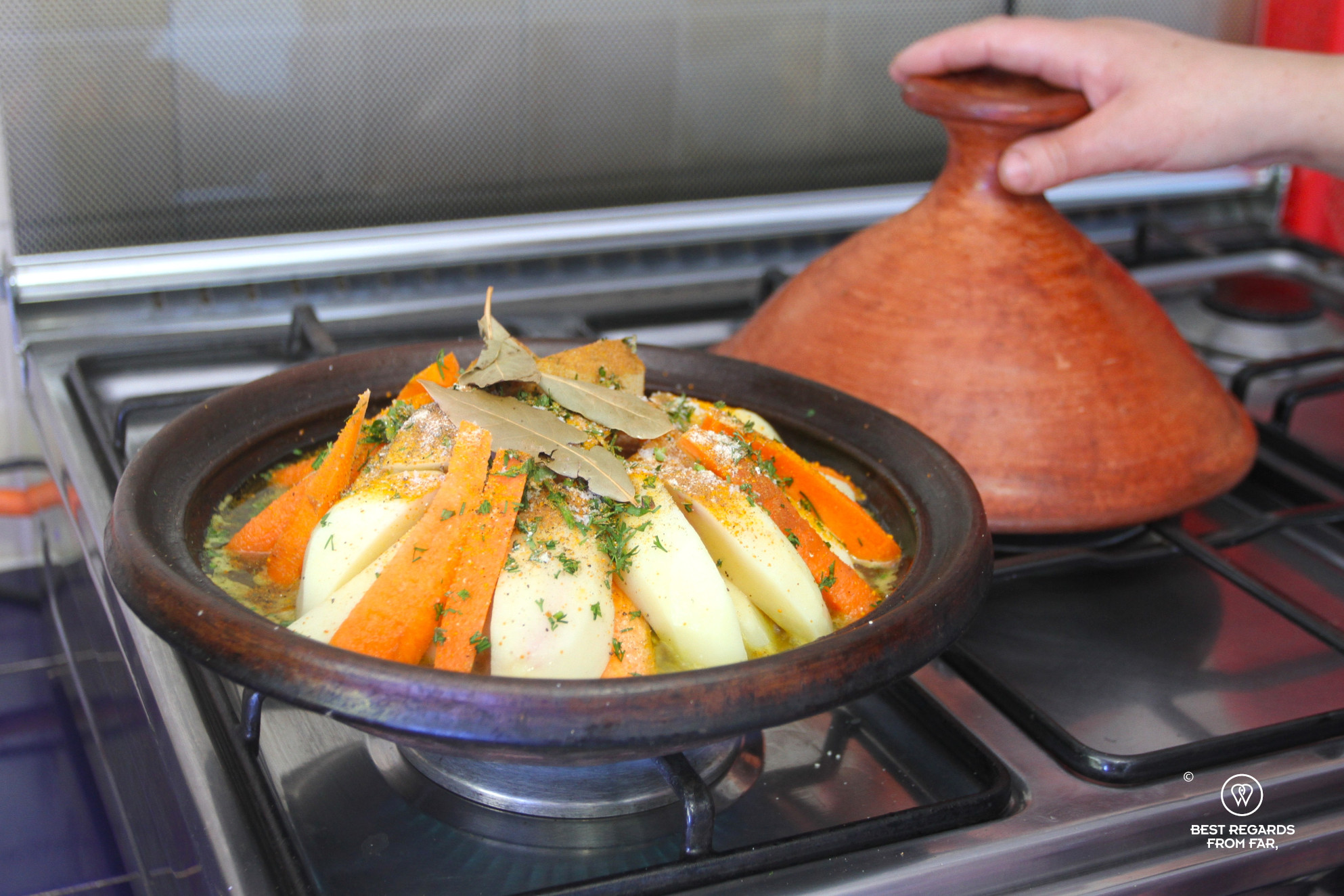
While the dough rises, Firdaous gets started on a chicken tajine. With only a few soft spices—curcuma, cinnamon, ginger, black pepper and salt—rich flavors soon escape from the traditional clay dish that is simmering on the gas stove. Some coriander and parsley from her brother’s garden just a few houses away are added to the dish, along with bay leaves that were picked from trees growing in the wild in the mountains above Akchour, and a branch of rosemary from the garden to make the flagship dish of Morocco complete. The savors match the flavors as we enjoy this chicken tajine with the bread still warm from the oven on a zellige table in the sun.



Day 6: Back to Chefchaouen
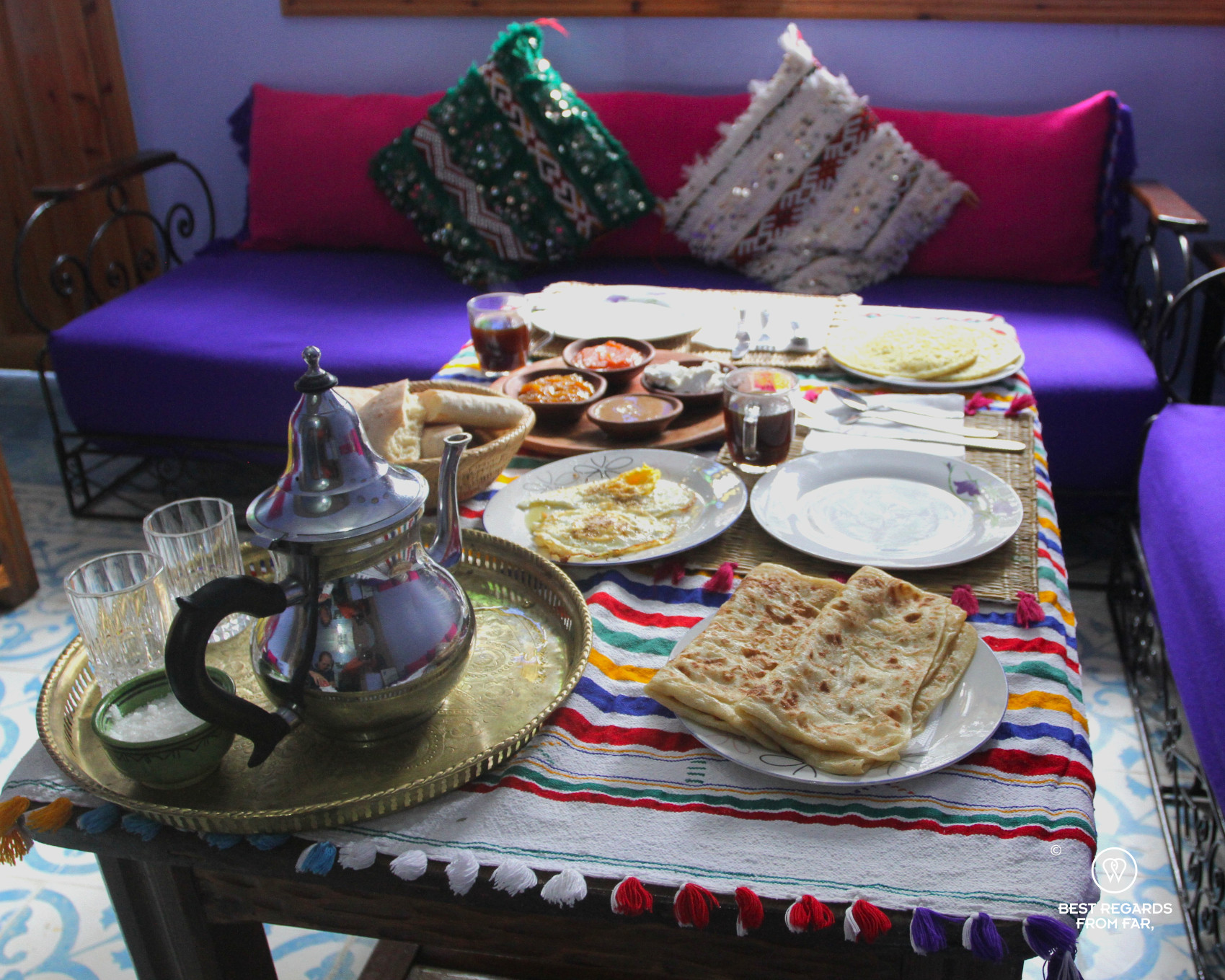
After a bountiful Moroccan breakfast made of the risen khobz bread; the flat, oily, and folded raief; and a barader—the local pancake—with marmalade from the garden, homemade peanut butter, and a sweet squash jam concocted by Firdaous, we have plenty of energy to loop back to the blue city of Chefchaouen.
Views on an expansive valley accompany us on the road until we reach the trail that cuts through the mountains to the Instagrammable city. Leveled, the trail is rather easy to walk and while we have harldy come across any groups during this short week, we greet some tourists led by guides to some viewpoints, such as the one by the white Jemma Bouzafar mosque overlooking Chefchaouen. We arrive back at the Ras El Ma spring that is teeming with tourist activity now that Ramadan is over. The women washing their carpets in the stream are long gone, and have been replaced by souvenir and orange juice vendors hassling passers-by.
Travel tips:
- Given the scarcity of services (food, accommodation) along the way, and the fact that most trails are unmarked, it is strongly recommended to hire a local guide and book your gîtes to make sure they operate. Refer to: fatima@gitetalassemtane.com.
- Make sure to book ahead your accommodation and activities at Gîte Talassemtane.
- To stay at the Ermitage d’Akchour (by far your most luxurious option along the way), make sure to book ahead.
- Inquire about the water situation. There are many springs along the way, and having a filter (after trying many water filtration solutions, we go only with ÖKO water filters that are safe, efficient and instantaneous) gives more flexibility and allows to save weight.
- To stay connected and to avoid expensive roaming fees we used an eSim from Sim Local which made this trip through Morocco a whole lot easier!
- Check out our interactive map for more in the area (black pins lead to an article):
For more in Morocco, click on these images!



 Best regards from far,
Thanks for the interesting letter!
Leena
Lähetetty sovelluksesta Outlook for iOShttps://aka.ms/o0ukef
Thanks for reading it 🙂
Hugs from Paris.