Text: Claire Lessiau & Marcella van Alphen
Photographs: Claire Lessiau
Perfectly showcasing the mix of centennial traditions in the capital of the former Lanna Kingdom with the rapid modernization of the region since its connection to the railway in 1912, the busy and bustling San Kamphaeng Road “handicraft highway” hosts precious workshops. Lacquerware, silk weaving, wood carving, silverware, paper umbrella making, celadon ceramics… pushing a few doors, it is the skilled craftswomen and craftsmen at work who reveal their handicrafts to the curious traveller to Chiang Mai, Thailand.
Pin it for later!
Chiang Mai was created out of nothing. In 1296, King Mangrai decided to build here the capital of his Lanna Kingdom (“the kingdom of a million rice fields”). Thanks to its fertile land and raw materials, Chiang Mai thrived, attracting many ethnicities from Burma (today’s Myanmar), Siam (today’s Thailand), and China. As wealth increased, so did sophistication, and crafts inspired by the plentiful surrounding natural resources became more and more refined.
If the Lanna Kingdom flourished fast to reach its golden age in the 14th and 15th centuries, it was only short-lived: the arrival of Europeans by sea favoured the more powerful coastal states of Siam and Burma. Still, while Chiang Mai turned into a sleepy town, the arts and crafts were not forgotten, but passed down from generation to generation to this day…
Wood carving
Visiting one of the 34 Buddhist temples within the city walls of Chiang Mai, or the majestic and holiest of all, Doi Suthep, gives a glimpse of the talent of local artisan woodcarvers. Wood carving is one of Thailand’s traditional art forms dating back to the Sukhothai period (1238–1438). Very durable teakwood and rosewood are often chosen for either bas-reliefs, deep-reliefs, or round-reliefs carved on every side.
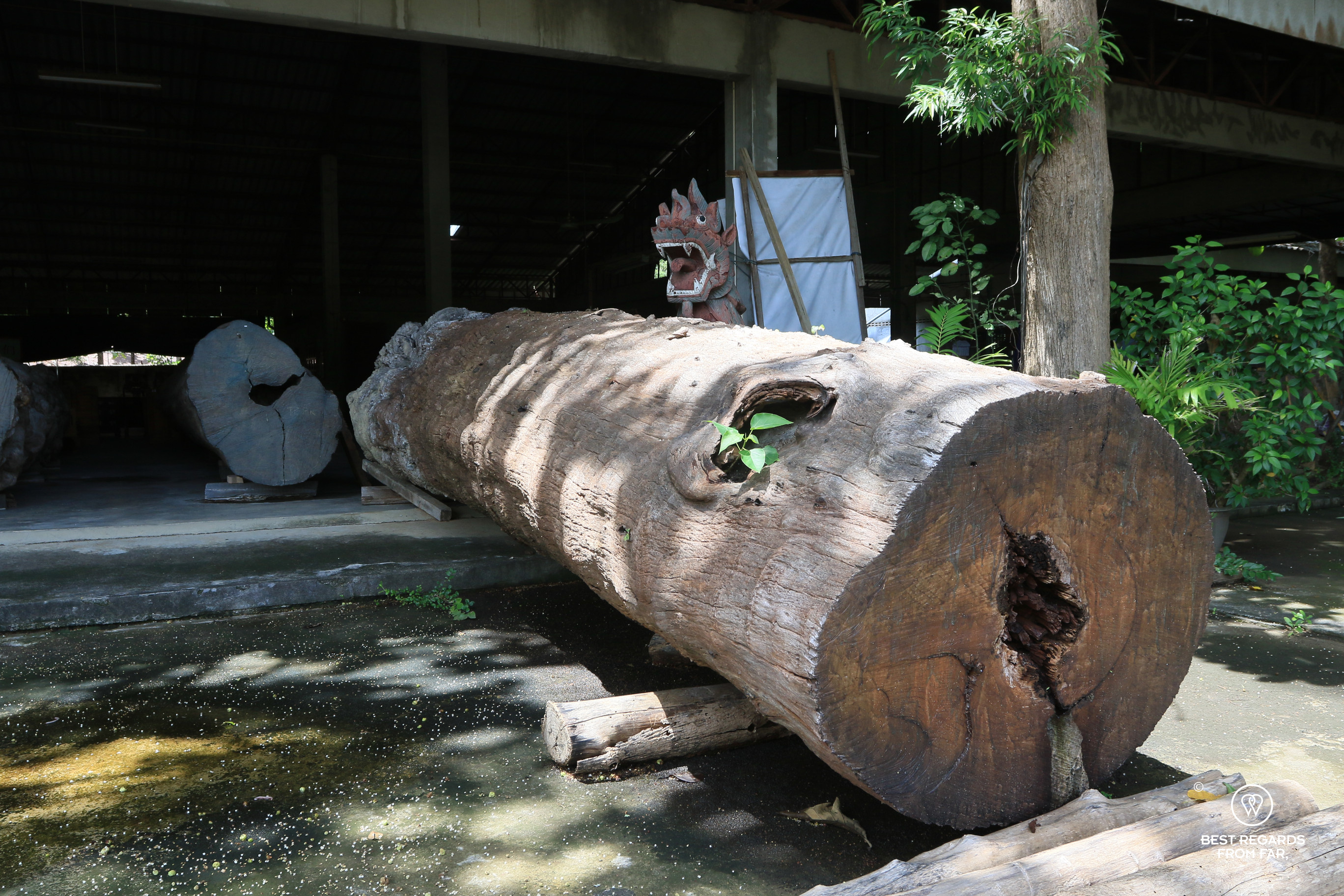


Starting with studying the trunk to see how to highlight it in the best possible way and make the most of the precious material, craftsmen design refined pieces of furniture, sculptures, and objects. In the naturally-ventilated workshops along San Kamphaeng Road, chisels, mallets, and pencils lay next to hand-sketches. Some deep-reliefs show layers of events in the rural villages with elephants, buffalos ploughing the fields, and rice planting. In the next atelier, the root flare of a teak tree has turned into a vivid scene with a herd of Asian elephants. Further, heavy dining tables and luxurious desks are waiting for an owner while Buddha sculptures are lined up to be delivered to a nearby monastery.


Umbrella making
Around Chiang Mai, the mulberry tree is not only planted for silk production. Bo Sang village has been famous all over Thailand for the crafting of umbrellas made of sa paper, itself derived from the bark of the mulberry tree. It is a Buddhist monk, Phra Intha, who is credited with importing the technique from Burma. There, the umbrellas kept people cool during the hot months and dry under the torrential rains of the rainy season. Phra Intha intently observed the Thai-Lue people of Chinese origins make these umbrellas, and taught it to the villagers of Bo Sang.
To this day, for traditional umbrellas, only natural products are used: the naturally peeling mulberry bark is soaked, boiled, and pounded into a pulp, dissolved in a tank of water, and collected with a fine mesh to dry in the sun to become sa paper. The frame, including the delicate spokes connected to the handle by cotton threads, are patiently and delicately made of bamboo. The sealing agent to make the umbrella stiff and waterproof is based on a fermented persimmon fruit secretion.


The leftover sa paper is turned into cards, notebooks, stationery, bags, lanterns, or gift wrapping paper sold in many of the colourful specialized stores off San Kamphaeng Road.
If initially, Bo Sang umbrellas were to be offered to monks and were a supplemental activity during the rainy season, they have gained so much popularity that it is now a full-time job for many of the Bo Sang villagers. Mass-production methods have also been developed. Studying the umbrellas carefully allows to notice small differences in the patterns that are expected for hand-made and hand-painted crafts.
Lacquerware
The evergreen forests of Southeast Asia are home to a vast flora, including the Melanorrhoea Usitata tree. Its sap turns into a shiny black coating when dried. The black lacquer is applied over coiled or woven bamboo objects (after they are treated with clay to make them smooth), teakwood or papier mâché creations to create a beautiful and resistant coating (careful, if the coating is waterproof, it is not dishwasher proof).


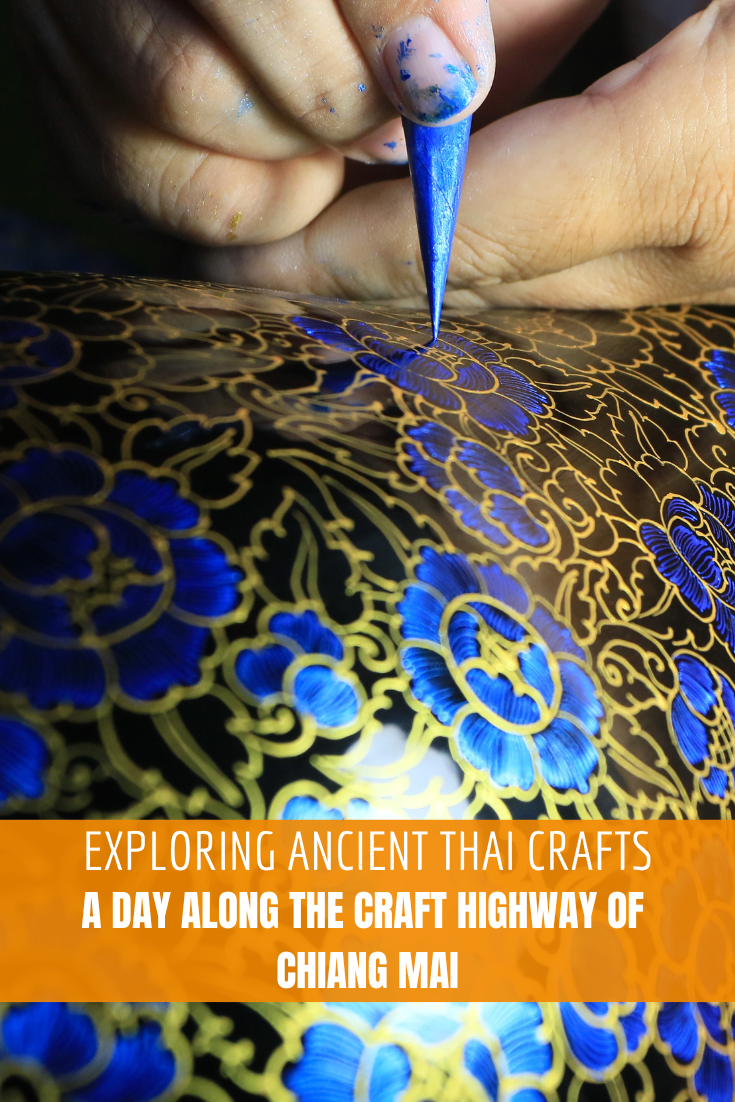
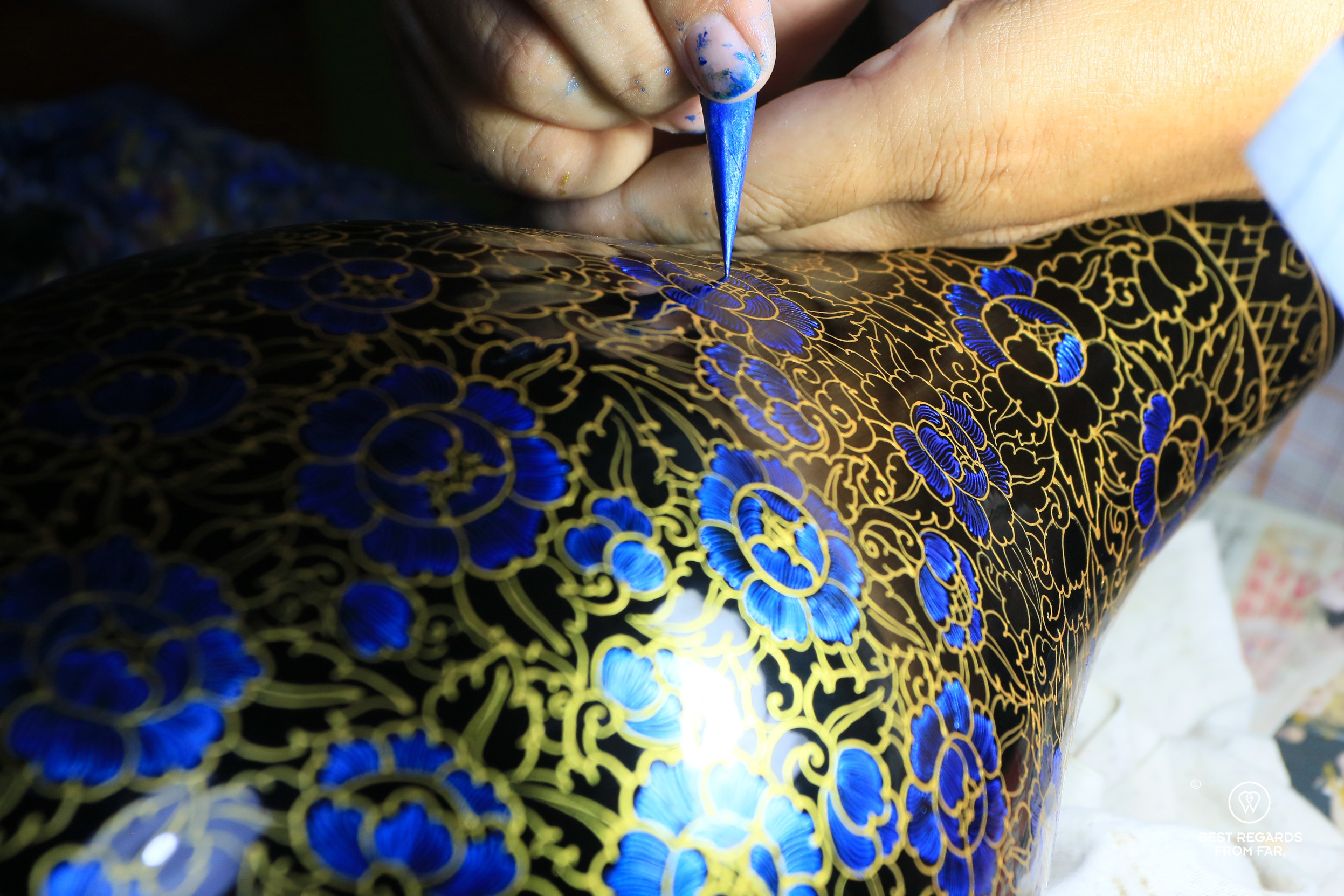
The ancient lacquerware technique appears to date as far back as to the Jōmon people who populated Japan about 9,000 years ago, and would have been introduced to Thailand by Burmese immigrants in the 18th and 19th centuries. In a workshop next to a showroom along San Kamphaeng Road, a skilled craftswoman starts by applying a first layer of lacquer that has to dry for 7 days. And this is only the first of many layers, as a minimum of 7 layers – and sometimes up to 12 layers – is required to get a solid and waterproof product, always with the same drying time in-between applications. The object is then polished with a combination of ash and clay, and later adorned with gold-leaf motifs, Lanna-style hand-painted decorations, or 750-year-old Chiang Mai patterns.
Very traditional in temples and initially limited to ceremonial objects, lacquerware has become stylish and more fashionable for all kinds of trays, bowls, boxes… and even for royal objects as soon as some gold-leaves are added to the decoration as highlighted in the showrooms in the suburb of Chiang Mai.

Celadon ceramics
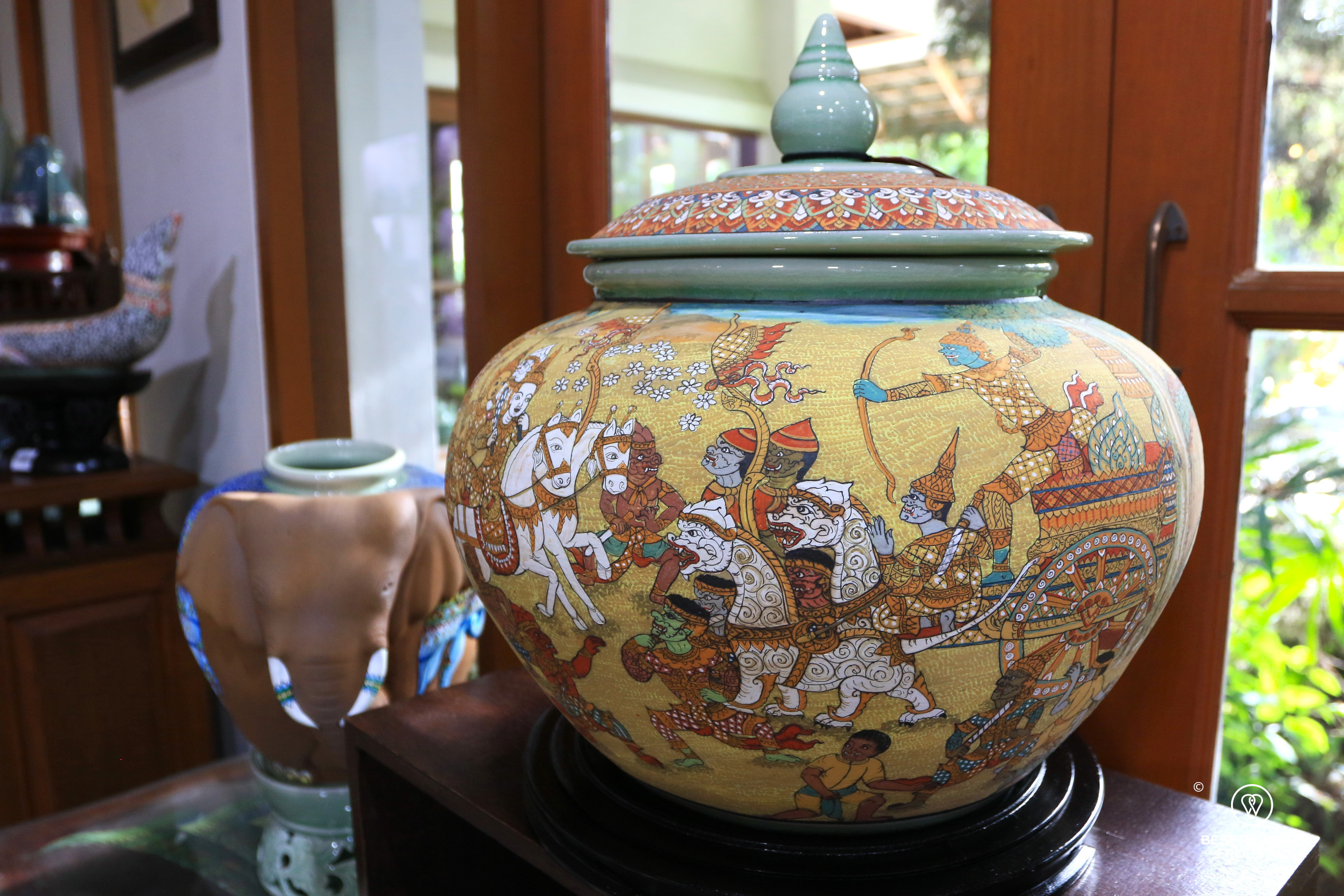
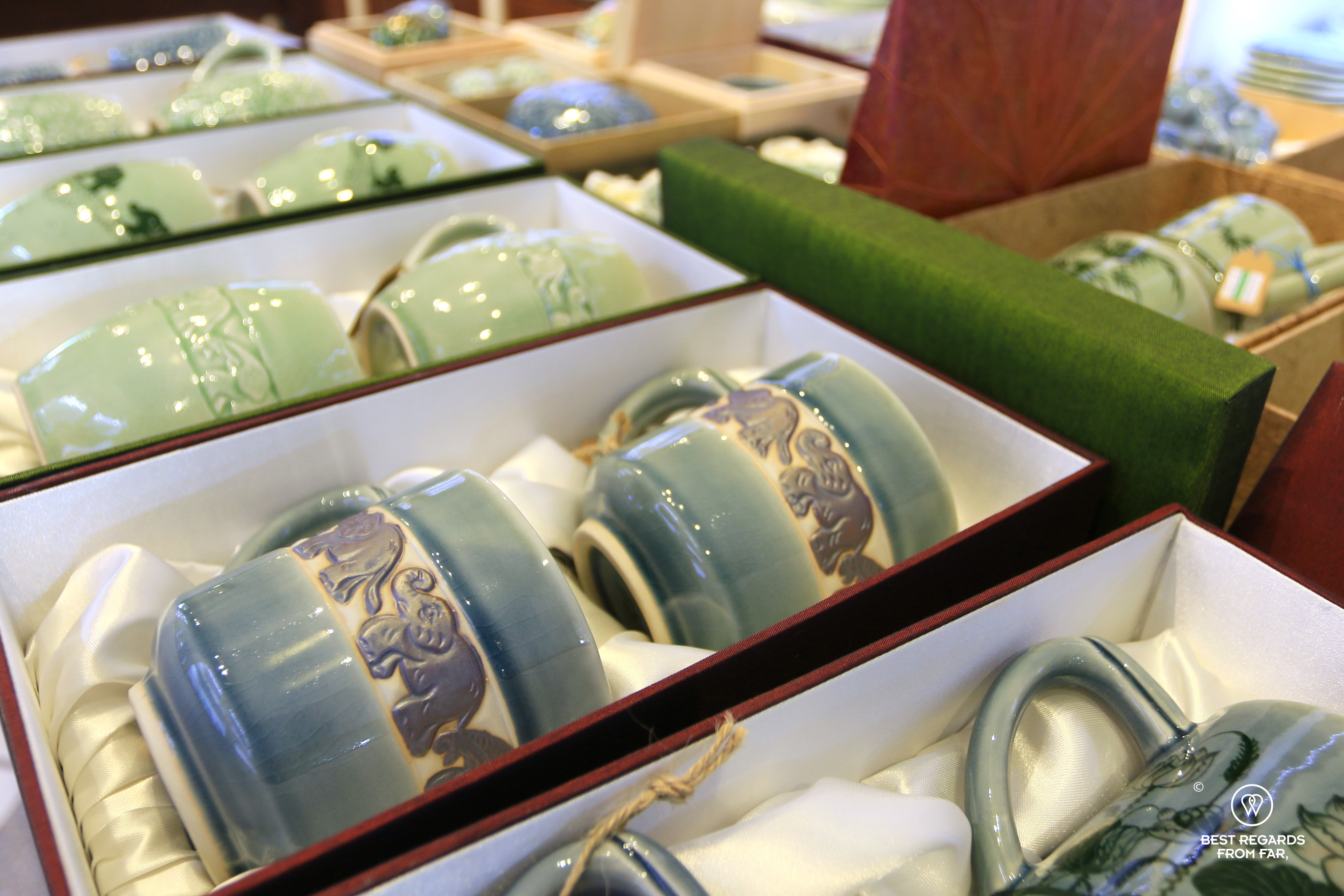
Celadon means green stone, yet the initial colour of the raw material is a black clay from the surroundings of Chiang Mai. Shaped into the desired form either on the pottery wheel or using a mould for the popular elephant designs for instance, it is then air-dried, and the patterns are all carved by hand before being put in an 800-degree centigrade furnace for a first 13-hour heat treatment. The now pinkish object is dipped into a secret potion made of wood ashes of the Overcus belutina tree and minerals such as cobalt or iron to obtain respectively blue or dark green earthenware always recalling the colour of jade of the Celadon ceramics. Another heat treatment at 1,250 degrees centigrade for another 12 hours is followed by a quick cool down, causing the glaze to crack, a sought-after effect to ensure that each item is unique.


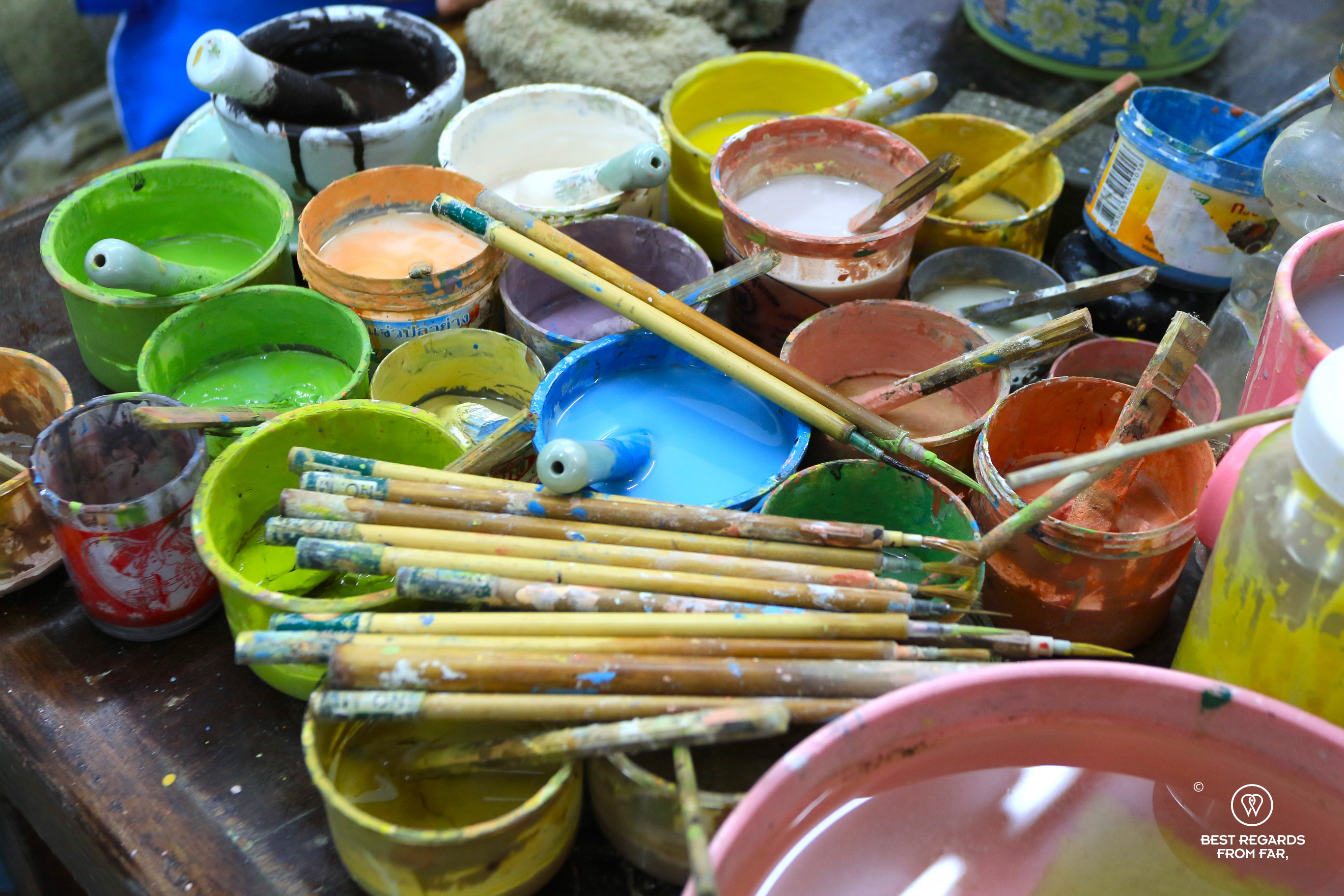
In the workshop of Baan celadon, some older women are extremely focused on the task at hand: they are hand-painting good size vases with delicate floral motifs. The hand steady, they are highly specialised and have been at it for dozens of years. Like for all the other crafts, it is hard to find younger artists to take over. Tons of patience and skills are required to work on these unique pieces that make the pride of the factory.
Silk weaving
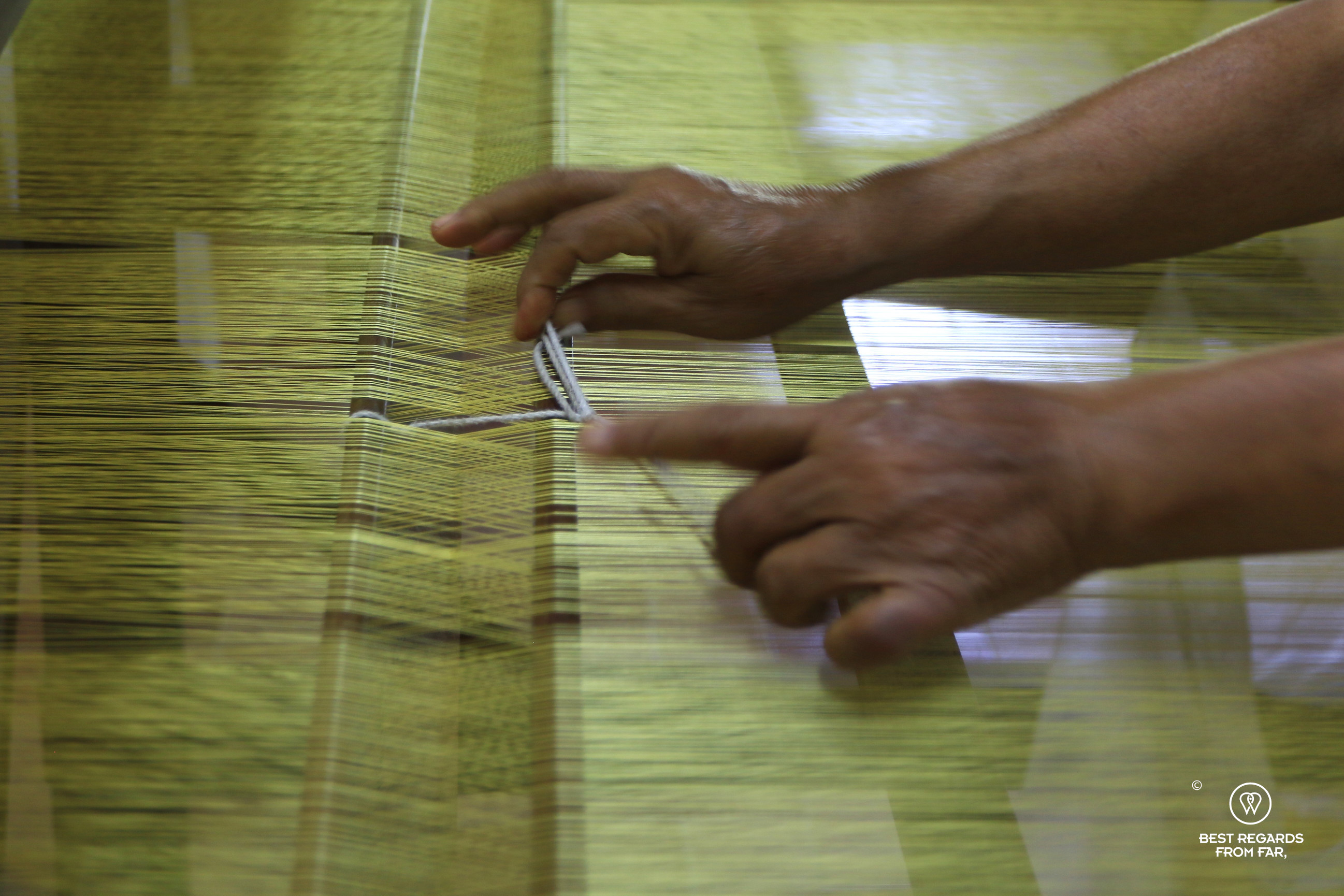
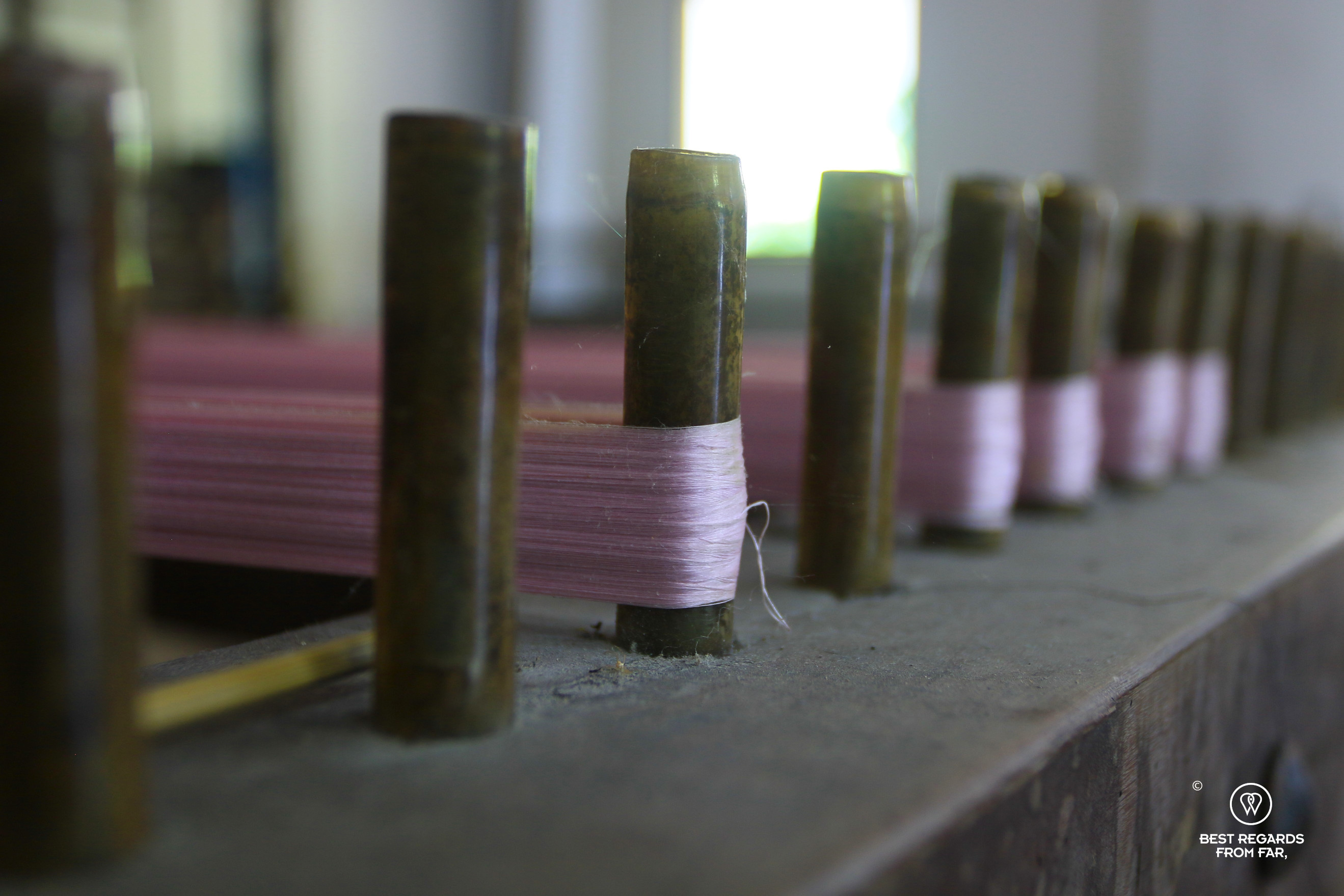
Local manufacturing started about 300 years ago in Thailand and was most likely imported from China where it has been mastered for thousands of years.
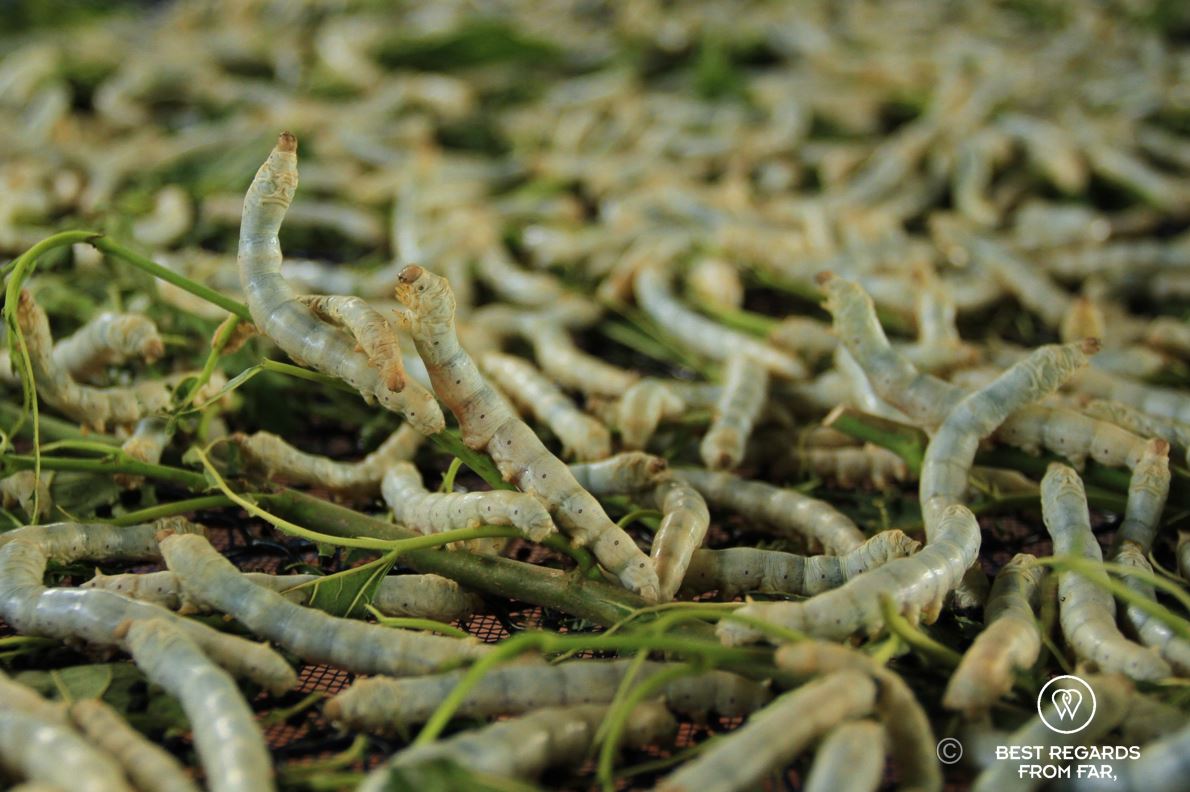

It is thanks to the involvement of the American silk magnate Jim Thompson (and probable spy with a spooky story) who revived the Thai silk industry after the Second World War creating the Thai Silk Company in 1948, and the royal support of Queen Sikirit in the 1970’s that the Thai silk not only survived but became reputed. Today, Thai silk remains one of the most sought-after souvenir for visitors to Thailand. The Chiang Mai area is home to a good number of factories, often with showrooms and also some explanations detailing the manufacturing process.
For more about this process, as well as a very inspiring success story, check out this article about Golden Silk in Cambodia!

***
If the know-how of all these centennial (if not millennial) crafts has survived, it seems to be at risk like never before as young generations show no interest at all in carrying on. In every workshop, old men with creased hands have the same attitude when asked about the future: the light of pride in their eyes switches off and the smile fades away, sadness appears. Often in a broken English and some hand signs, they make it clear that we are looking at the last generation at work. If there is a bit of hope, it may be coming from Myanmar from where some skilled artisans may try to escape insurgencies and civil war for a better life…
Travel tips:
- If you happen to be visiting Chiang Mai during the third weekend in January, the Bo Sang Umbrella & San Kamphaeng Handicrafts Fair is held each year, where all the local artisans compete to see who can make and decorate the best products.
- The best way to get around to discover these gems is to be autonomous by scooter, allowing easy stops along San Kamphaeng Road. To rent a scooter, Cat Motors is a serious and reliable company in the heart of Chiang Mai.
- Check out this interactive map for the specific details to help you plan your trip and more articles and photos (zoom out) about the area:
 Best regards from far,
Fantastic article! I wish I had seen all of this!Sent from my iPhone
Thanks! Yes, it is quite off the beaten path and unfortunately easy to miss. Maybe next time! Thanks for your read.