Article updated July 28, 2025
Text: Claire Lessiau
Photographs: Claire Lessiau & Marcella van Alphen
While natural rubber had been paramount to the wealth of several Southeast Asian countries such as Thailand, Indonesia and Malaysia, it had nothing to do there in the first place! Natural rubber is tapped from the Hevea brasiliensis tree that is endemic to South America…
In 1876, the British Sir Henry Wickham smuggled 70,000 Hevea brasilinesis seeds from the Brazilian rainforest to the Royal Botanical Gardens at Kew in London. Of these, only slightly over 2,000 germinated and were taken all over the British Empire. They arrived in Ceylon in 1877 and were taken to other countries of Southeast Asia. Some of these rubber tree seedlings arrived in Malaya (today’s Malaysia) to be planted. Thanks to its favourable environment and climate, the tree quickly flourished and by the 20th century large-scale plantations of rubber trees had become an integral part of the Malayan economy.
Today, tall thin trees with only very few leafs planted in perfectly aligned endless rows covering large areas of soil are a common sight in Southeast Asia. The rubber trees provide a little bit of shade during the hot summer months, give off a slightly offending smell and supply the farmers with an income.
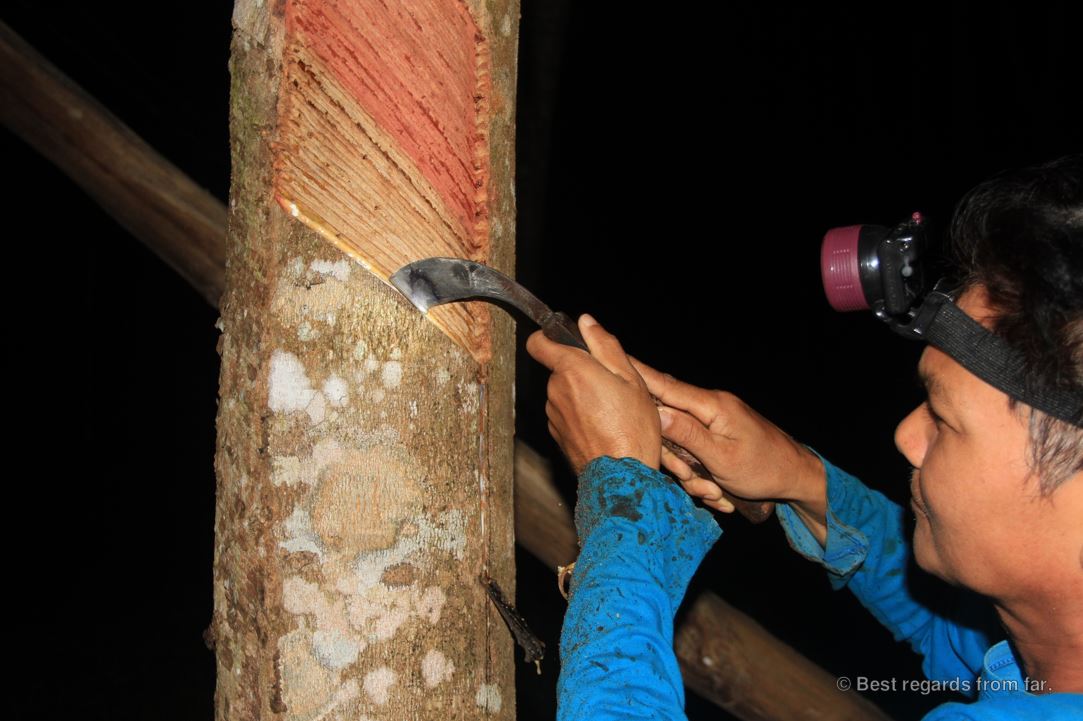
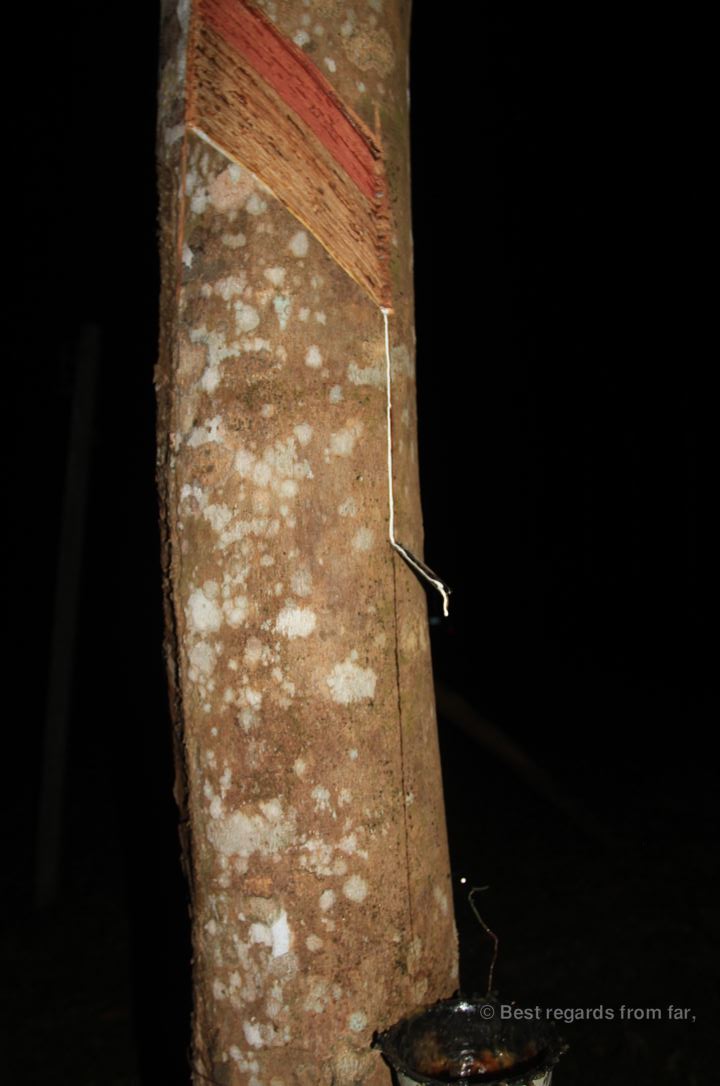
It is after sunset that the rubber tree plantations come alive. Not only is it easier to work when the temperatures are a bit cooler, but more importantly the coolness of the night impacts the viscosity of the latex that flows better thus improving the yield.
Cutting the bark of the tree to tap latex without damaging the tree too much is a precise work. Circular slits are carved around part of the tree trunk. A special tapping knife is used to shave off the thinnest possible layer from the intact section of bark. Care must be taken not to cut too deep, nor too thick as this will reduce the productive life of the tree. If done skilfully, a tapping panel will yield latex for up to 5 years while each tree can produce latex for up to 30 years.
An eight-millimetre deep and a rough 30-centimetre long incision is made along a spiral shape just underneath the cut of the previous day. The viscous white liquid slowly drips into a cup attached to the tree for about four hours until the cut has healed itself.
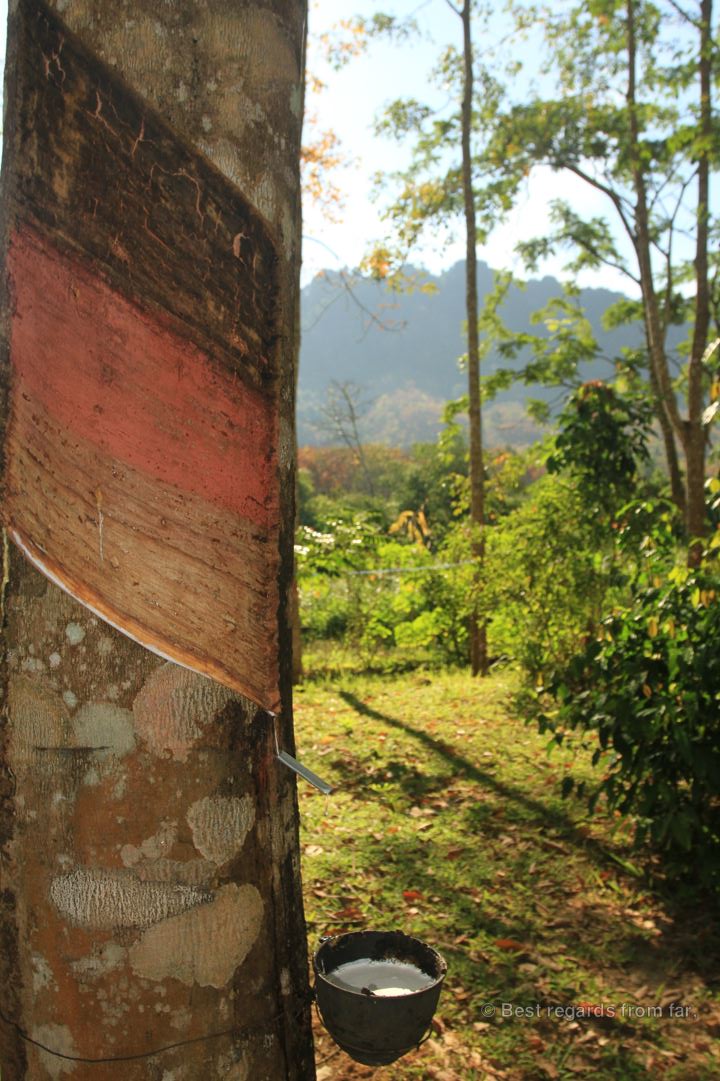
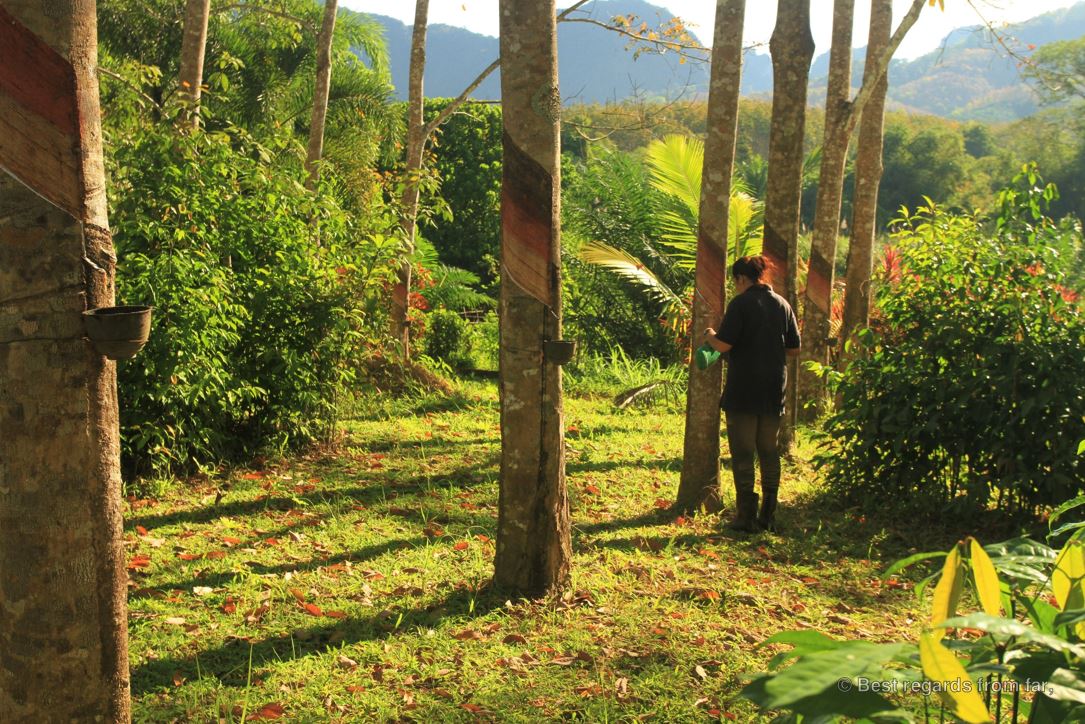
In the morning, the rubber tappers return to collect the container. There are different ways of collecting the latex once it has dropped into the cup based on the desired end-product. Some gather the viscous liquid by adding ammonia to prevent its coagulation for rubber sheets or dipped-rubber products, while others collect a rubber clump.
The latex is then brought and sold to the rubber processing plant for further treatments. In its original form, latex is easily affected by temperature, light and chemical reactions: various treatments are applied to strengthen it and waterproof it before the rubber is shaped into the desired form to serve its purpose. In the final stage, the rubber is heated to about 150°C and mixed with sulphur – this is the vulcanisation process – in order to reach the utmost endurance.
If it is the boom of the automotive industry between 1910 and 1925 that led to the peak of the natural rubber production and the synthesis of rubber, the automotive sector remains its largest consumer as it enters in the manufacturing of not only tyres, but also hoses, seals, gaskets, belts, and airbags. Other applications include the aerospace industry, construction, footwear, sporting goods household items, healthcare and also electronics and telecommunication where rubber is used as insulating material and also for vibration control. Natural rubber is preferred for its elasticity, durability, and biodegradability making it often a choice for the medical industry and condoms while its American cousin enters in the composition of organic and natural chewing gum.
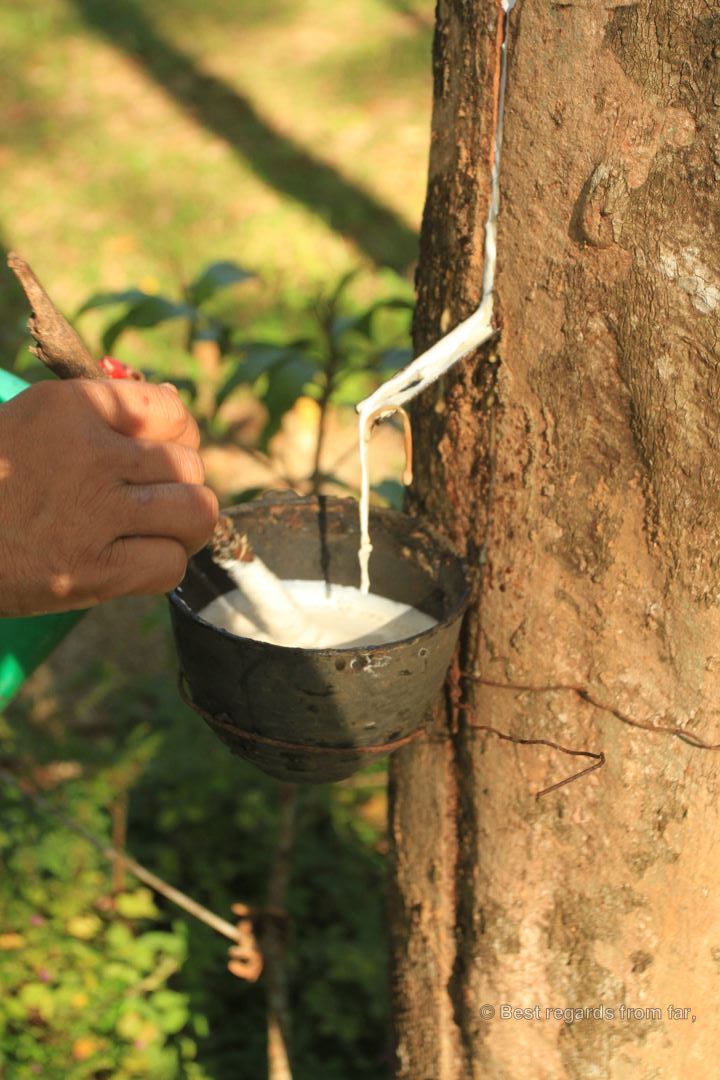
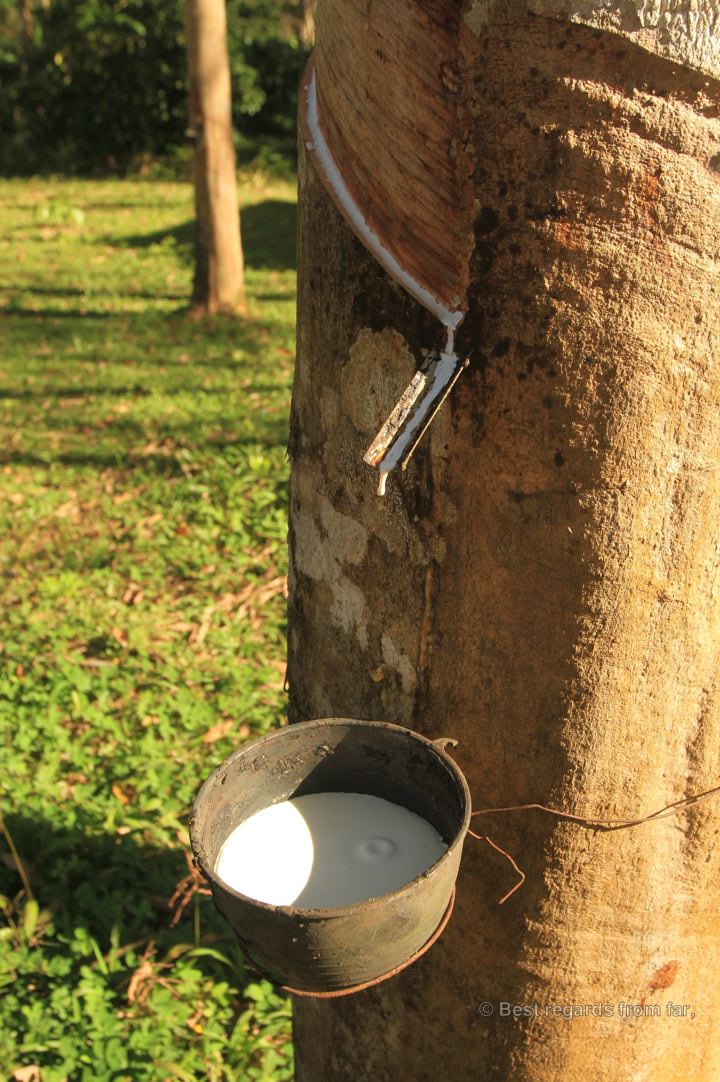
To this day, and despite synthetic rubber, natural rubber remains a significant income for many farmers in Southeast Asia. Since World War One, rubber had been one of the main contributors to the Malaysian economy and Malaysia is still among the world’s top 10 of natural rubber producing nations, accounting for almost 20 percent of the world’s natural rubber. Thailand has become the leading producer and exporter of natural rubber, but over the last few years the prices for natural rubber have decreased dramatically, affecting about two million people in Thailand who have struggled to make a living. Due to the oversupply of natural rubber and the rising demand for synthetic petroleum-based rubbers, many rubber farmers expand into the more profitable oil palm plantation with a dramatic impact on the rainforest.Tall thin trees with only very few leafs are planted in perfectly aligned endless rows that cover hundreds of hectares of Thai soil. They provide a little bit of shade during the hot summer months, give off a slightly offending smell and supply their owners and their farmers with an income. We are talking rubber trees and are about to discover the ins and outs of rubber making.
For more, click on these images:


 Best regards from far,
Interesting. Have to admit I thought natural rubber was a thing of the past. Presumed it was all a mixture of chemicals by now. Do my motorcycle tyres still come from trees 🌲? Good read.
Thanks! Not sure for your motorcycle, but natural rubber is used a lot in the transportation industry (race car tyres, truck, planes) for its superior tear strength and resistance to heat. With synthetic tending to take the main stage it is nice to see that natural ways are still there or coming back, just like chicle in Central America (https://bestregardsfromfar.com/2016/01/01/preserving-rainforest-chicle/).
When we were in Chiang Mai, we met folks who shared with us how the farmers had cleared so much forest to plant rubber, unfortunately to detrimental to bio diversity!