Text: Marcella van Alphen
Photographs: Marcella van Alphen & Claire Lessiau
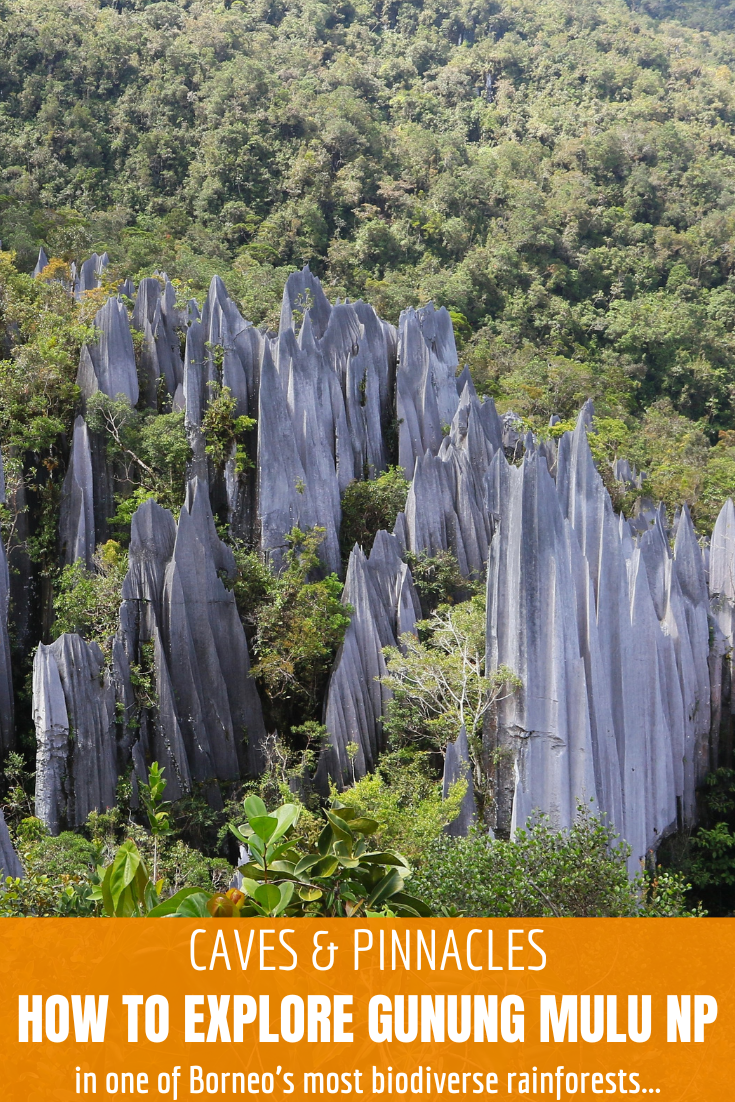
Situated on the Malaysian part of Borneo between Indonesia and the small country of Brunei, lies a pristine gem for wildlife fanatics, archaeologists and adventurers alike; the remote Gunung Mulu National Park. Far from the oil palm plantations that seem to have taken over large parts of Borneo, the park’s vast cave systems, amongst the largest in the world, stunning pinnacles, scenic rivers towered by limestone formations, rich biodiversity in a mountainous primary rainforest, and UNESCO World Heritage status has caught the attention of travellers in the know…
Pin it for later!
A staggering biodiversity
If a rainforest is already very biodiverse by itself with an average of more than 480 different tree species per hectare, compared to 10 tree species on the same area for a temperate forest, Mulu takes it to the next level. Thanks to a wide altitude range from 35 metres (114 ft.) to 2,376 metres (7,795 ft.), the 52,865-hectare-park (130,632 acres) is a biodiversity heaven. These various altitudes imply vast temperature gradients leading to 17 different forest types such as dipterocarp, peat swamp, kerangas, and montane forest. Beyond the scientific terms, in a nutshell, the variety of forest habitats of Mulu NP hosts an extremely biodiverse flora and fauna.
Maybe counterintuitively, the rainforest is actually quite poor in nutrients as they are constantly washed away by the rain and species compete fiercely under the trees, and some have adapted greatly with fascinating strategies. Gunung Mulu National Park counts 270 different species of birds, 80 of mammals, 50 of reptiles, 75 of amphibians, 1,500 types of flowering plants, and an impressive 20,000 insect species!


World’s largest cave opening [& its bat exodus]
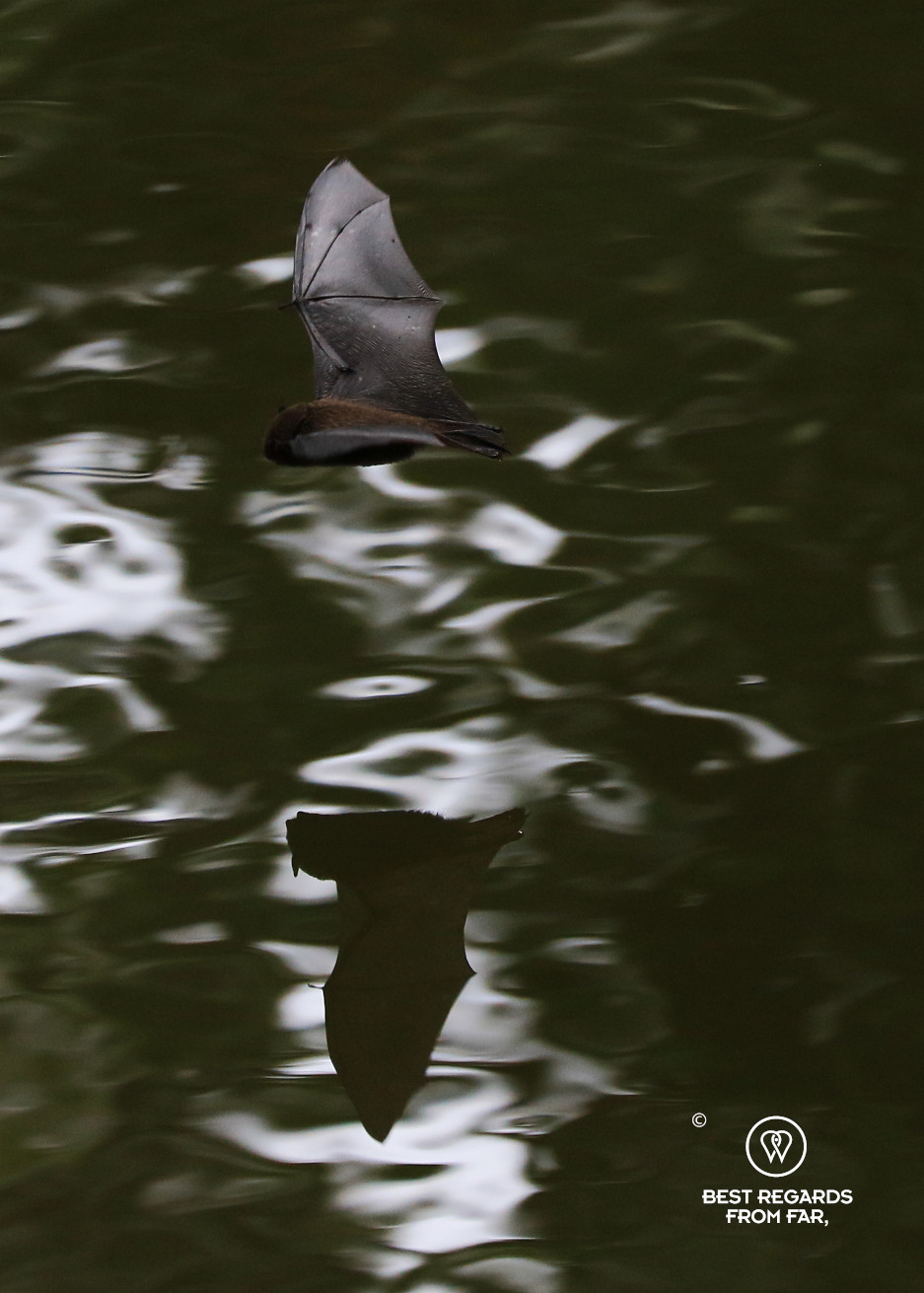
It is no coincidence that with such an amount of insects living around world’s largest cave opening, 12 different bat species totalling millions of bats have taken residence on the ceiling of the Deer Cave.
As a logic consequence, thick piles of guano cover the cave floor that we carefully navigate trying to omit the offending smell. The brown mineral-rich substance attracts deer that lick the guano to complete their diet with the necessary salts, hence the name of the cave. It has been a shelter for deer, amphibians, and reptiles alike as excavations have shown.
The nearby Lang’s Cave, known for its stalagmites and stalactites proves to be a perfect shelter for us during one of those tropical rainstorms that starts as soon as we enter. At least 2,000 millimetres (79in) of annual rainfall is required for a rainforest to be called as such, and here in Mulu the number is double, making it a very proper and well-named rainforest! Over the past millions of years, it is the rainwater that has shaped these spectacular caves and passages by slowly eroding the limestone.
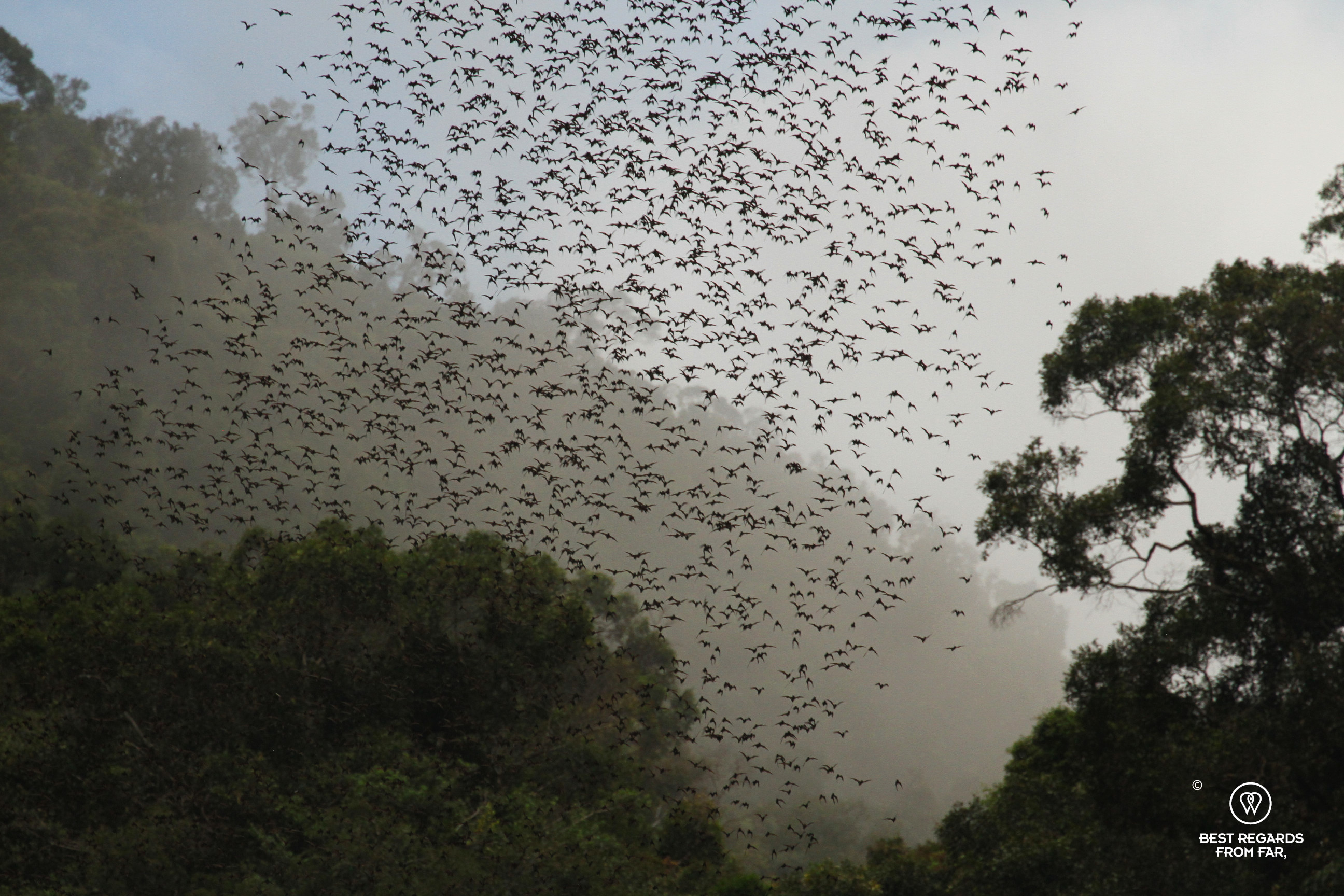
The daily rain shower has passed when we step back into the rainforest to attend a natural spectacle. The wrinkle-lipped bats that we have previously witnessed hanging upside down on the cave ceiling are about to wake up. That is about 3 million of them that are ready to fly over the forest in search for food. By the thousands, the bats leave the cave, forming figures in the air, navigating in one coordinated dance to confuse raptors. Together they will eat about 30 tonnes of insects tonight, each consuming two thirds of its weight every night!


The Clearwater Cave & its research value
The intricate cave formations in the park are many and require multiple days to be enjoyed to the fullest. The presence of wind inside the Wind Cave not only delicately shapes the rocks but also betrays its connection to other caves such at the Clearwater Cave of which we explore only a fraction of its 250-kilometre-long system (155 miles), world’s 7th largest at the time of writing and that is still being explored and mapped. Apart from a fun playground for speleologists, the caves of Mulu are a paradise for researchers as they offer valuable insights into our planet’s history. They provide clues about the cave’s age while sediments reveal past climates and fossilized animal bones show how climate change has affected local vegetation.


Yet, the spectacular cave systems is not what has drawn us so deep into the jungle of Gunung Mulu NP…
The Pinnacles: Borneo’s most breath-taking view & most exhilarating hike!
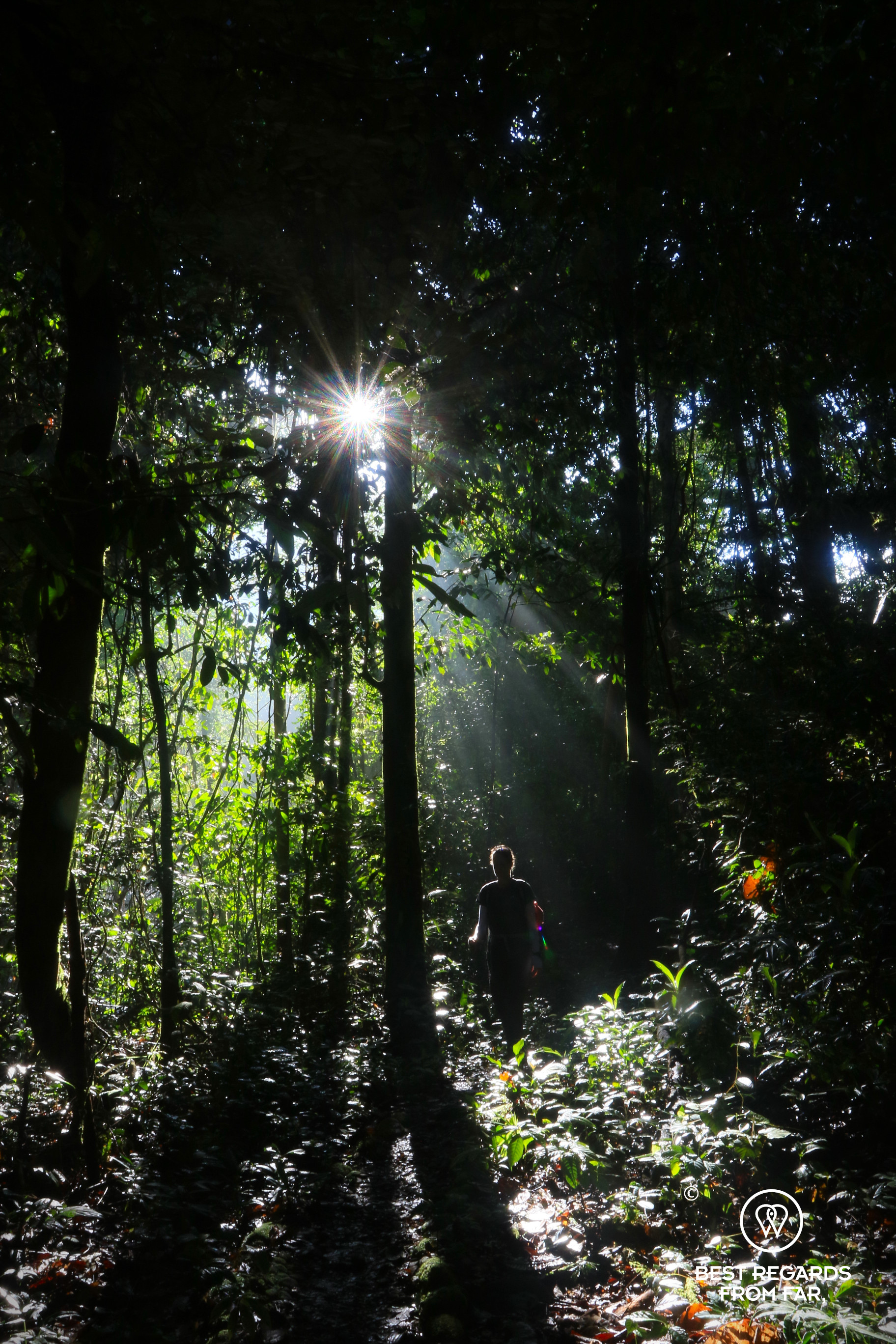
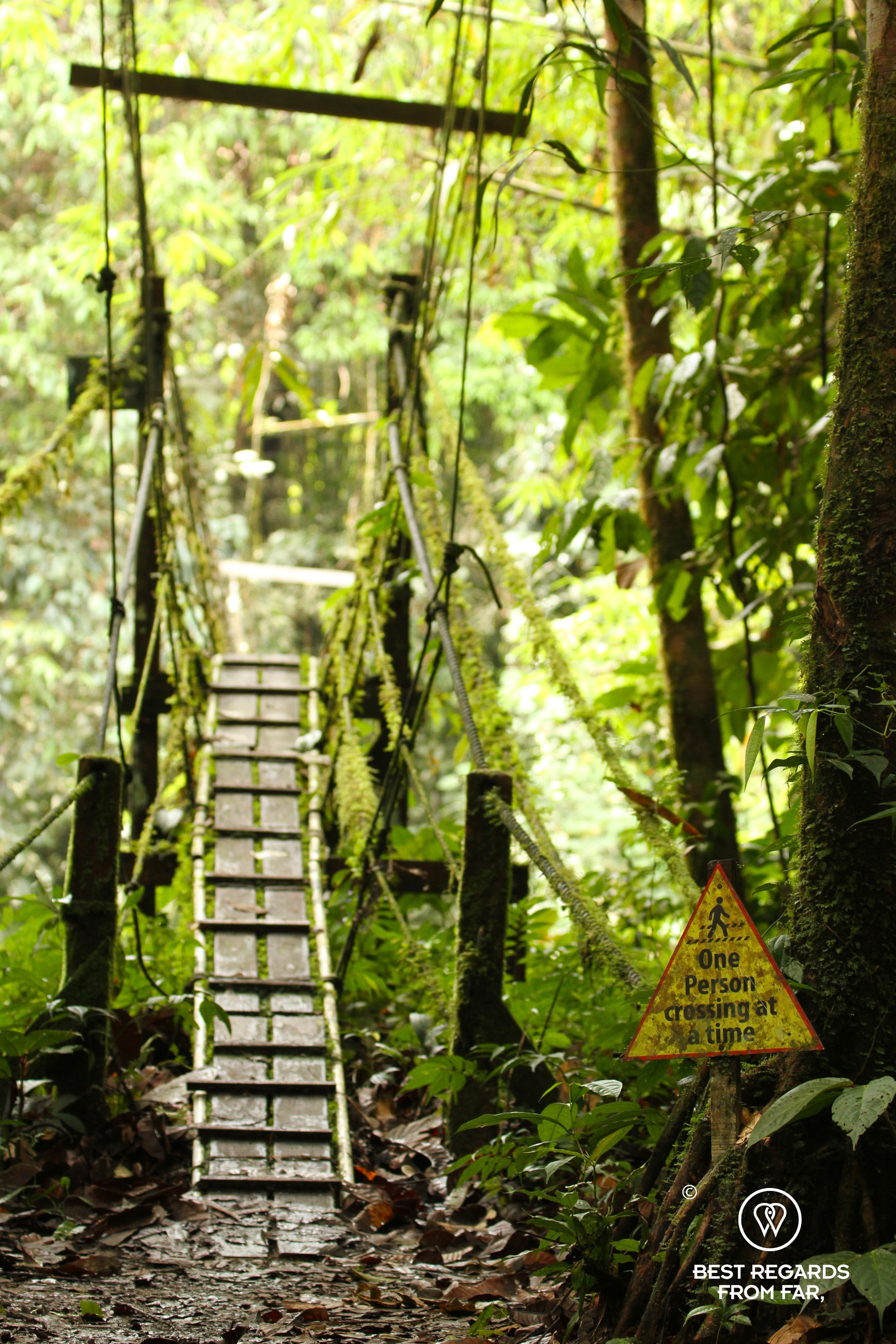
It is 5 a.m. The dense rainforest of Gunung Mulu National Park is still cloaked in darkness. As nocturnal creatures make their way home, we emerge from our liners and step out of our mosquito net at Camp 5 where we arrived the night before after a long-tail boat ride on the spectacular Melinau River towered by limestone formations and lined by trees linked by lianas. Then, a 3-hour jungle trek crossing wide rivers on suspension bridges led by our passionate guide Larry Siga took us to camp. A satisfying dinner cooked by Larry with fresh and foraged ingredients to the sounds of the forest was all we needed for a short night before the real adventure began.


As we slowly emerge from our sleep, having spent an hour in the kitchen already, Larry greets us with a big smile and maybe more critical at this specific moment, freshly brewed coffee and a hearty breakfast that he has prepared with care. “Please, eat. You will need the strength for today’s challenging climb up to see the iconic Pinnacles,” he says in his deep, gentle voice.
The hike to the pinnacles is renowned for its technical difficulty rather than its distance (a mere 5km (3 miles)) or elevation (even though 1,300 metres (4,265 ft.) of positive elevation should always be taken with humility). The terrain can be treacherously slippery due to the rainforest’s constant humidity and rain. Larry has completed this hike over 500 times and leads us competently while enthusiastically sharing his wealth of knowledge about medicinal and edible plants and his life as the eldest son of the chief of the local Tabun tribe of Limbang, a village located at the end of the Mulu NP’s Head Hunter trail.
After a long and challenging hike up through the dense montane forest, the last stretch that is not for the faint of heart starts. The fun and technical climb involving ropes, staples, and shaky ladders thrown horizontally over deep crevasses eventually leads us to the dramatic pinnacles!


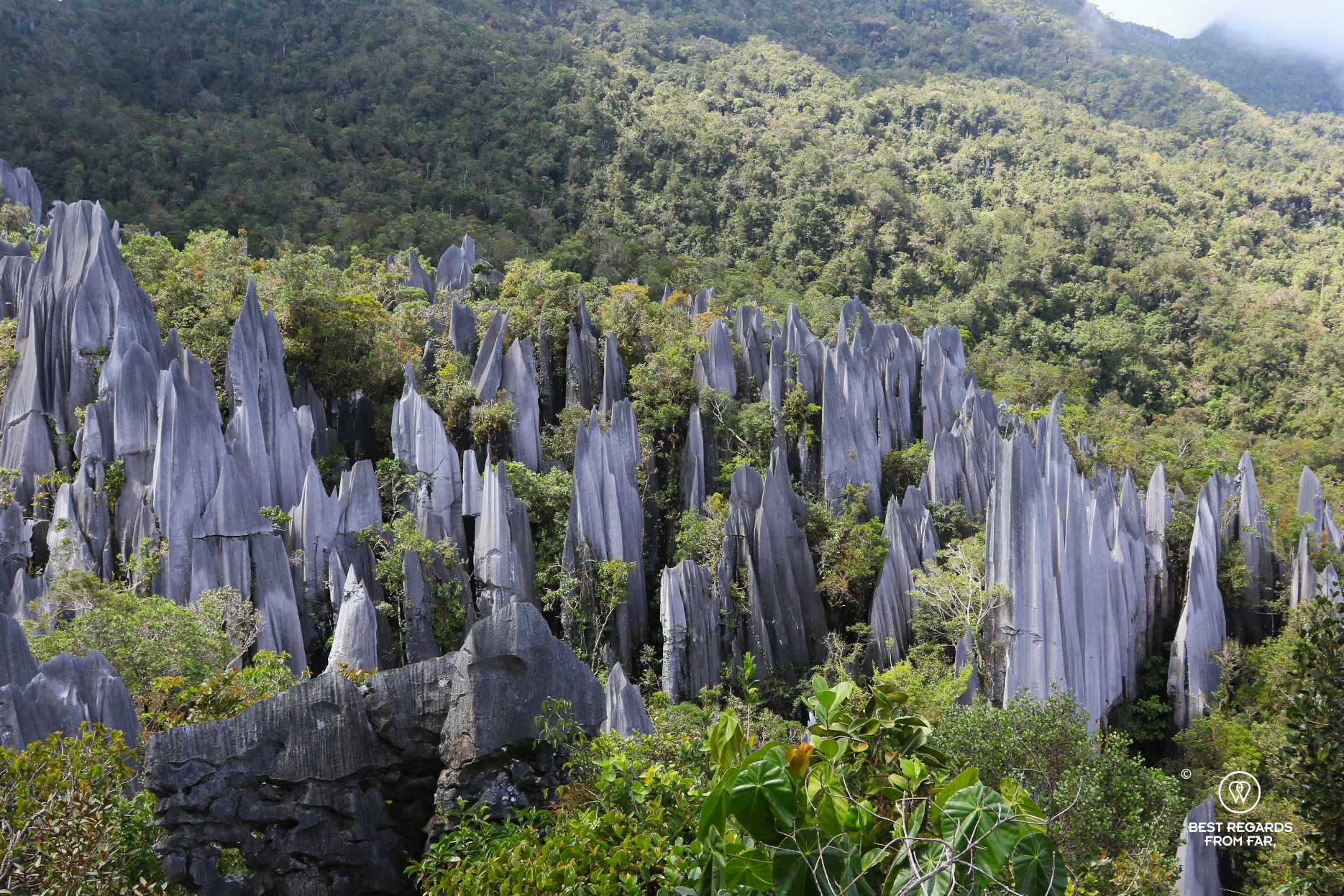
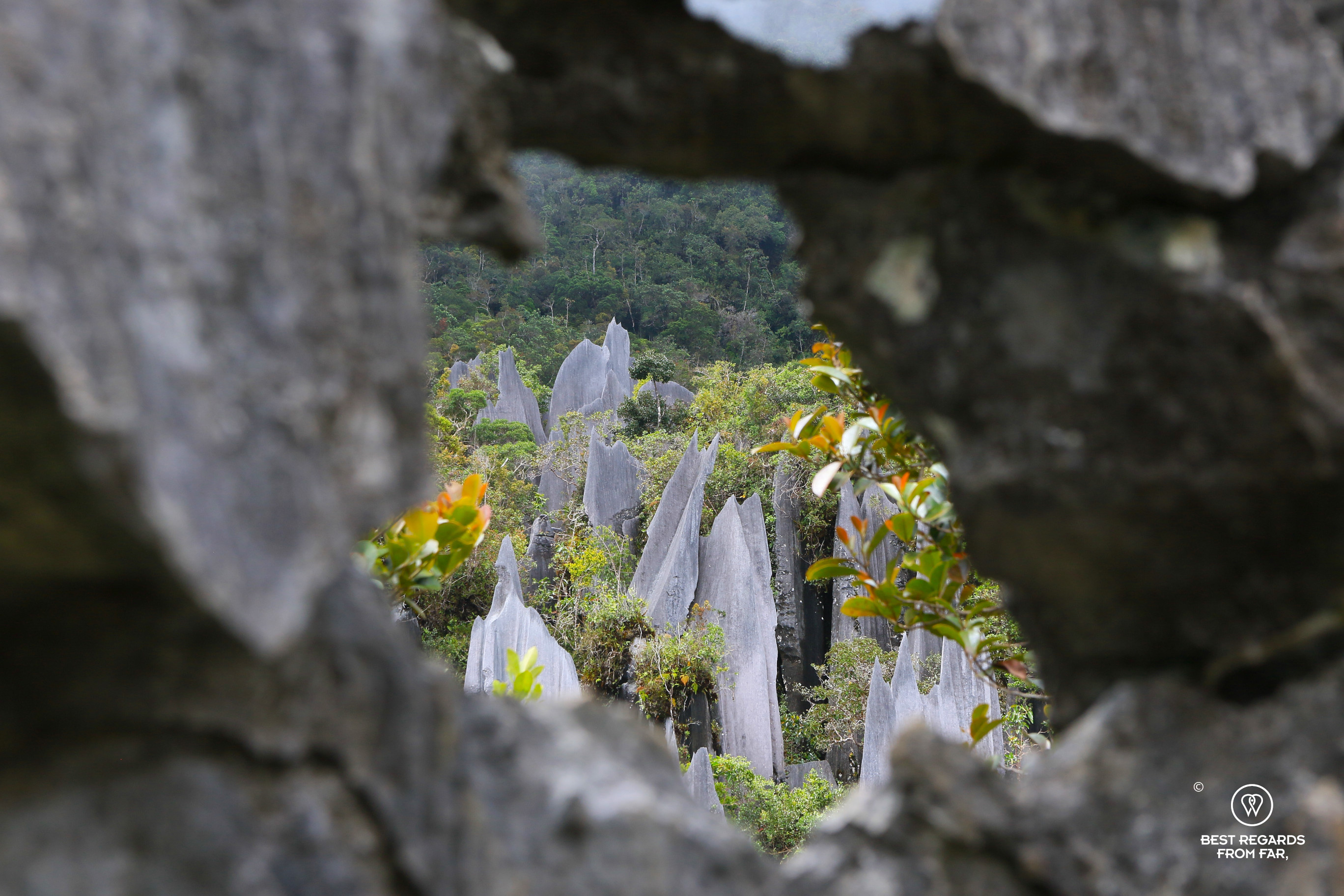
The sight of these sharp limestone formations reaching for the sky is simply breath-taking and a reward for the multiple-day journey. We take in the view of the unique rock formations that started to be shaped millions of years ago when the limestone emerged from the seabed sediment. It was pushed up by tectonic forces and then sculpted by rainwater into the delicate and sharp needles we see today.
The way down turns out to be more challenging than up as one of these rainforest showers catches up on us and turns the trekking adventures into a canyoning expedition! The terrain is extremely slippery between rocks and roots and one misstep could lead to a fall on the sharp limestone ridges potentially causing serious injuries.



It is mid-afternoon when we make it back to Camp 5 where we bathe in the river and rinse our already soaked clothes as the sun breaks through. Part of trekking in the rainforest is accepting to not ever get completely dry. It does not mean that we do not try in the sun while Larry is preparing his specialty for dinner: steamed krabu fern that he foraged with a healthy salad version of the wild plant, and a delicious BBQ chicken with a ginger and pineapple sauce. Dinner at camp turns into a feast to celebrate today’s unforgettable adventure.
***
Exploring Mulu’s Pinnacles and diverse caves is an adventure into the heart of one of Borneo’s most biodiverse and geologically fascinating regions. With guides like Larry, who embody the spirit of the rainforest and its indigenous people, this adventure is not just about witnessing the natural beauty of the rainforest but also understanding and appreciating the deep connections between the land, the wildlife and its people. Gunung Mulu National Park has only revealed some of its secrets to us and scientific research is ongoing to uncover more of its hidden gems deep inside the wilderness of Borneo.
Travel tips:
- The easiest way to reach Gunung Mulu NP is to fly in Mulu airport.
- The Pinnacles hike requires a guide and the passionate Larry Siga (WhatsApp: +60178503666, mulujungleguide@gmail.com) is an experienced Sarawak Park having guided in Mulu since 1995, and reliable, with a great English. Make sure to book ahead of time as your guide also needs to book the limited spots at camp with the park authorities. Homestays in his village are also possible.
- The Pinnacles hike is better enjoyed spending 2 nights at Camp 5.
- Other hikes such as continuing to Larry’s village along the head-hunters trail are also an option.
- A guide is required to visit the caves.
- There is a wide range of park accommodation for all budgets and the upper end is quite comfortable and perfectly located in the park. It is your best bet!
- As arranging park accommodation online and guides onsite can be cumbersome, Borneo Adventure is an award-winning tour operator that is ideal to set up your Mulu adventure and arrange the ideal itinerary from airport pick up to drop off.
- Bring contention socks with you: they work really well to prevent leeches from sucking your blood!
- Check out our interactive map for more in the area (black pins lead to an article):
For more in Malaysia, click on the images below:



 Best regards from far,