Article updated on December 27, 2024
Text & Photographs: Marcella van Alphen & Claire Lessiau
“You’re going to Preah Vihear? All the way up in the Dângrêk Mountains? On a scooter? By yourselves? Wow… do you even know the road?”
With wide smiles and our small backpacks slung over our shoulders, we exchange glances with the friendly young woman at our Siem Reap scooter rental, who is clearly both intrigued and concerned. She eyes our 120cc scooter, her expression deepening into a frown. “Whatever you do once you reach the foot of the temple, don’t drive your scooter up there—it’s too steep!” she warns. “Be careful, and enjoy!”
We smile, wave, and take off. But deep down, we know that exploring Preah Vihear will not be a typical temple visit. Situated in a remote corner of Cambodia, it is not only challenging to access but also far removed from the hordes of tourists who all flock to the must-visit Angkor Wat. A site of intense military tensions between the Cambodian and Thai armies in 2008 as both countries have been claiming the temple, Preah Vihear remains relatively untouched and cloaked in mystery, making it all the more appealing to adventurous travelers.
Pin this article for later!
A Temple on the Edge of the World
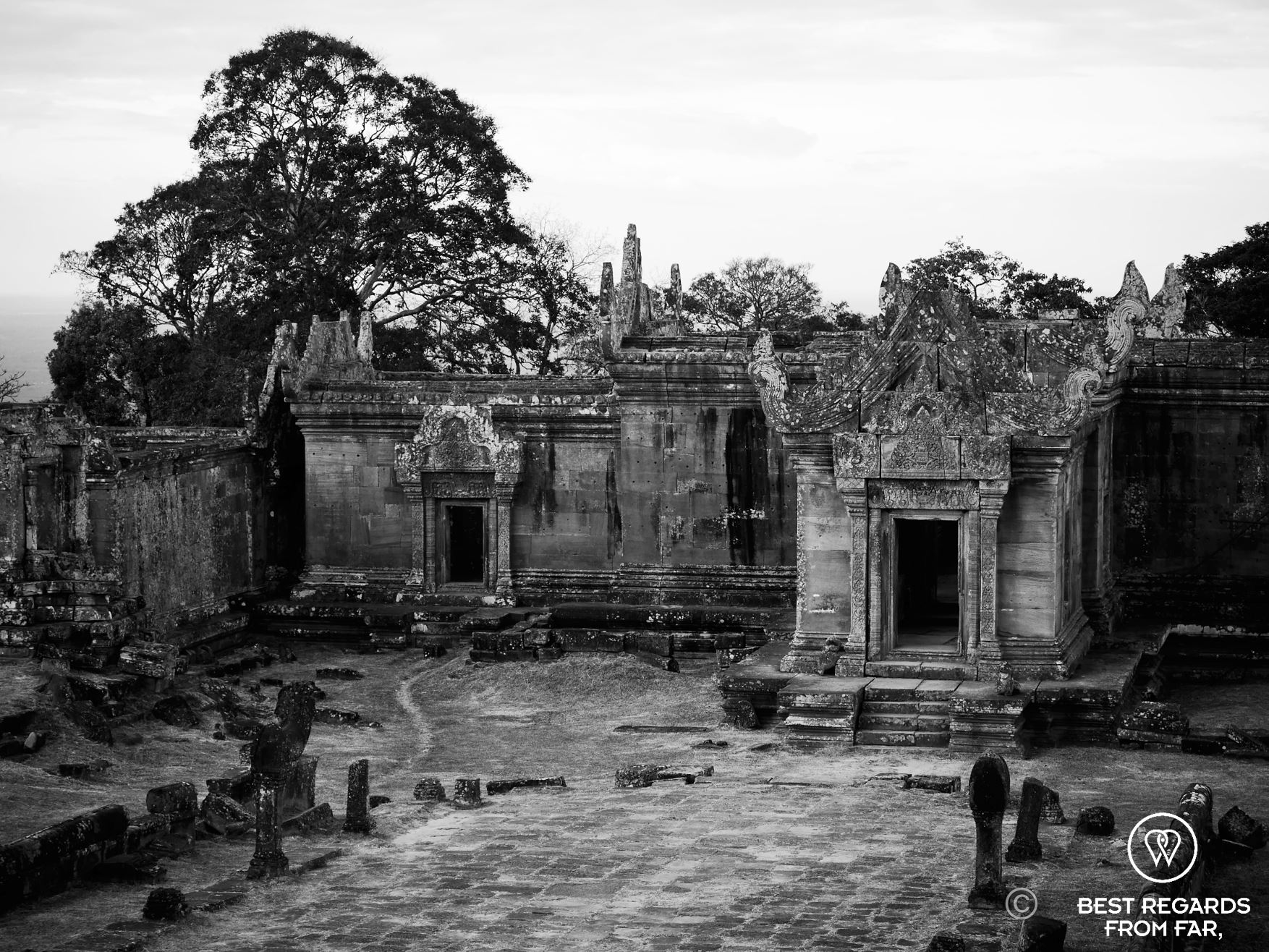
Preah Vihear, an awe-inspiring temple dedicated to the Hindu deity Shiva, stands on the edge of a dramatic cliff more than 500 meters above the plains of northern Cambodia. From its ancient stairways to its serene courtyards and sanctuaries, the mysterious temple sprawls along an 800-meter axis.
Although its foundations date back to the 9th century, Preah Vihear was built primarily during the 11th and 12th centuries under Kings Suryavarman I and II—the great builders of the Angkor temples. It is a true a masterpiece of Khmer architecture. Famous for its intricate stone carvings, its uniqueness resides in its harmonious integration with its surrounding landscape, defying the conventional construction norms of its time. Like Angkor Wat that represents the earthly home of the gods, Preah Vihear is modeled after the sacred Mount Meru, the mythical center of the universe.
Though originally a Hindu sanctuary, Preah Vihear, like many Khmer temples, was later converted to Buddhism: the blend of both religions only adds to the temple’s mystique, a reminder of Cambodia’s complex spiritual and political past.


The Challenging Road to Preah Vihear
“Let’s fuel up at the next village!” I shout over the roar of our scooter engine, which seems to be struggling to keep up with the steep incline of Route 67. The day has been long—two hours and 100 kilometers of winding roads, passing sleepy villages, silk farms, and the occasional herd of chickens. The heat is oppressive, the smell of drying taro roots on the burning hot asphalt thick in the air as we speed past.
We stop at a local gas station, and two young girls run inside the attached house to fetch their brothers. They watch us curiously, giggling as we top off our fuel, before waving us off enthusiastically. We are about half-way.
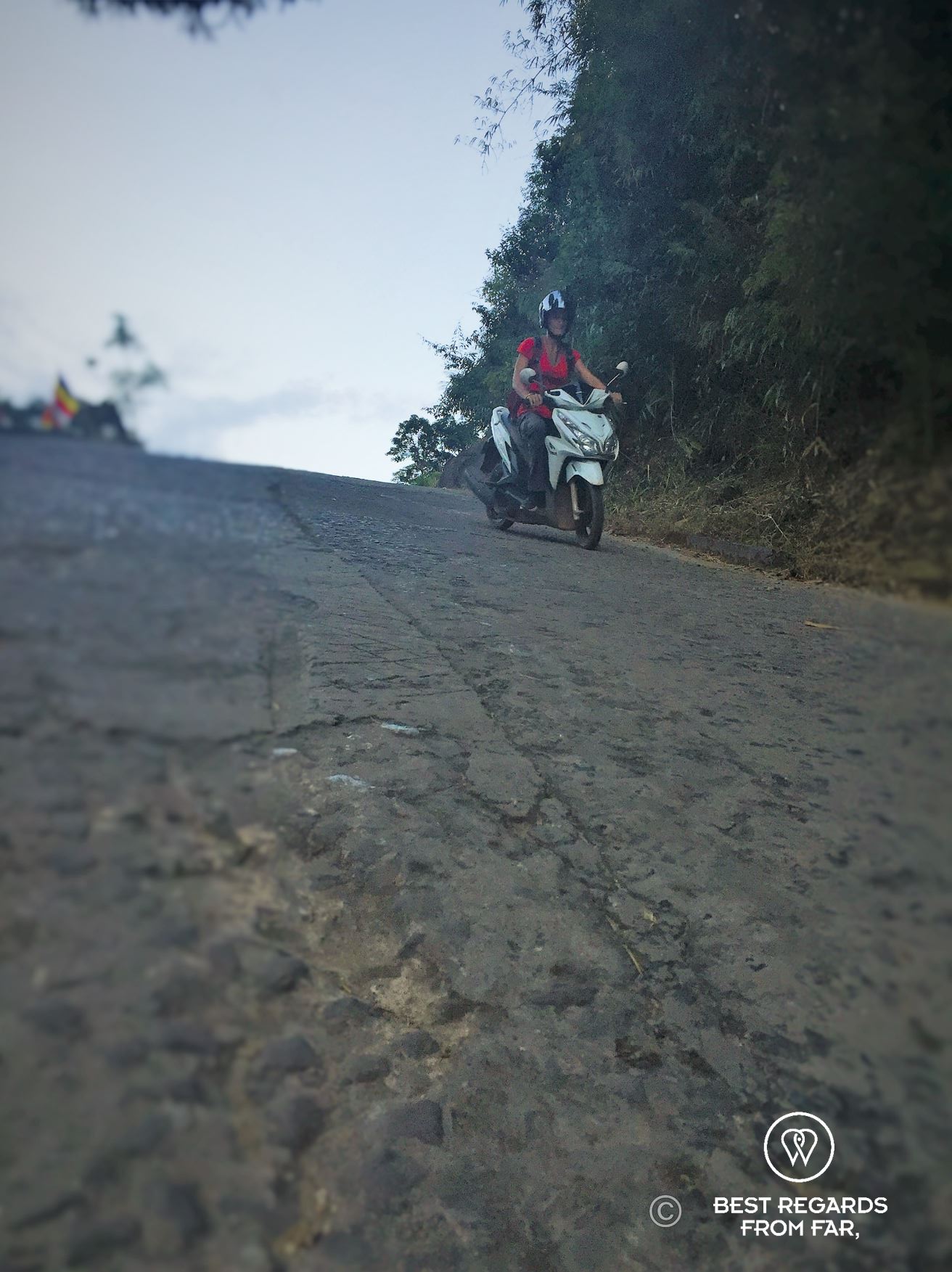
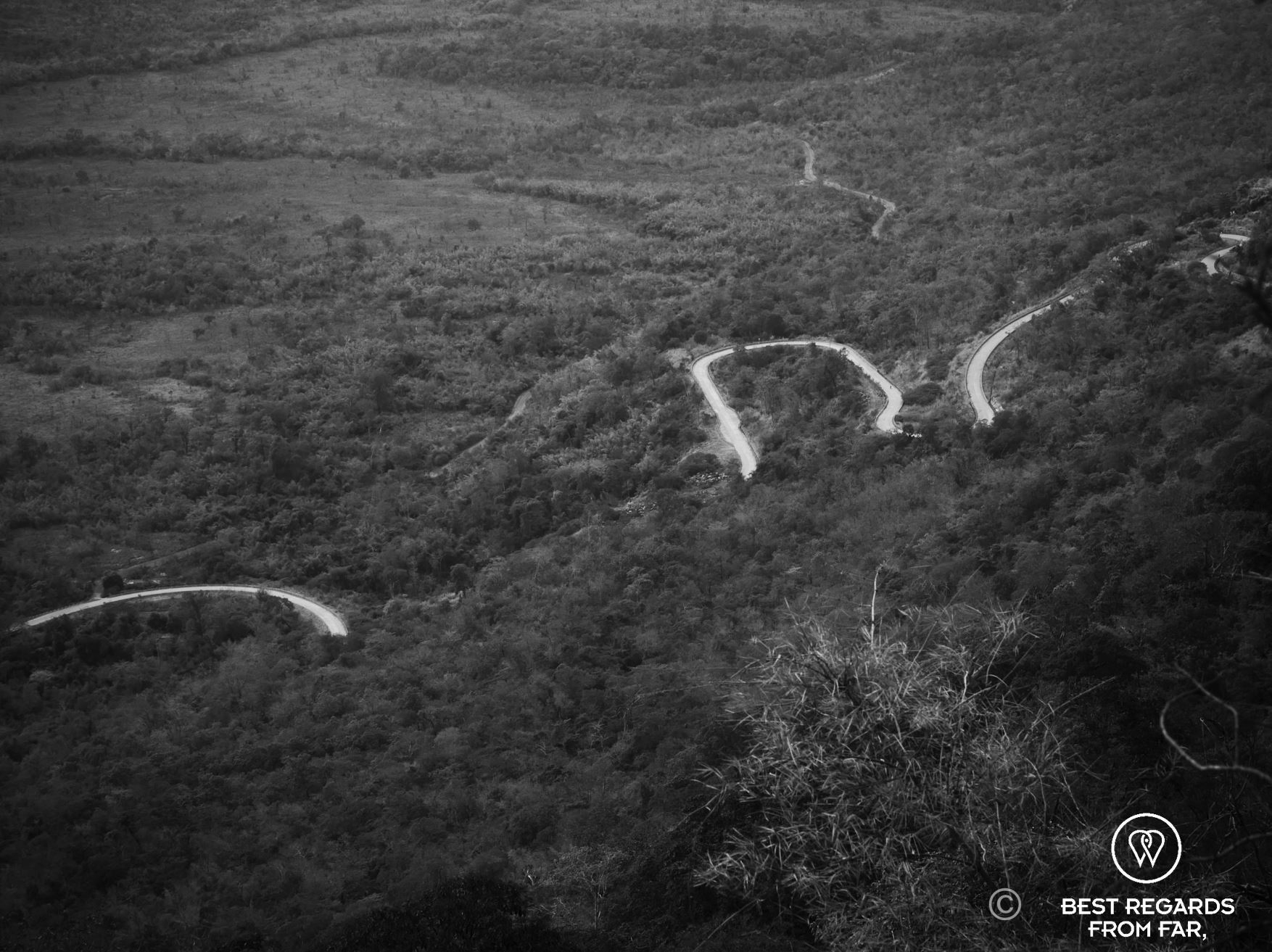
As we ascend into the Dângrêk Mountains, the landscape begins to shift. The lush green of the plains gives way to hills, and the road narrows, becoming steeper with each turn to culminate past the ticket booth of Preah Vihear. A few moto-taxi drivers, on their own 110cc semi-automatic Honda scooters, wave us forward, shouting, “Moto-taxi!” It is a welcome change from the constant “Tuk-tuk!” we usually hear.
We politely decline. We start driving up the road that has been created in 2003 to provide access to the temple from the Cambodian side. Two moto taxi drivers follow us, are clearly doubting our abilities, and pointing at their passenger seat. The incline becomes nearly vertical, or at least this is the way it feels on the saddle of our scooter that is almost halted at this point. My heart races as I glance up at the daunting road ahead—there is no way we will make it unless I take some calculated risks. Claire, sensing the impending challenge, hops off, and I lean forward, keeping the throttle wide open.
With every twist and turn, the scooter inches its way higher, the steep slope making the engine strain and my pulse quicken. It is a tight, nerve-wracking uphill, but finally, I reach a flat spot—just as our moto-taxi escorts do, shaking their heads with a mixture of admiration and frustration.
A few officials look surprised as we park our scooter. They point at us and the scooter, talk together in Cambodian, and end up laughing and shaking their heads while applauding.
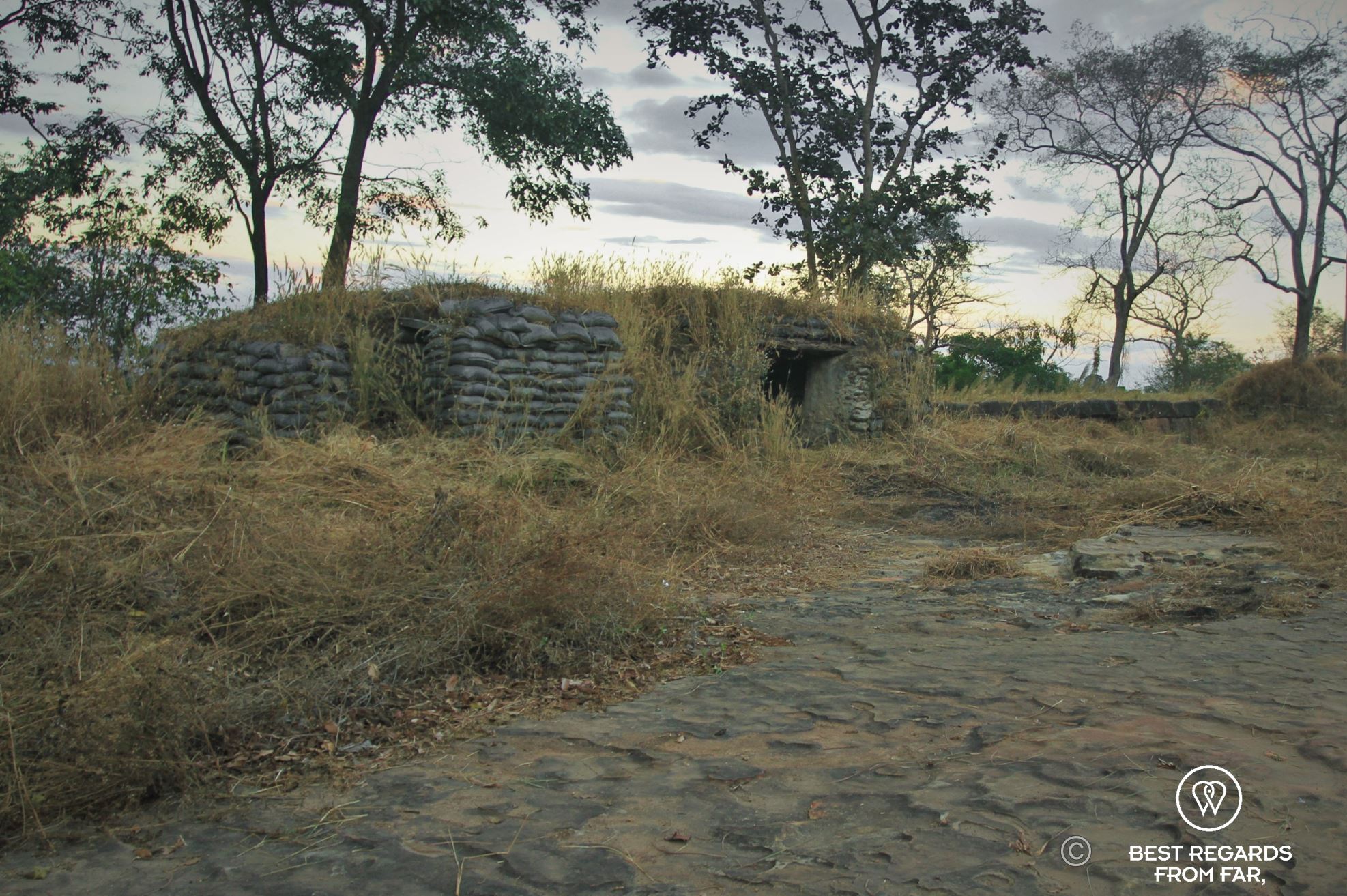

There would be a much easier access on the Thais side. But since 2015 the access from the neighbouring country has been forbidden. When the French left Cambodia in 1954, Thailand immediately claimed the temple. Cambodia protested and years of political tension followed until the International Court of Justice in The Hague arbitrated in favour of Cambodia in 1962. Shortly after, the Cambodian civil war broke out and Preah Vihear appeared to be a strategic point for the Khmer Rouges who eventually conquered it. Years after the fall of Pol Pot, the Khmer Rouge fighters were still sheltering on these heights until their final surrendering in 1998.
The Sacred Heights
Arriving at the site, we are greeted by the fluttering of a blue UN flag in the wind. It is late afternoon, and we seem to be the only visitors. We walk the long metres of the ancient causeway leading to the steps of the temple itself. The vast expanse of Preah Vihear and its solitude, set against the backdrop of the rugged mountain ridge, feels almost untouched by time.

Like Angkor Wat, the temple’s five gopuras (towers symbolizing the sacred Mount Meru) stand in perfect harmony with the landscape, never all visible at once. As we explore the towers, we enter different gateways all carved with animals apsaras, mythical dancers who adorn the walls of this holy site. The second gopura reveals one of Preah Vihear’s masterpieces—a bas-relief depicting the “Churning of the Sea of Milk,” an important story also found at Angkor Wat, illustrating an iconic moment from Hindu mythology.


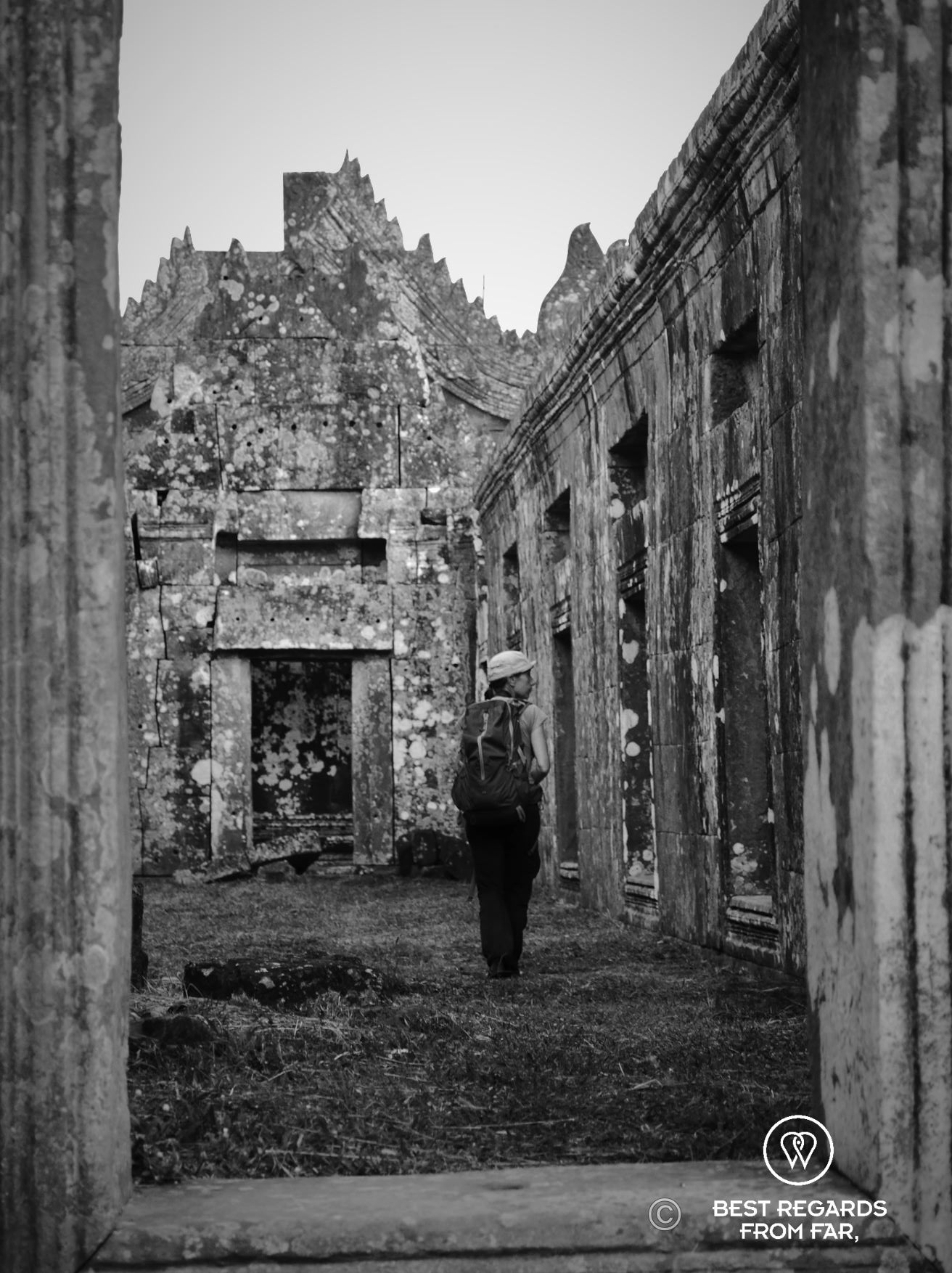

The stone carvings, still vibrant in places, seem to come alive as the setting sun casts dramatic shadows across the third tower, surrounded by two former libraries and courtyards that evoke a sense of timelessness. Military personnel quietly observe, but the site feels peaceful, as though it belongs to no one but us and the gods.
We wander further to the cliff’s edge, where an ancient staircase is said to descend to the plains below. The path is faint, barely visible, but the weight of its history is palpable. In 1979, thousands of Cambodian refugees were pushed off from this very cliff by Thai officials. Some fell to their deaths, while others perished in minefields below after making it down the now faint staircase. The Khmer Rouges were still occupying the area. A rough 3,000 innocent lives were lost in this expulsion of refugees that Thailand did not longer want to take responsibility for. The ones who survived the descent and five kilometres of mine fields were helped by the Vietnamese, who had freed the country of the Khmer Rouges. As we look out over the plains, the stark contrast between the bloodshed of the past and the serene beauty of the present is haunting.


Descending the Mountain
As the sun dips behind the horizon, we leave the site. Night is falling, and we still have the steep, nerve-wracking descent ahead of us. This time, we take it slow, using the scooter’s brakes to control our speed as we carefully navigate the road back down. The weight of the history we have just experienced lingers in the cool evening air. I switch on the headlights and roll into the night to the next village, 20 kilometres from here.
This visit, this adventure, has left a deeper impression on me than any other temple in Cambodia. Perhaps it is the rugged journey to get here, or the sense of solitude we felt as the only visitors at such a sacred site. Maybe it is the adrenaline rush of the ride, or the poetic fusion of the stones with nature, or simply the profound history of the place that makes it unforgettable. Whatever it is, our journey has only just begun. Tomorrow, we will head deeper into the jungle to discover even more hidden temples—where few ever go.

Travel tips:
- Preah Vihear is best reached from Siem Reap.
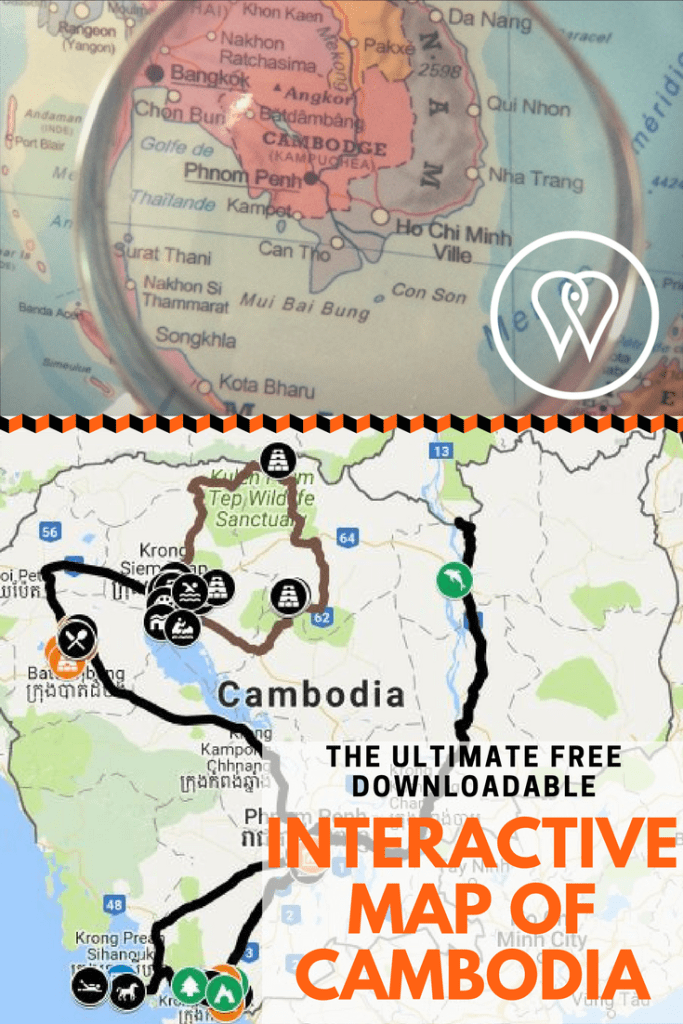
- Refer to the interactive map below to plan a multi-day adventure from Siem Reap to discover Preah Viehar and Preah Khan.
- Check out this interactive map for the specific details to help you plan your trip and more articles and photos (zoom out) about the area!
For more in Cambodia, click on these images:




 Best regards from far,
2 Comments Add yours