Article updated on December 27, 2024
Text: Marcella van Alphen
Photographs: Claire Lessiau & Marcella van Alphen
As our driver follows along a narrow straight road, memories of the dykes that prevent water from flowing from one field to the next near my childhood home in the Netherlands come to mind. The road is perched atop. Just the hordes of cyclists are missing. The landscape is as flat as the one I grew up in, and I smile when I spot a familiar bird: a Common Snipe (Gallinago gallinago) wading through the muddy shallows beside the road, searches for food. This wader, once featured on Dutch 100-Guilder banknotes, I had not seen in a while, and here, it feels like an old friend.
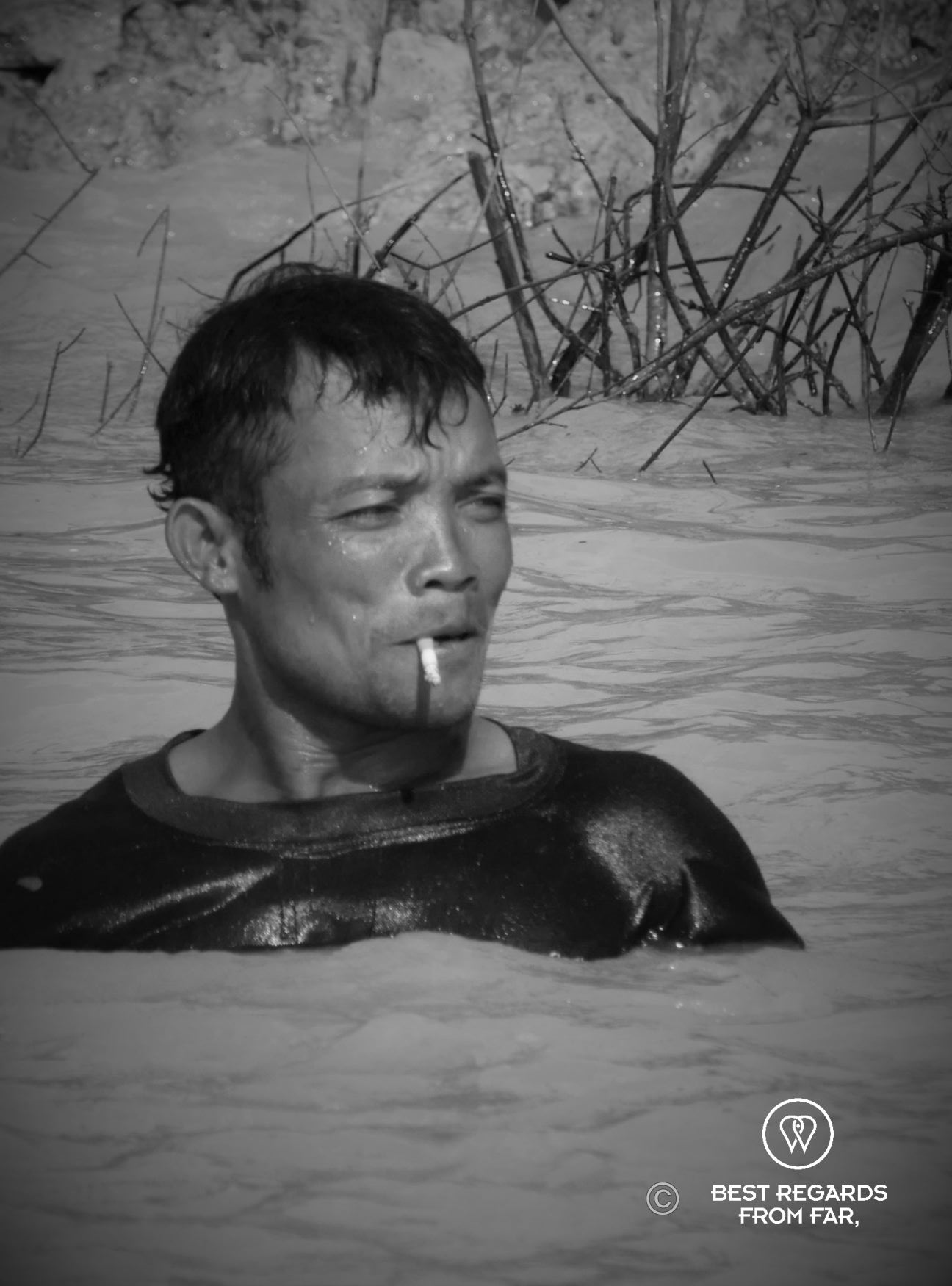
It is not the only one searching for food. Bare-chested, sun-tanned fishermen wade through the murky waters, ready to cast their nets. Above them, a kingfisher swoops down in a flash of color, striking from the air. The road, rebuilt each year after the waters of the gigantic Tonlé Sap Lake recede during the dry season, ends at a dusty parking lot next to a stream that leads into the lake. We are about ten thousand kilometers from the Netherlands when the captain of a traditional wooden boat welcomes us on board to explore his floating village, Kampong Phluk, in the heart of Cambodia.
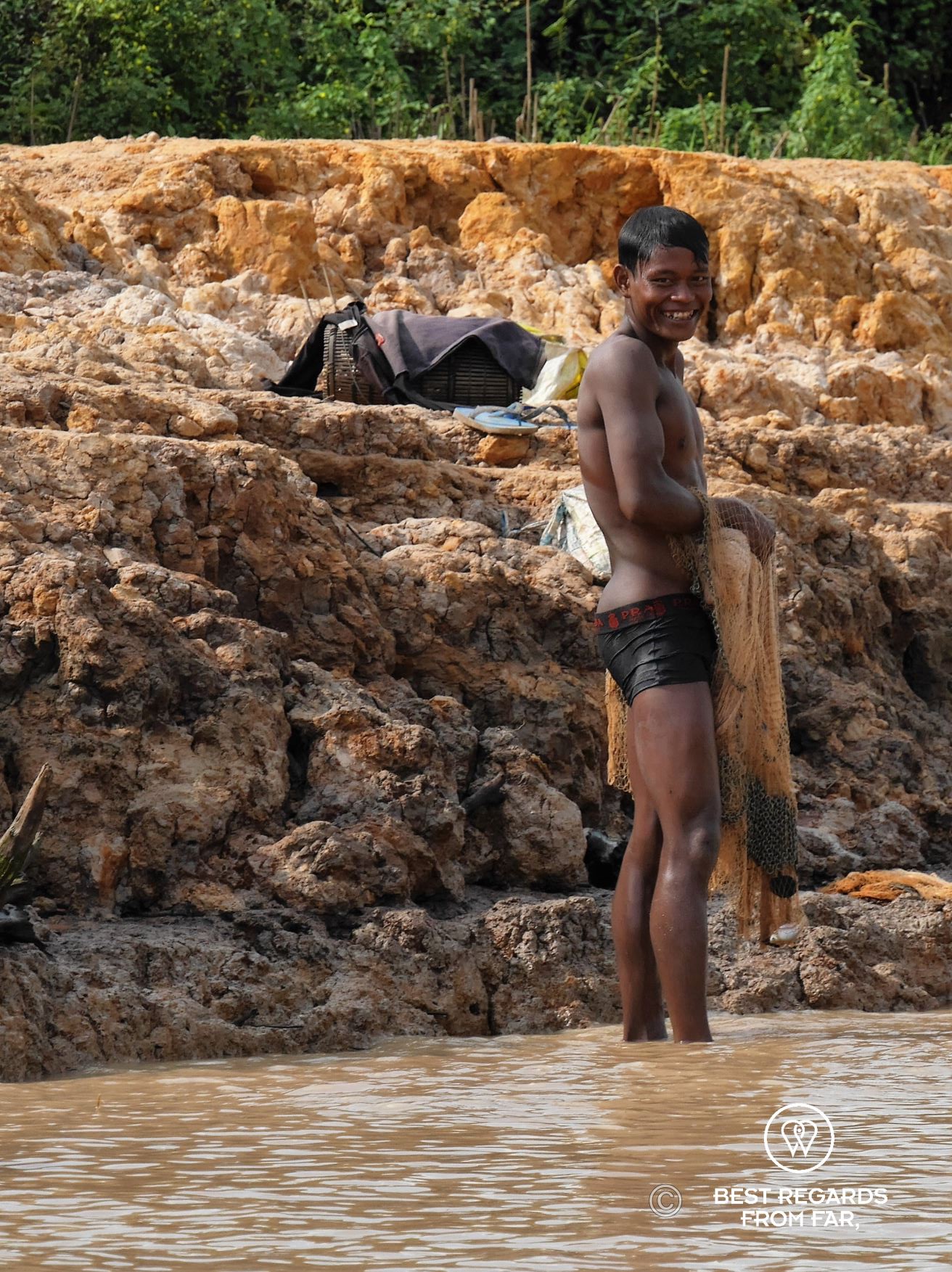


It feels as though time has stood still here. The handmade wooden houses contrast greatly with the booming city of Siem Reap where tourists touch down to explore the majestic temples of Angkor. In Kampong Phluk, life moves at a slower pace. Children navigate small boats, women wash in the water alongside their children, pigs live on boats, and vegetables grow in suspended pipes. Wooden frames covered in fishing lines mark small handmade fish farms. Some homes are literally floating, resting gently on the calm water.
Our enthusiastic guide explains: “Owning a boat here is vital—it is the primary means of communication with the outside world. The fish the villagers catch are sold in markets along the shore, but for the children, boats are also their mode of transport to school.” As our boat pulls up to the dock, we disembark and ascend a few concrete stairs to a sandy street where young boys challenge one another in a playful wood-log throwing game. Others play soccer while some girls practice riding bikes, their focus intense as they try to keep their balance.
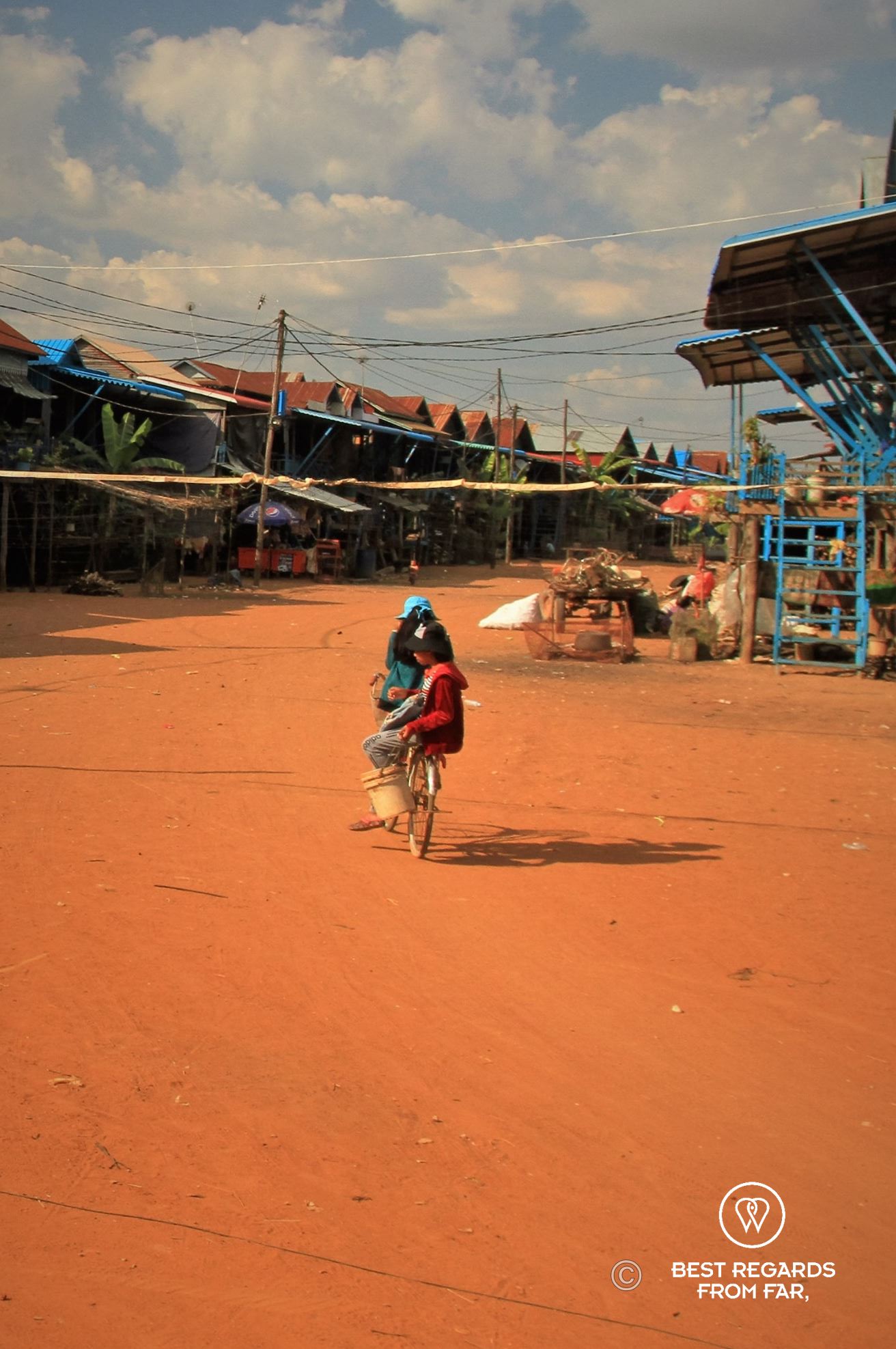

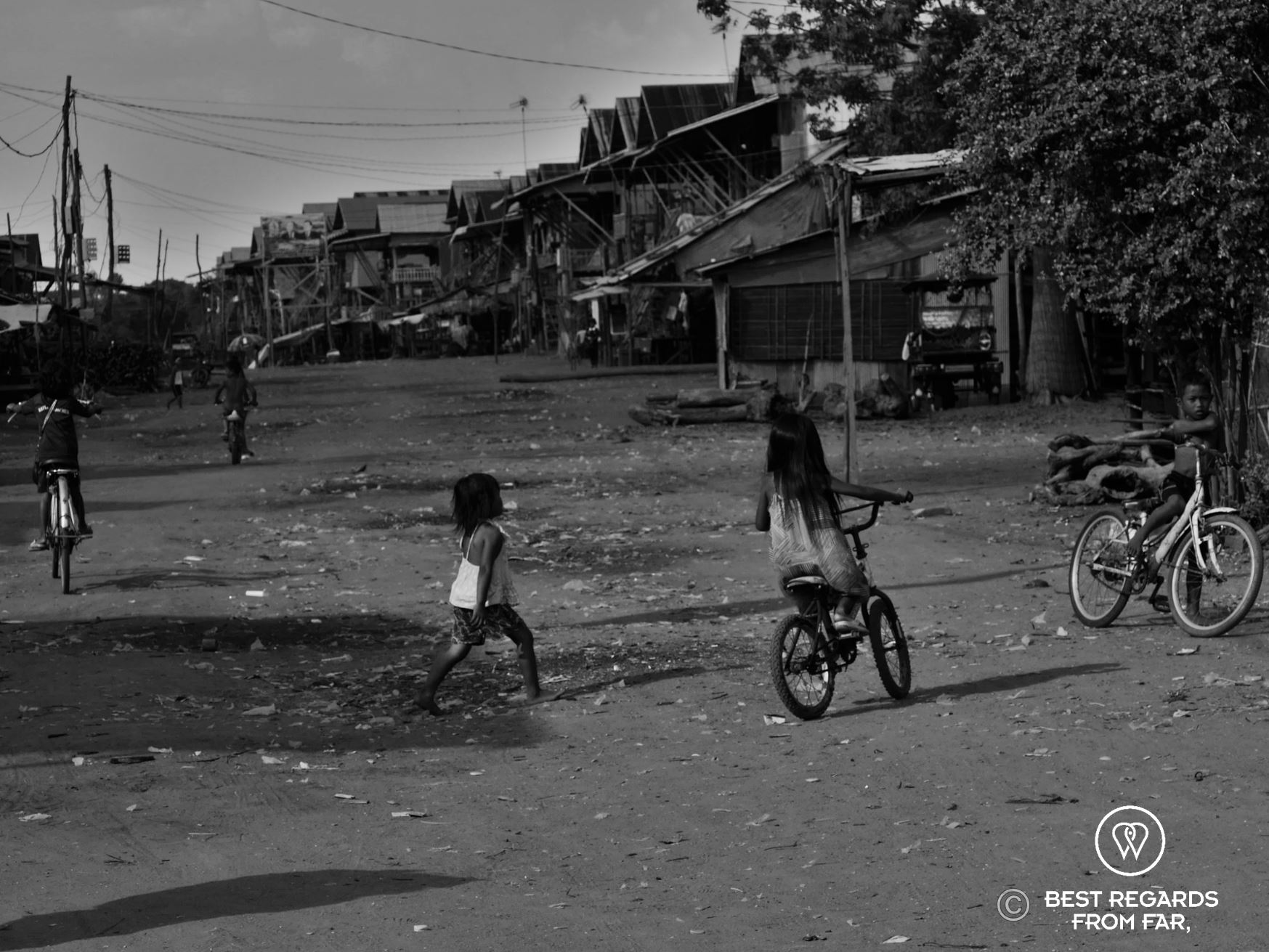


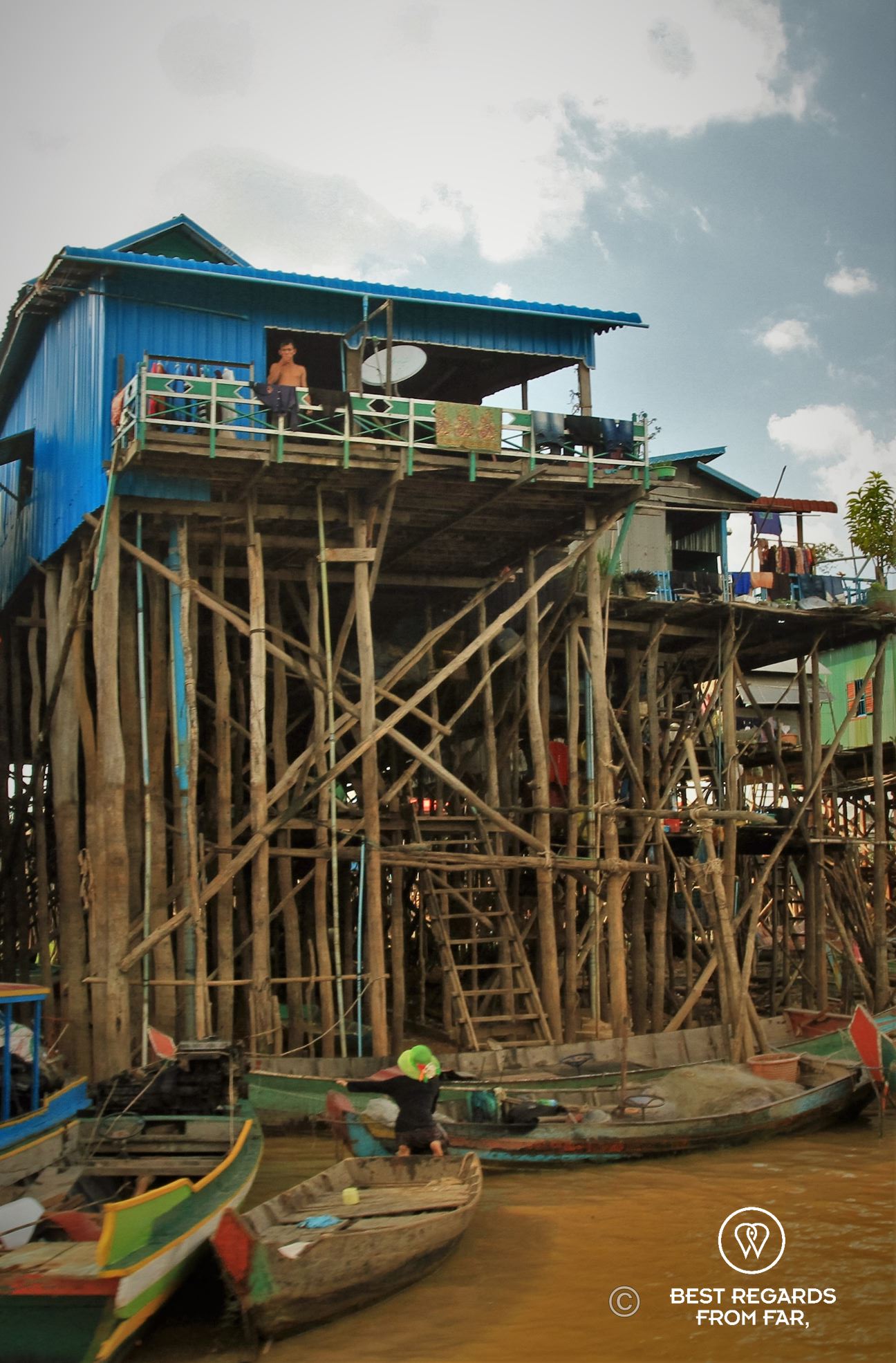
On either side of the street, colorful wooden houses rise on stilts, some up to ten meters high, their steep vertical ladders leading to tiny balconies where herbs and vegetables grow and children’s feet dangle precariously over the water below. Our guide adds, “Life here changes completely between the rainy and dry seasons. During the rainy season, from June to November, the water level rises to just beneath the entrances of the houses, and the whole village is accessible only by boat. Transport to the school, temple, markets and other towns is exclusively by boat. The children can no longer play soccer or cycle.”
While Kampong Phluk is a seasonal floating village, another village farther onto the Tonlé Sap Lake floats all year round. We board our comfortable boat once more, passing the colorful wooden school building before reaching the lake’s shore, where we transfer to a wooden canoe. Here, local women silently paddle through the flooded mangrove forest, their rhythmic strokes creating a peaceful atmosphere. The absence of roaring engines heightens the tranquility of the scene, and in the distance, a Cambodian woman sings softly as she glides on the water with a monk in his orange robes.


We board the Princess Tara once again and set out across the vast Tonlé Sap Lake. Aside from the puffing of our boat’s engine, the lake is eerily quiet. Only the plastic bottles floating on the surface, marking the many fish traps hidden below reveal that the lake is frequently navigated. As the sun begins to set, the lake’s still surface shifts through hues of gold and orange. In the distance, I spot a series of anchored boats and pontoons, and long-tailed boats ferrying people to a floating wooden platform. Slowly, we approach Chong Kneas, another floating village, home to a community of people who fled Vietnam. This village is totally different from Kampong Phluk: instead of stilts, the houses float directly on the water, rising and falling with the changing water levels. The sun casts a golden glow on the wooden homes, creating a serene and picturesque scene.
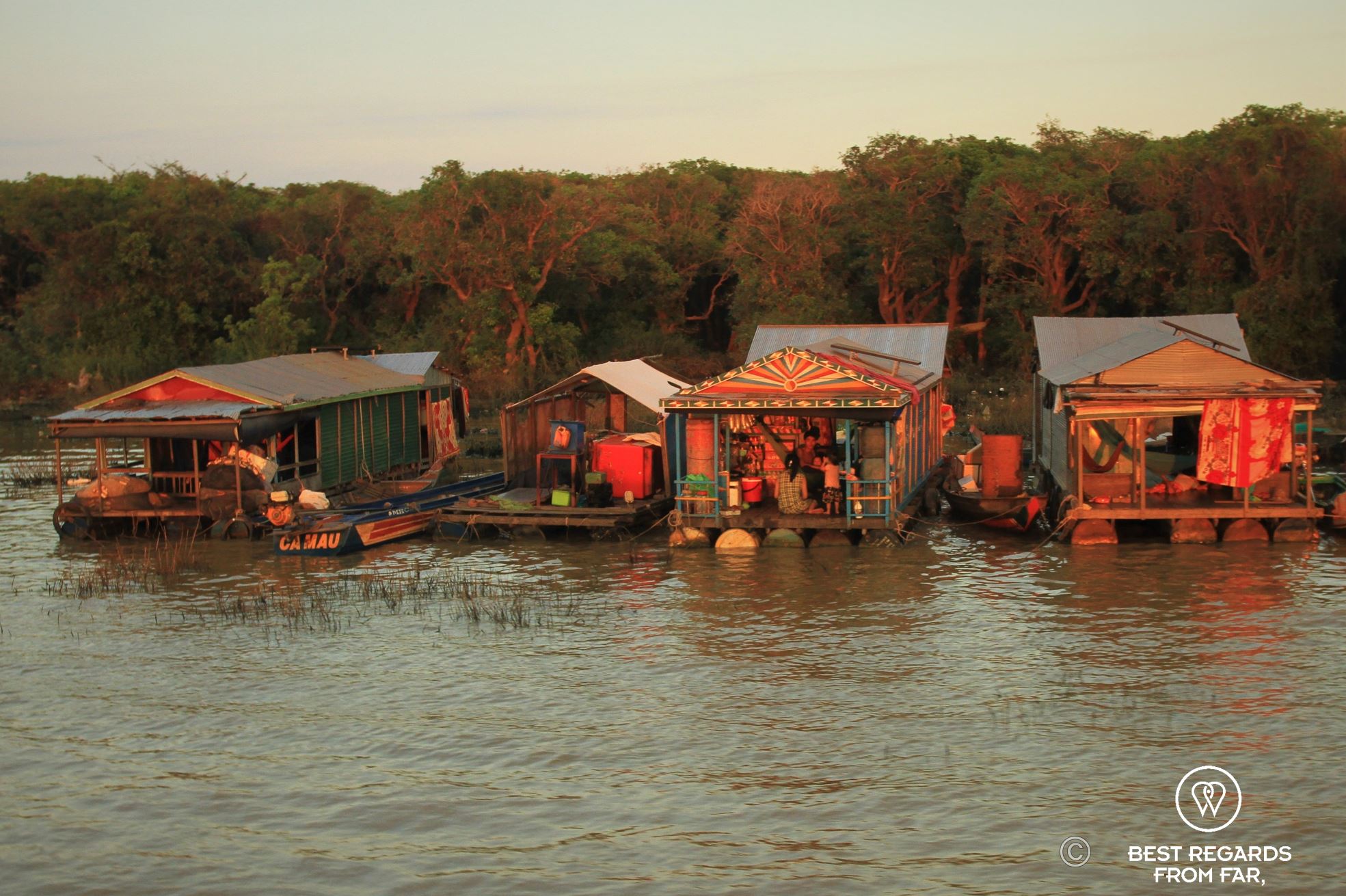

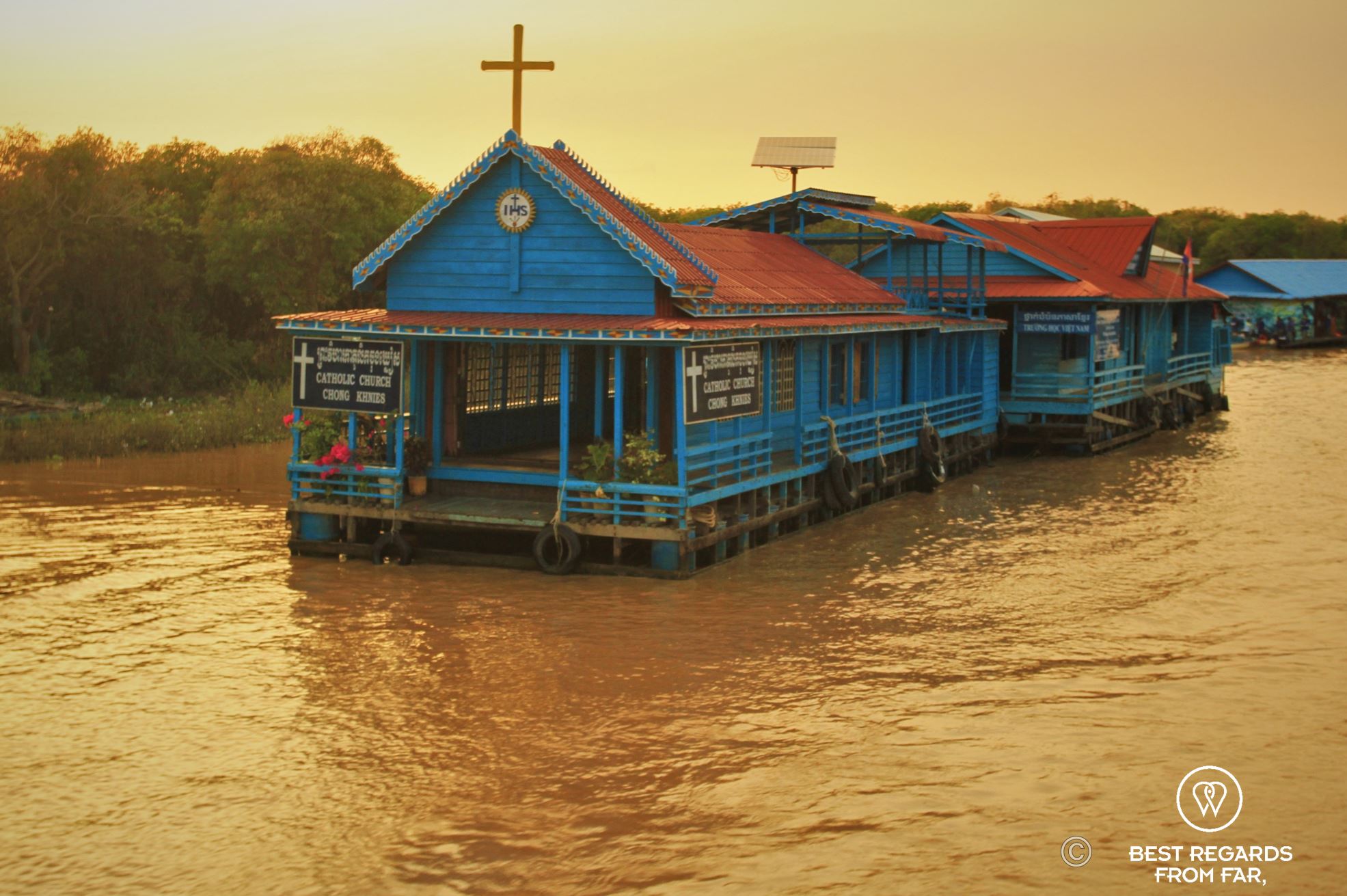
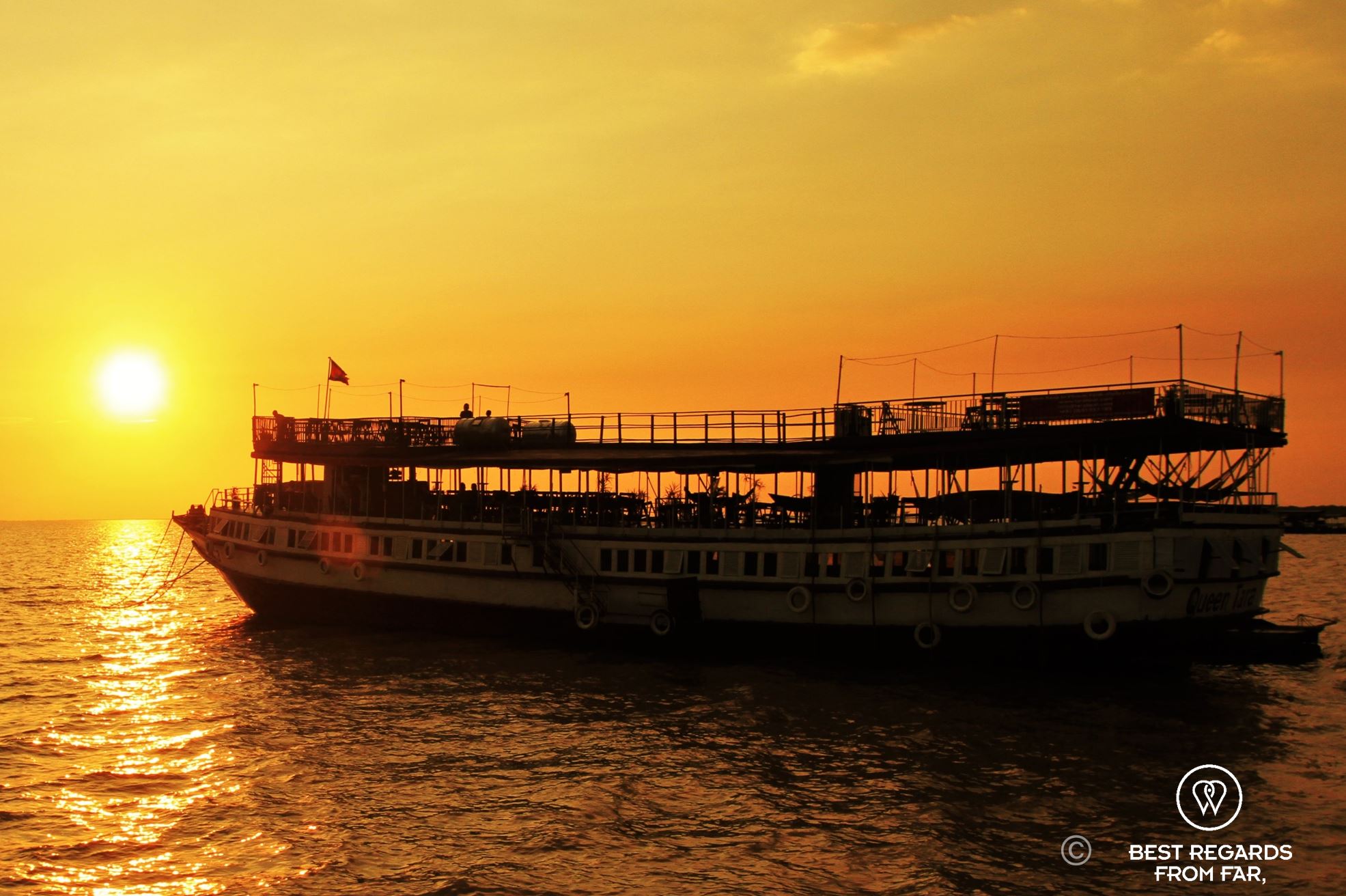
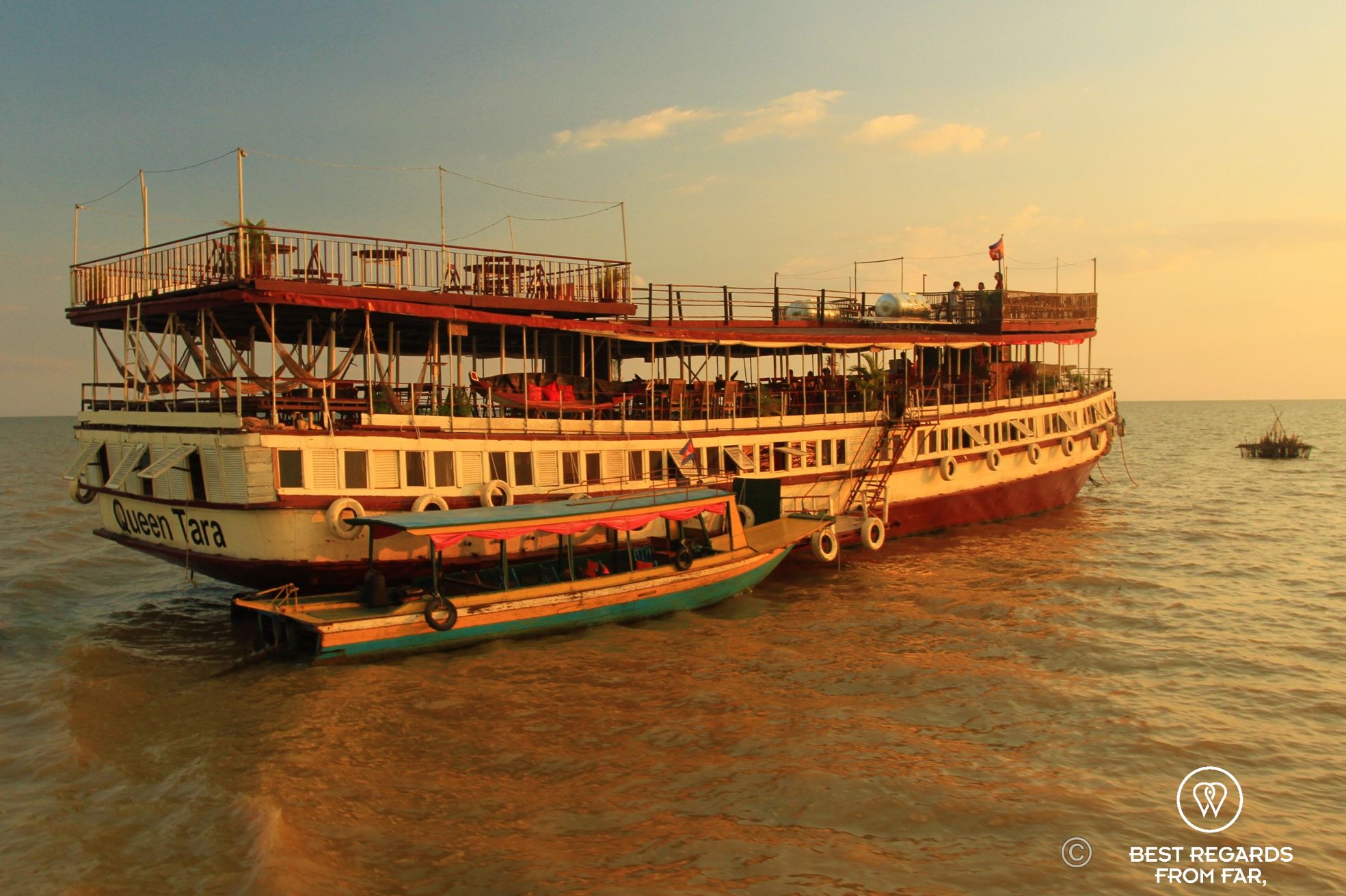
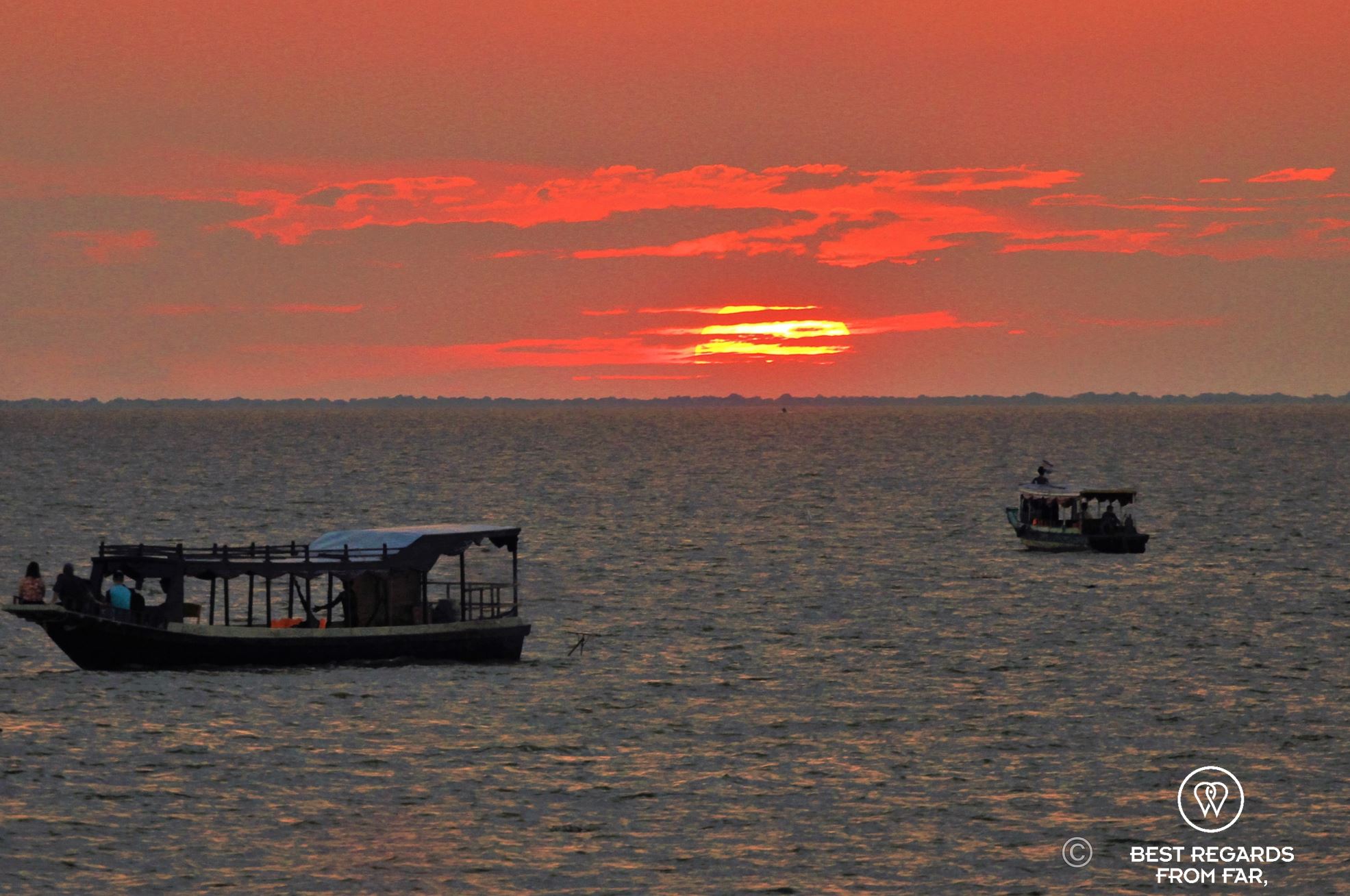


As Princess Tara docks alongside the larger Queen Tara, from where we watch the sun dip below the horizon, painting the sky in rich oranges. On deck, we relax with a drink and savor a delicious meal while contemplating the unique lives of the floating village residents. What must it be like to live on a small raft—cooking, sleeping, studying, washing, raising children, and caring for the elderly—all in the same confined space? It is such a different world, yet only a stone’s throw away from the busy streets of Siem Reap.
Travel tips:
- Both floating villages can easily be visited on a half-day trip from Siem Reap. For a more authentic experience, Kampong Phluk, being less touristy, is recommended.
- Contact Tara Boat to arrange half-a-day guided visits to the floating villages. They run excellent tours, giving back to the communities.
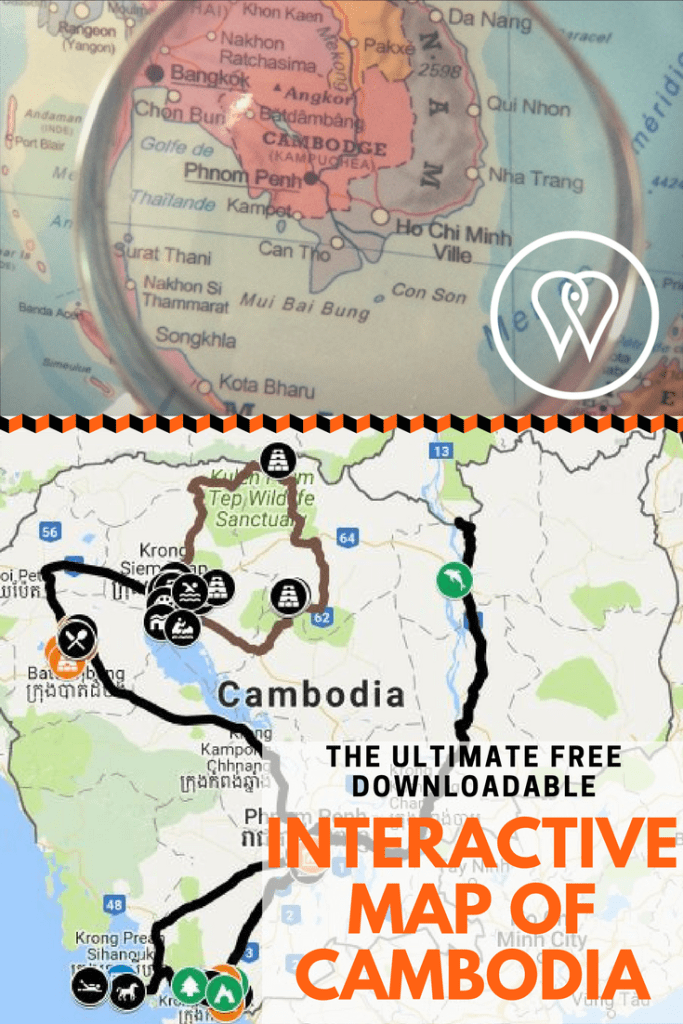
- Check out this interactive map for the specific details to help you plan your trip and more articles and photos (zoom out) about the area!
For more in Cambodia, click on the images below:




 Best regards from far,
Very cool. I would love to see this some day. Thanks for sharing.
Happy to inspire you! There is so much to discover around Siem Reap, off the beaten path. Thanks for your read.
If there would be one thing to come back to Cambodia for, this would be it!
It is indeed definitely worth it, a total different world from the streets of Siem Reap or anything else in Cambodia.
I hear the sunset is spectacular!
It truly was indeed, a spectacular sunset, the whole lake was bathed in a golden light. 🙂
This village was one side trip all of us in our group loved. Couldn’t believe the homes on stilts, the men casting fishing nets, and the unity of families as they worked together. We visited one family whose business was drying fish, and we watched as everyone from grandmother to littlest child lent a hand in the day’s affairs. A vision I’ll never forget!
Thanks for sharing your experience ! Yes it is a very specific way of living and very interesting to witness.