Text: Claire Lessiau & Marcella van Alphen
Photographs: Claire Lessiau
The world’s very first abstract art piece was found here in a cave along the rugged coastline of South Africa close to Cape Agulhas. A few of weeks ago while exploring the diverse wildlife of the De Hoop Nature Reserve, the excellent exhibit by Craig Foster, director of the Academy Award-winning documentary My Octopus Teacher, was an absolute revelation. The small rock with abstract lines reveals our evolution as a species. Here at the southern tip of Africa, we truly are standing in the cradle of humankind. The iodine-rich ocean food from fish, shells, and probably seaweed once eaten by our ancestors in these caves most likely contributed greatly to their brain development, giving them an evolutionary advantage over others and allowing these Homo sapiens to expand.
Pin it for later!

My Octopus Teacher was shot only a stone’s throw away from where we are standing now, intently listening to Lindy Taverner, founder of RE Wild Food, as she introduces us to seaweed foraging in order to hone in the health benefits of these plants. Scaborough Beach, which we reached after cruising along the Atlantic Ocean on our Vespa scooters on some of the most spectacular roads in the world, is a few kilometres away from Hout Bay where the famous octopus used to live. It is just far enough from the industrial harbour of Cape Town and close to Cape Point National Park, the perfect location to guarantee non-contaminated algae that are authorized for collection for non-commercial use.
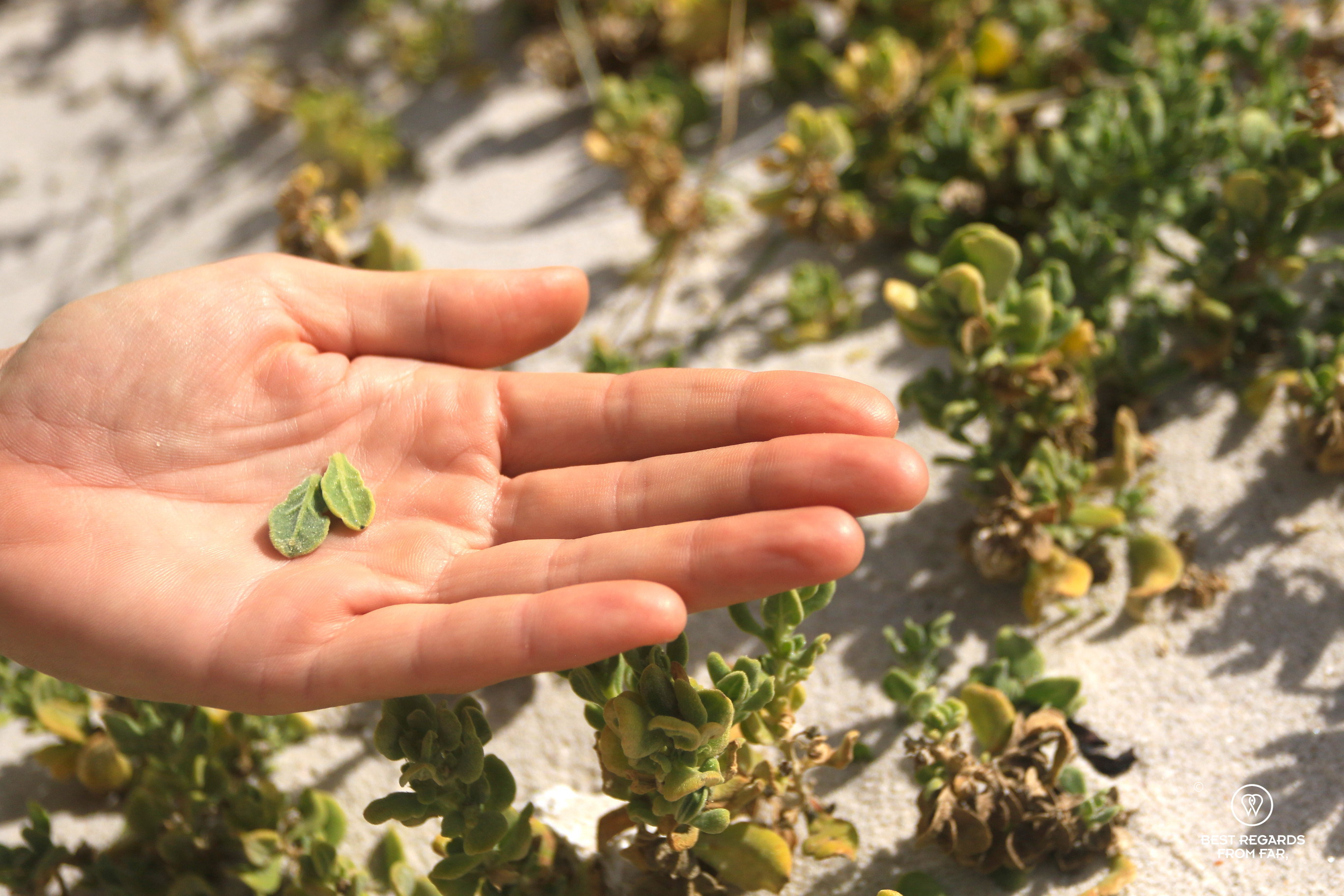
Lindy has timed our visit to coincide with the low tide, when the seaweed is most accessible, close to the tide line. We pass by dune spinach—velvety and slightly acidic and quite nice even raw though a bit sad at the moment—most dune plants are nicer in spring than in the height of summer, when much of their energy is dedicated to flowering. Soon, we arrive at the intertidal pools, where an abundant variety of seaweed thrives.


You Can Hardly Go Wrong
Fortunately, in South Africa, of the 850 species of seaweed lining the country’s 3,500km (2,174 miles) coastline, only one is inedible: the Desmarestia firma, or “acid weed.” coastline. Thankfully, it is fairly easy to recognize: brownish with spikes, it grows in the very cold waters of the Atlantic Ocean. Dangerous to consume due to its ability to release sulfuric acid upon exposure to air, it is best left untouched.

Why the Hype About Seaweed?
Fast growing, seaweed is a highly nutritious and mineral-dense macro algae. In addition to its iodine content that also supports thyroid health and helps regulate hormones, seaweed is a valuable plant source of calcium, vitamins A through K, iron, and one of the few vegetable sources of vitamin B12.
“Seaweed fall into three categories: brown, green, and red,” as Lindy explains. And each seaweed offers its own unique nutritional benefits.

Seaweed is an important part of diets in the East. Today, Porphyra capensis (nori by its Japanese name that has made it famous to the world, kim in Korean and chi choy to the Chinese) is the most widely eaten, and offers a very high protein dosage that is around 35 percent—season and species dependent. The kelp (Ecklonia maxima) that we see floating in the ocean contains high levels of minerals, vitamins and trace elements, and is very high in iodine and potassium.
The sea lettuce that we are harvesting boasts great amounts of calcium, iron, magnesium, manganese, protein, and vitamin C—its highest content reached when harvested in early summer. “Like nori, it is also great for chips but it has a bit more of a seaweedy taste to it,” Lindy comments. As we harvest, we ensure to only take a third of each plant, allowing it to regenerate for future foraging.


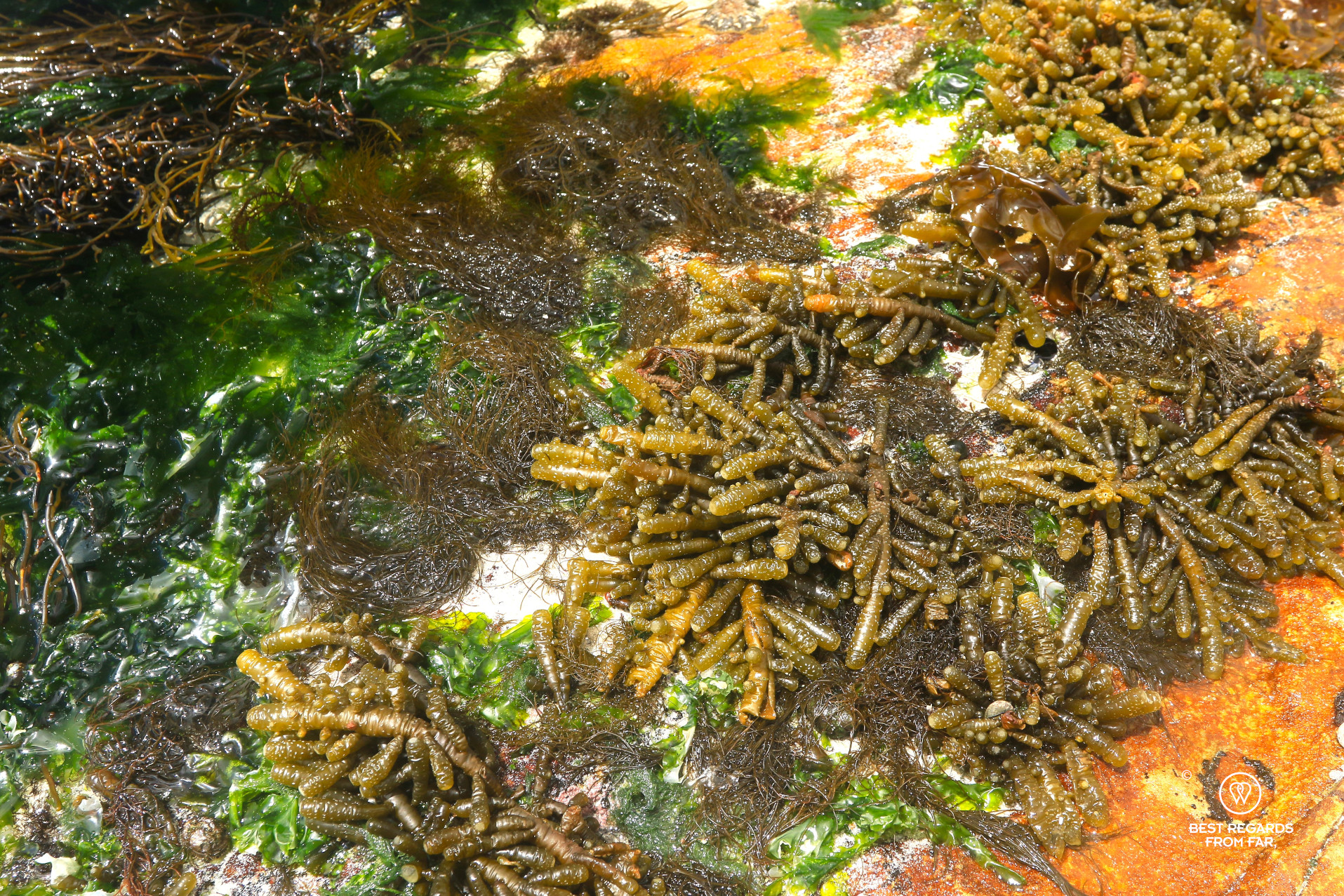
In another intertidal pool, Lindy points to hanging wrack (Brassicophycus brassicaeformis), a crunchy seaweed that can be enjoyed raw. It offers a subtle iodine flavour and is a perfect snack to whet our appetites.
Beyond identifying the seaweed and harvesting them, it is all about learning how to process and highlight at best in different dishes this valuable and rich food source…
Cooking with Seaweed
After our foraging session, we follow Lindy to her home in Scarborough, where she has prepared a selection of dishes showcasing the versatility of seaweed. First up are crispy nori chips sprinkled with nutritional yeast, paired with either a local organic wine or a refreshing beer brewed by Lindy’s husband, Franz.
“Nori is a red seaweed so it doesn’t rot due to its agar-agar content,” Lindy explains. “Simply rinse it, either in seawater or fresh water to remove sand, dry it in the sun for a few hours, then toss it with olive oil before baking it at 140°C (284°F) for about 8 minutes. Add your seasoning of choice, and voilà: healthy, crispy nori chips!”
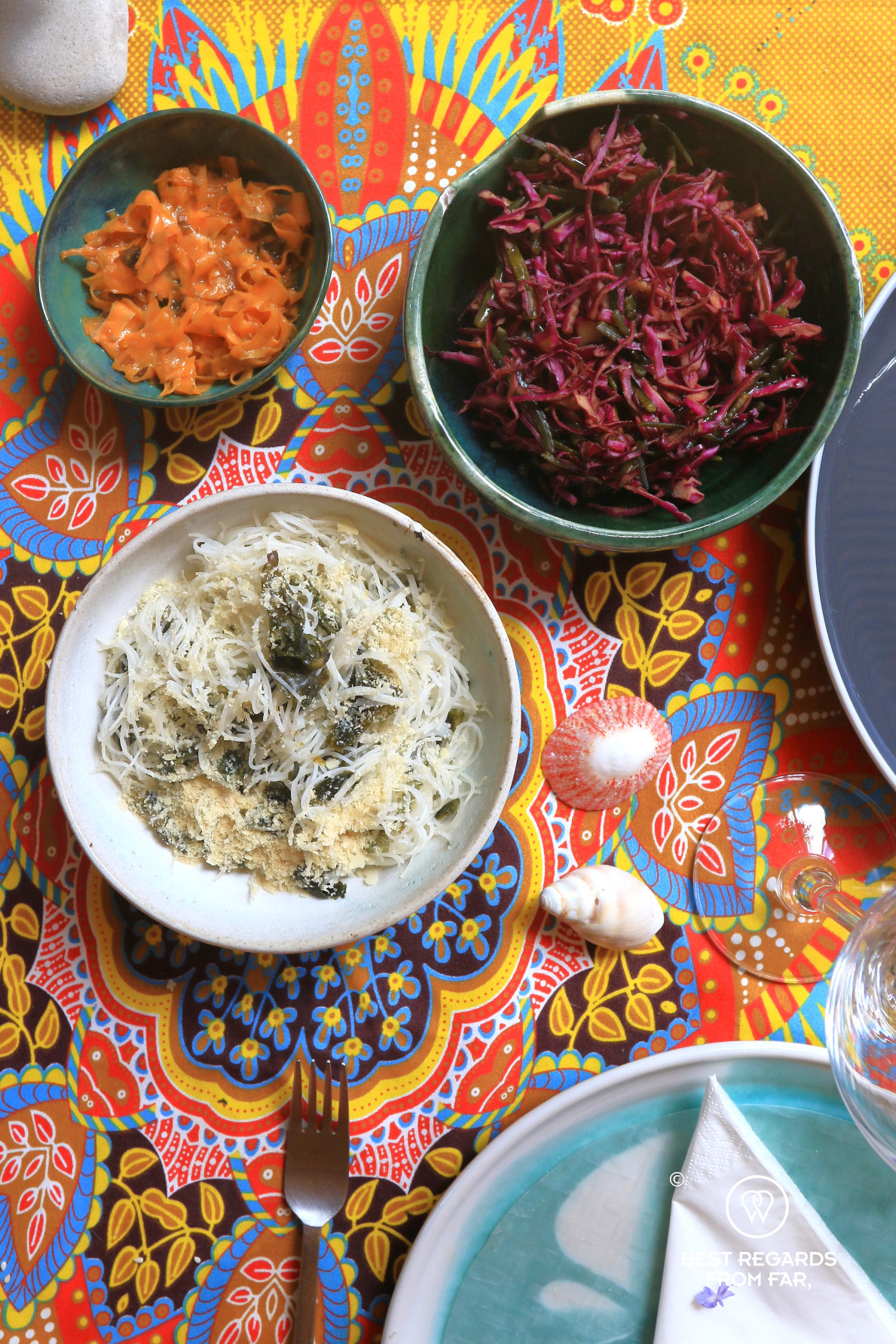


Algae do not have to take the main stage and can often be a tasty and healthy supplement. We each make spring rolls using rice paper, which we dip in cold water to soften—our Thai experience is going to help! Filling them with grated carrots, seasoned with miso, sesame oil and nori, some red cabbage mixed with wrack seaweed, seasoned rice noodles, and a drizzle of tahini and sesame seeds, we create a perfect introduction to the flavours of the sea. Even those new to seaweed can begin to appreciate its subtle nuances.
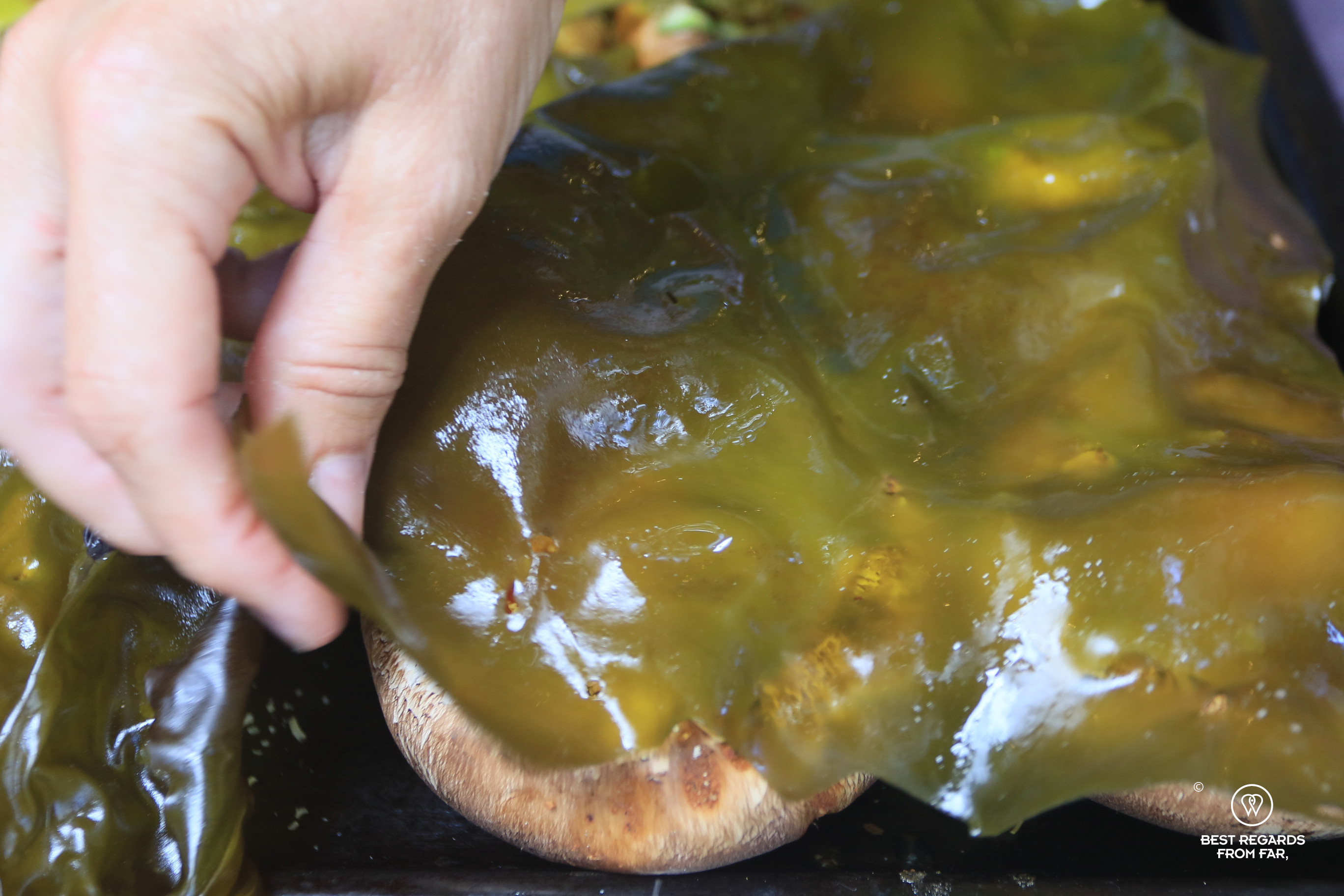
The main course is cooked with the fast-growing slippery orbit seaweed (Pachymenia orbitosa) instead of tin foil. It can be used to wrap fish, roast, or cover vegetables like in the mushroom recipe that Lindy and Franz prepared. The slimy plant adds a hint of umami depth to the dish.



On the side, we are having a taste of the invasive Mediterranean mussels. They came to South African shores on the hulls of ships as unwanted guests, and are very enjoyable cooked in white wine with garlic and thyme from the garden.
We conclude this seaweed-themed lunch on a sweet note with a brownie with a kelp candy.
Processing Our Own Seaweed
Not only satiated, but also very inspired, we leave Lindy and Scarborough behind, passing Misty Cliff, riding Chapman’s Peak drive, and Victoria Road always keeping the ocean in sight, eager to experiment with the variety of seaweed we harvested.
The first step is to sort them out and rinse them thoroughly. While using algae fresh is the best from a nutritional standpoint, seaweed also freezes very well— only the kelp needs to be cooked or processed before freezing. When needed it simply needs to be thawed at room temperature.
Starting with Lindy’s RE Wild Food e-book to get some ideas, nori, wrack, mermaid’s hair (Chordariopsis capensis), and sea lettuce have since been included to fresh salads, humus, as burger toppings, crisps seasoned with fynbos salts… As Lindy explained, a small amount of baked nori or cooked kelp has also been added as a food supplement to fresh juices or smoothies. The weird-looking dead-man’s fingers (Splachnidium rugosum) have become part of a weekly routine, used as face masks.


***
By uncovering the bounty of the ocean’s edible plants, we have connected more deeply with nature and gained a new appreciation for the nutrient-rich offerings right on our doorstep here in Cape Town. With a little knowledge and practice, incorporating seaweed into our meals offers a simple yet powerful way to enhance our health and wellbeing while adding subtle flavours to our menus.
Travel tips:
- To learn how to harvest and cook seaweed, book your seaweed foraging workshop with RE Wild Food.
- In South Africa, wherever it is allowed to fish, foraging is allowed. A permit is required. Enquire at any post office.
- Check out our interactive map for more in the area (black pins lead to an article):
For more in Cape Town, click on these images:






 Best regards from far,