Text: Marcella van Alphen
Photographs: Claire Lessiau & Marcella van Alphen
Spanning approximately 7,000 kilometers (4,300 miles) along the western coast of South America, the majestic Andes stretch through seven countries: Venezuela, Colombia, Ecuador, Peru, Bolivia, Chile, and Argentina. They are known as the backbone of South America. World’s longest mountain range by far, it is also one of the highest after the Himalaya and a fun playground for adventure seekers or perfect training grounds for others.
With 15 peaks reaching over 6,000 meters (or 9 summits over 20,000ft) in the Bolivian part of the famous mountain range only, many reach for the highest summits such as the famous Huayna Potosi that sees hordes of hikers and has been a victim of its own success.
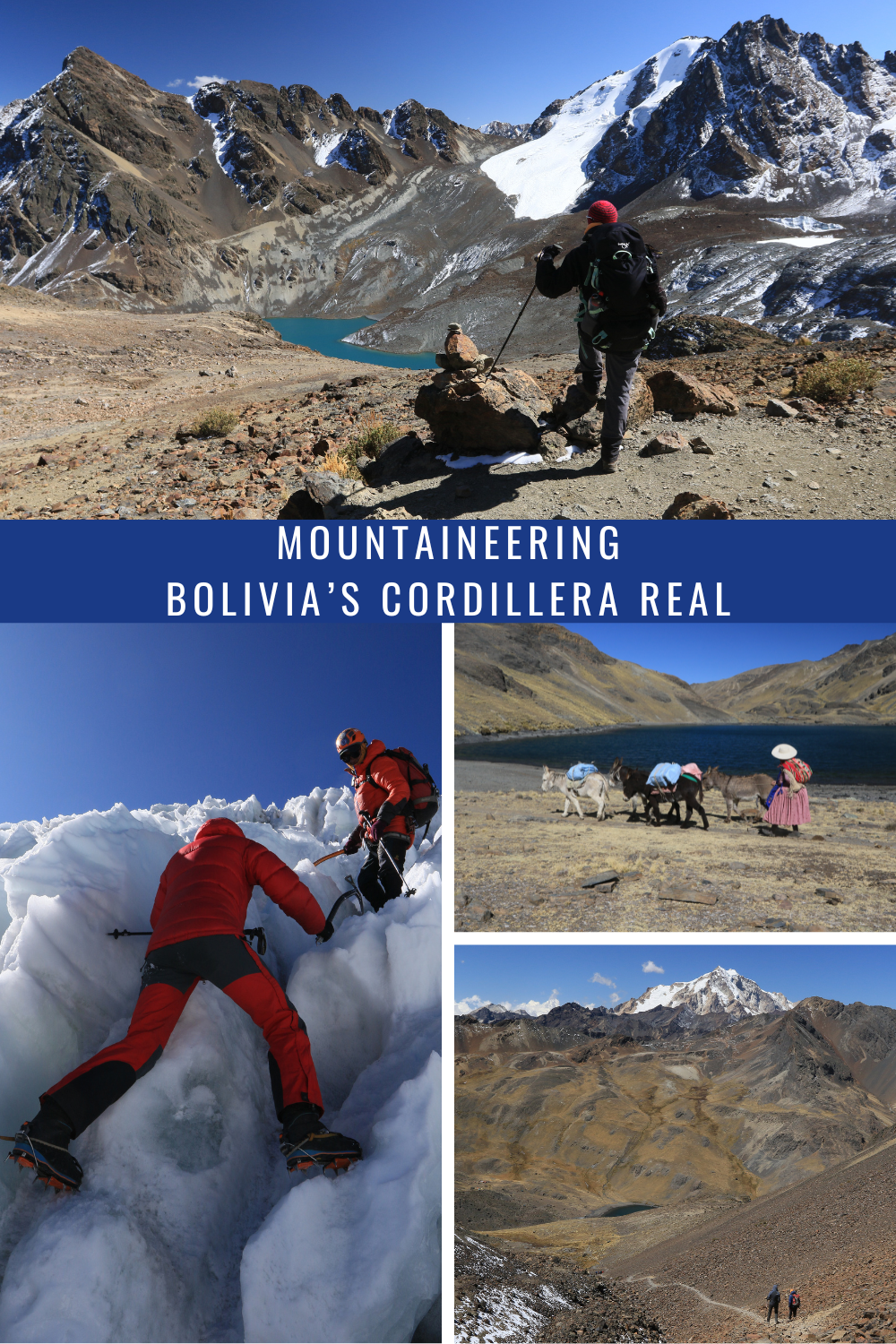
Instead, we have come to explore the remote corners where crowds are few, landscapes wild, and routes technical. Join us on a tailor-made expedition by a certified Bolivian high-mountain guide to summit the lesser-known mountains and glaciers in the Condoriri National Park.
Pin it for later!
***
Day 1
Leaving the Bustle of La Paz & El Alto Behind
After flying over La Paz and its canyon with the practical cable cars, we leave the chaotic streets of El Alto that towers the capital behind. With the 2.3 million inhabitants of La Paz, the conurbation with El Alto totals 4.6 million inhabitants, far more than the 3 million of Santa Cruz de la Sierra, Bolivia’s fastest growing city. Street vendors, mainly women wearing colorful aguayo (the traditional carrying cloth), sell their products by the road, street dogs scavenge for food, the air is filled with the hustle of daily life, and nonchalant drivers honk the horn of their cars in the congested traffic.
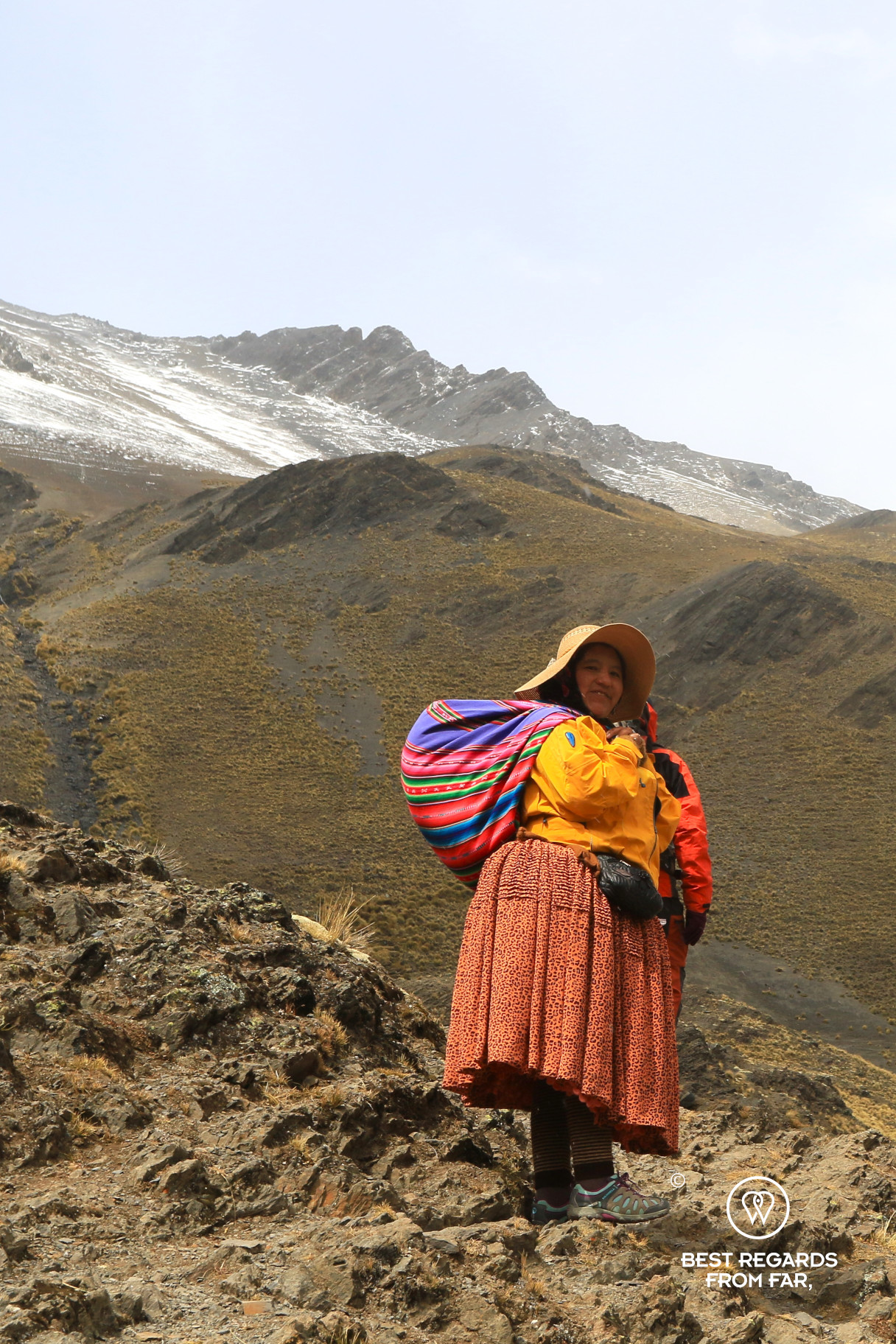
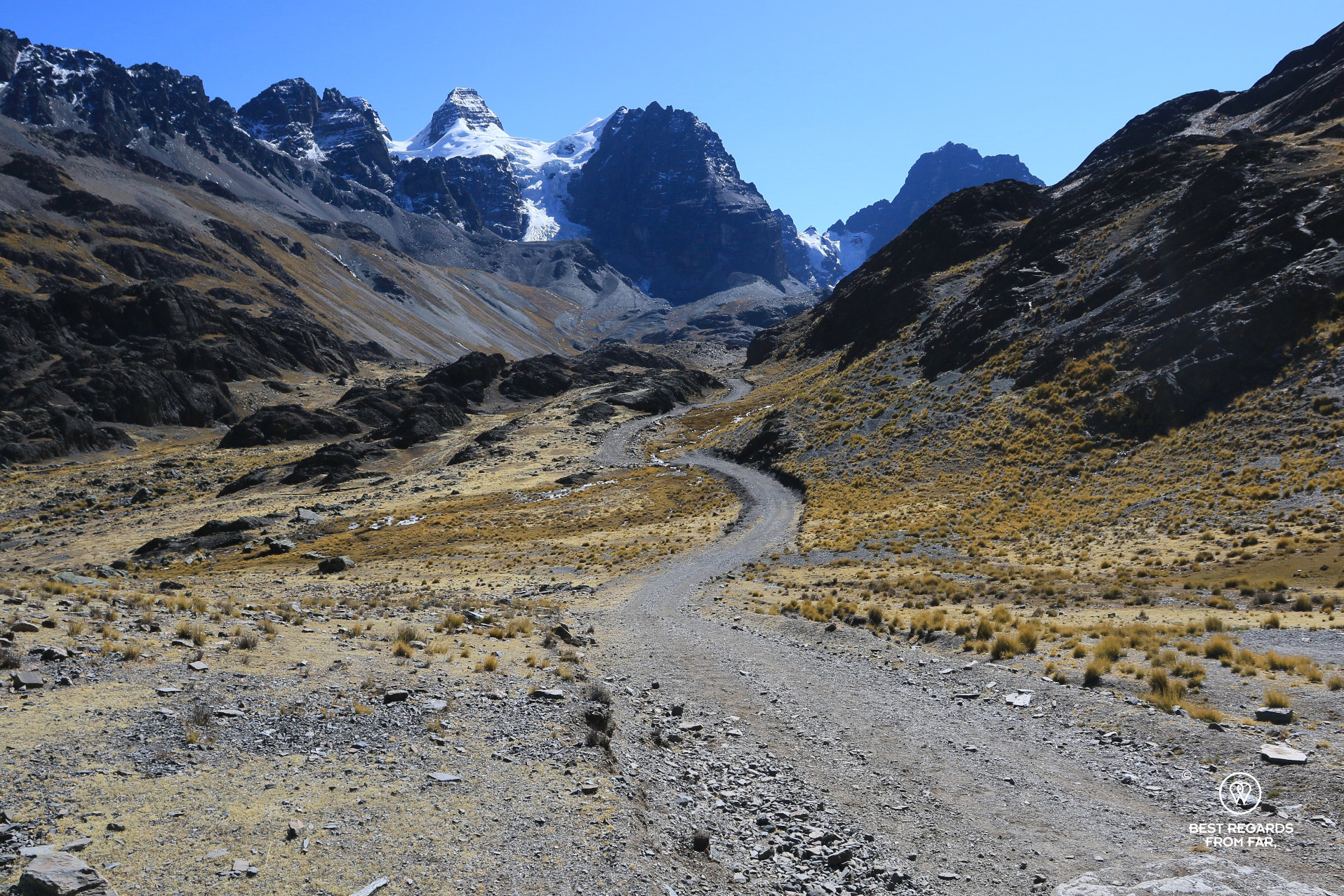
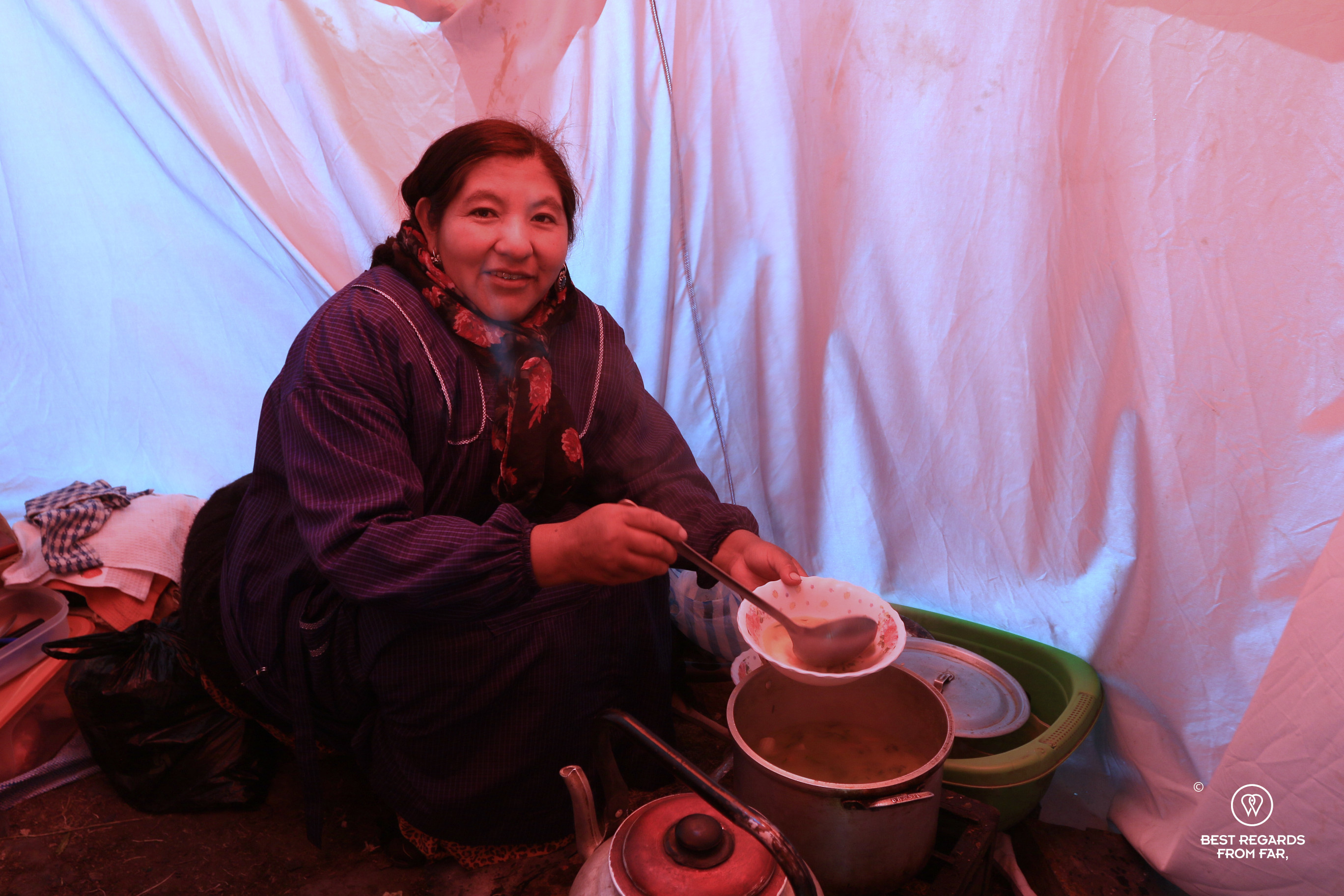
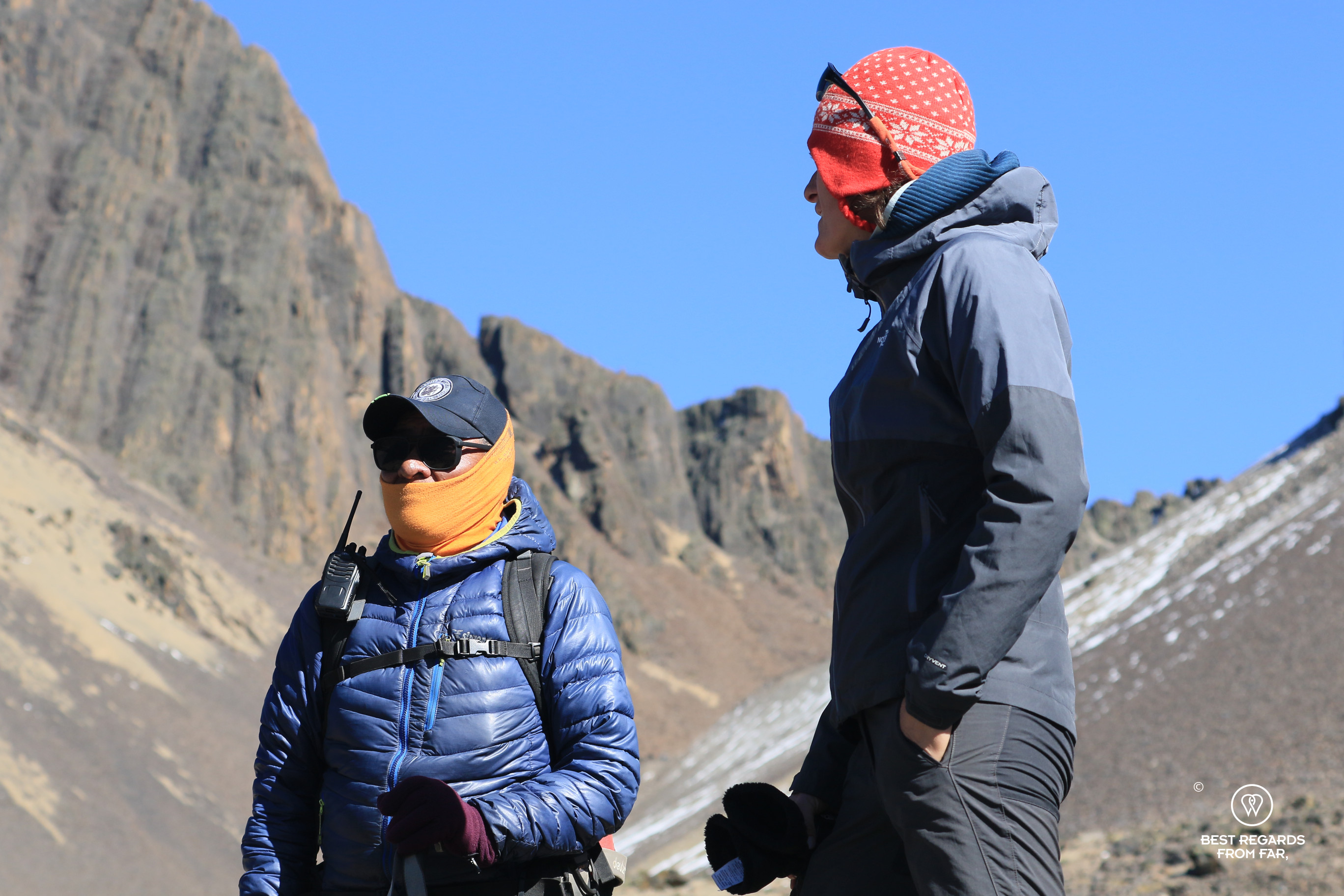
As we drive out of town, the majestic Cordillera Real, the most remarkable of the four mountain ranges surrounding La Paz, gets more striking by the minute. Veering off the highway, a dirt road takes us through the characteristic puna vegetation of the Altiplano that stretches out before us with dramatic snow-capped peaks looking bigger and bigger in the background. As we admire the landscapes in awe, our mountain guide Nolberto Soliz orders the driver to stop once in a while to teach us about the flora. Passing a curve, his cook Vicky points out to an abandoned adobe house which is slowly returning to the land where she was born, here in the seemingly desolated landscape. She still owns some of the alpacas and llamas that we pass by that sustain her and her family who live in El Alto. While she keeps an eye on her camelids, Vicky is eager to be back in her beloved mountains that she knows by heart and treks in her traditional clothes—her homemade alpaca wool tights will prove to beat all our technical clothing when sleeping at altitude!
Condoriri Basecamp in the Snow (4,700m / 15,420ft)
Our destination today is Condoriri Base Camp, located at the foot of the stunning Condoriri Peak culminating at a dazzling 5,648 meters (18,532ft). Nolberto studies the clouds while we are gearing up. “It is going to snow, so let’s head out as soon as possible,” he exclaims. As a high-mountain guide with over a decade of experience, he knows these very mountains and their tricky weather patterns. Dark clouds are packing fast and we head out into the blizzard following Nolberto into the rugged terrain after a quick lunch in what feels the end of the world.
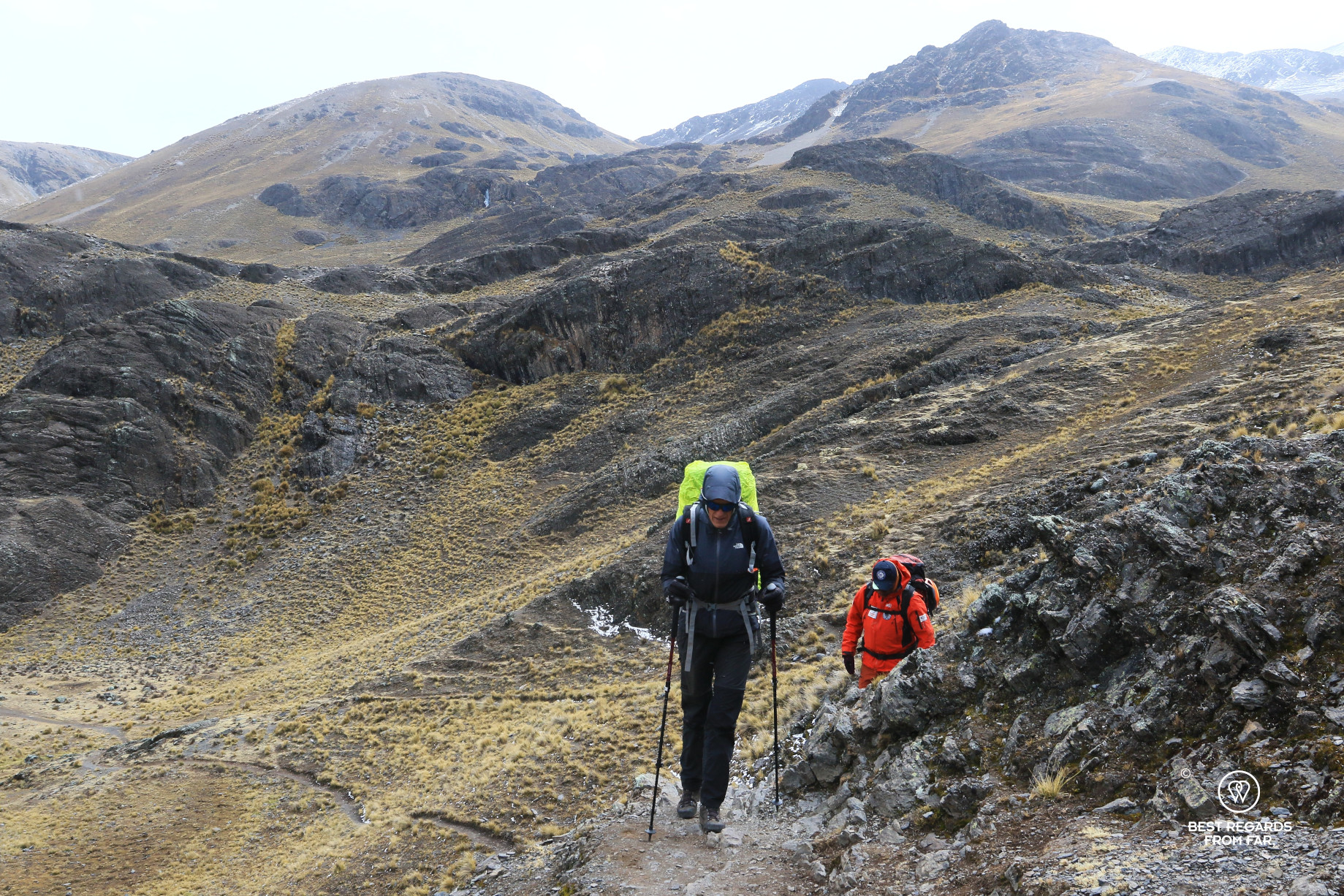
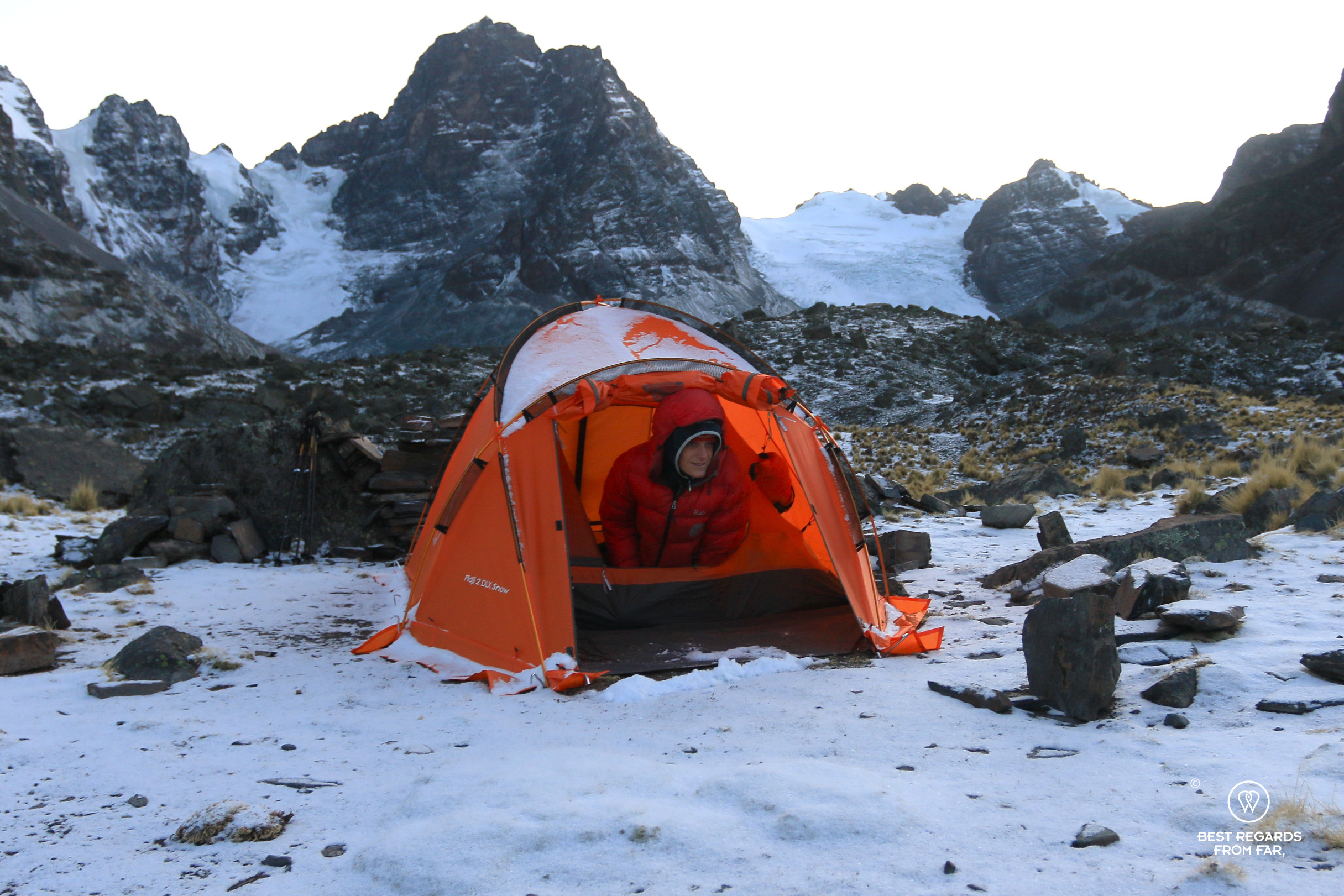
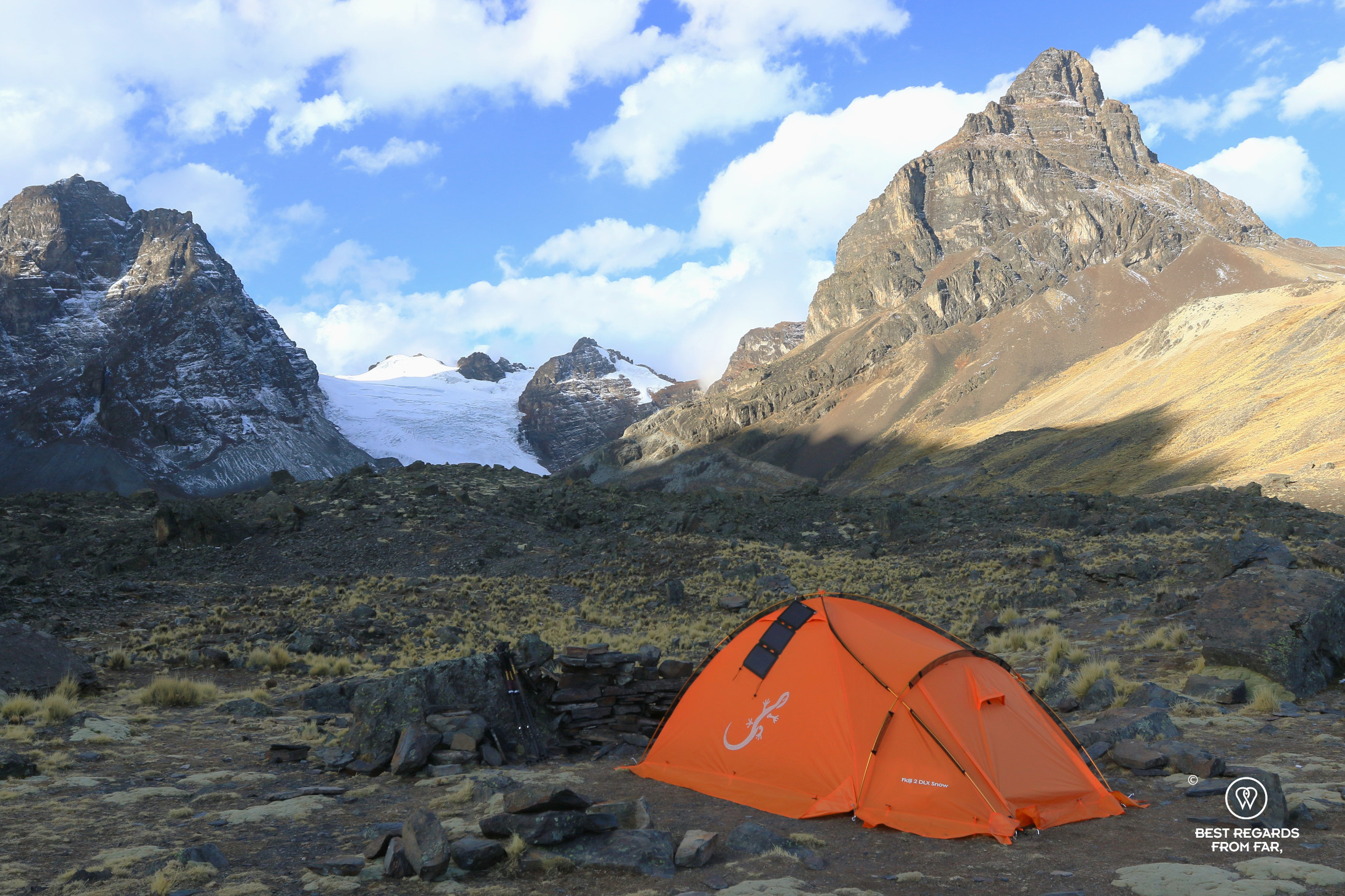
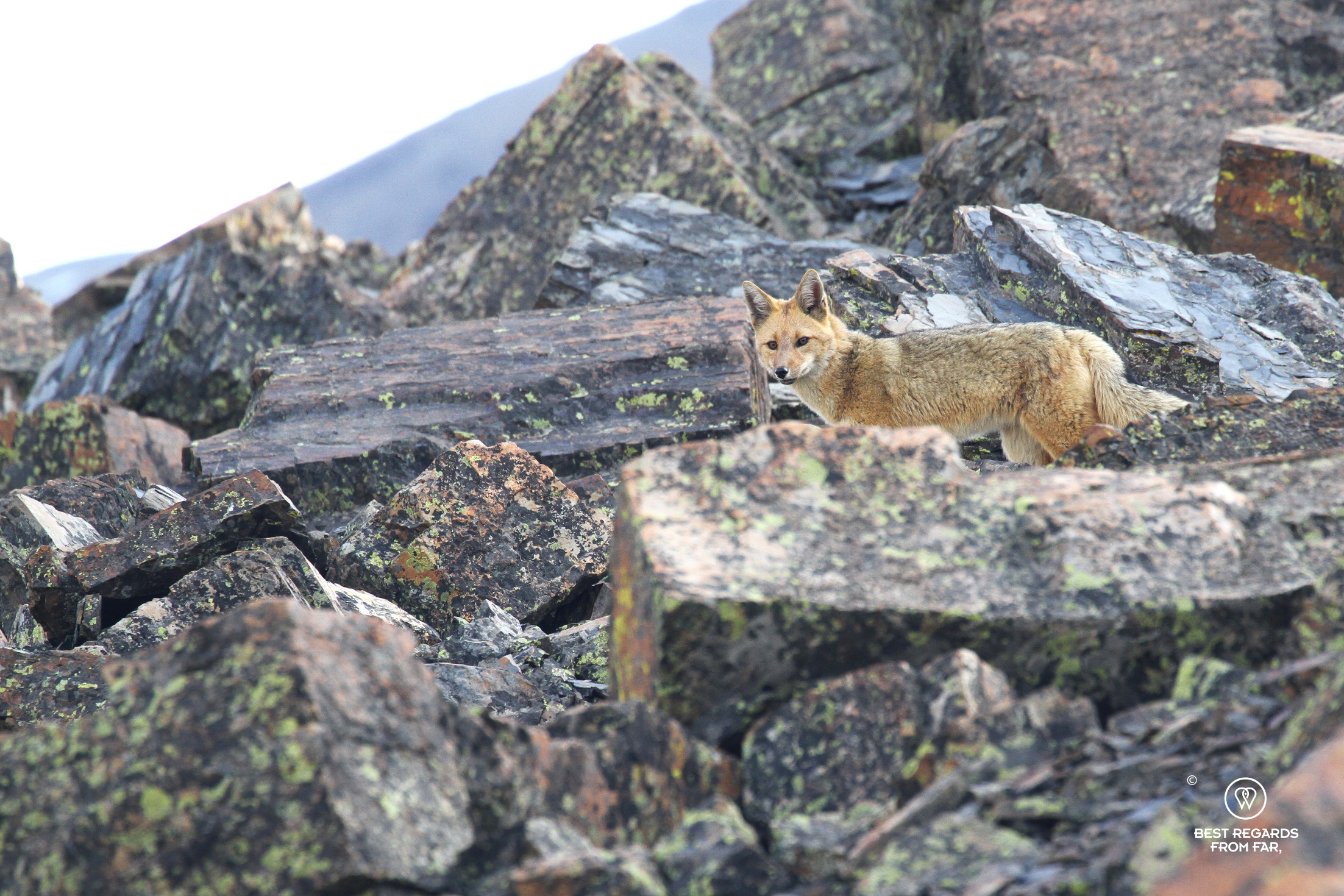
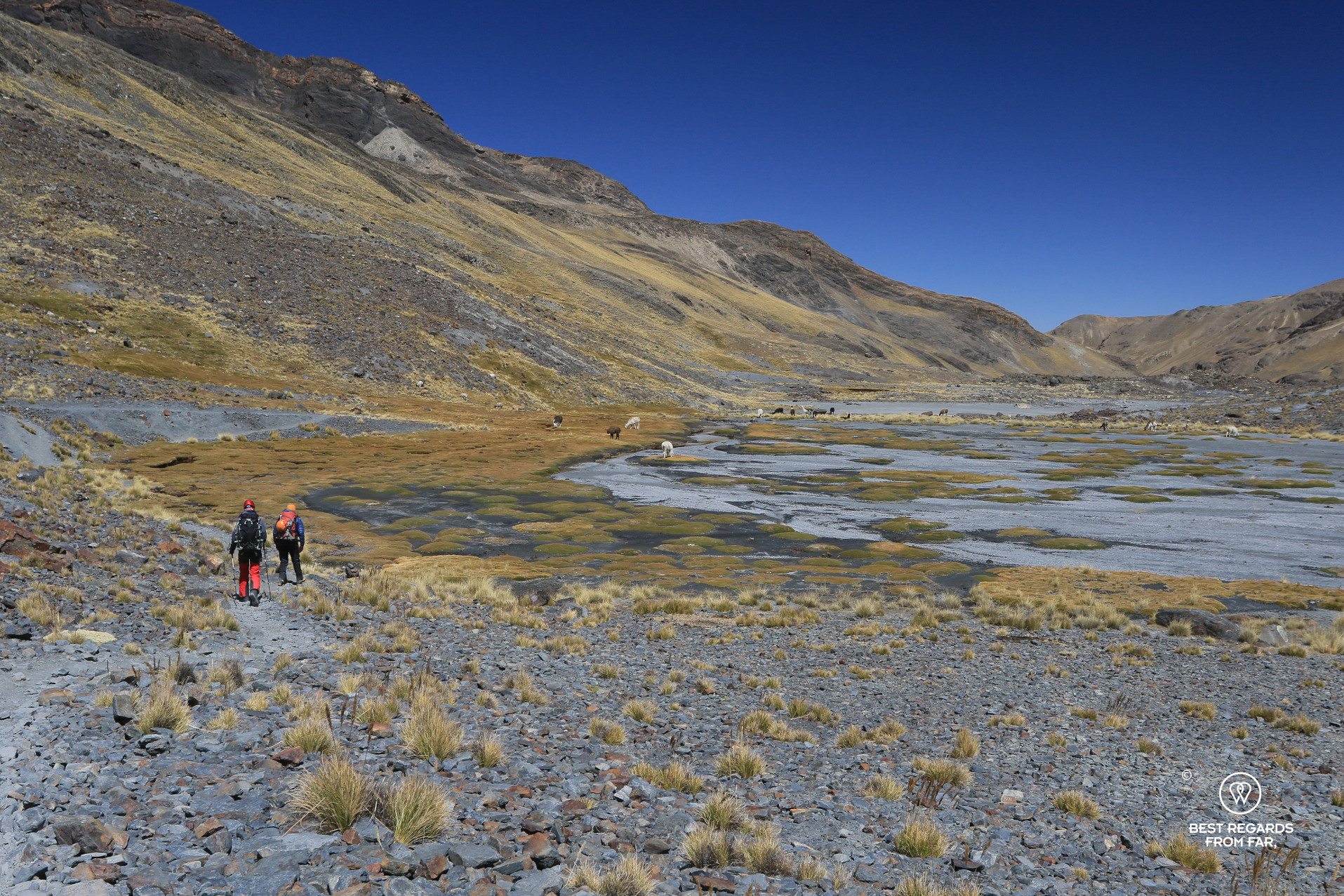
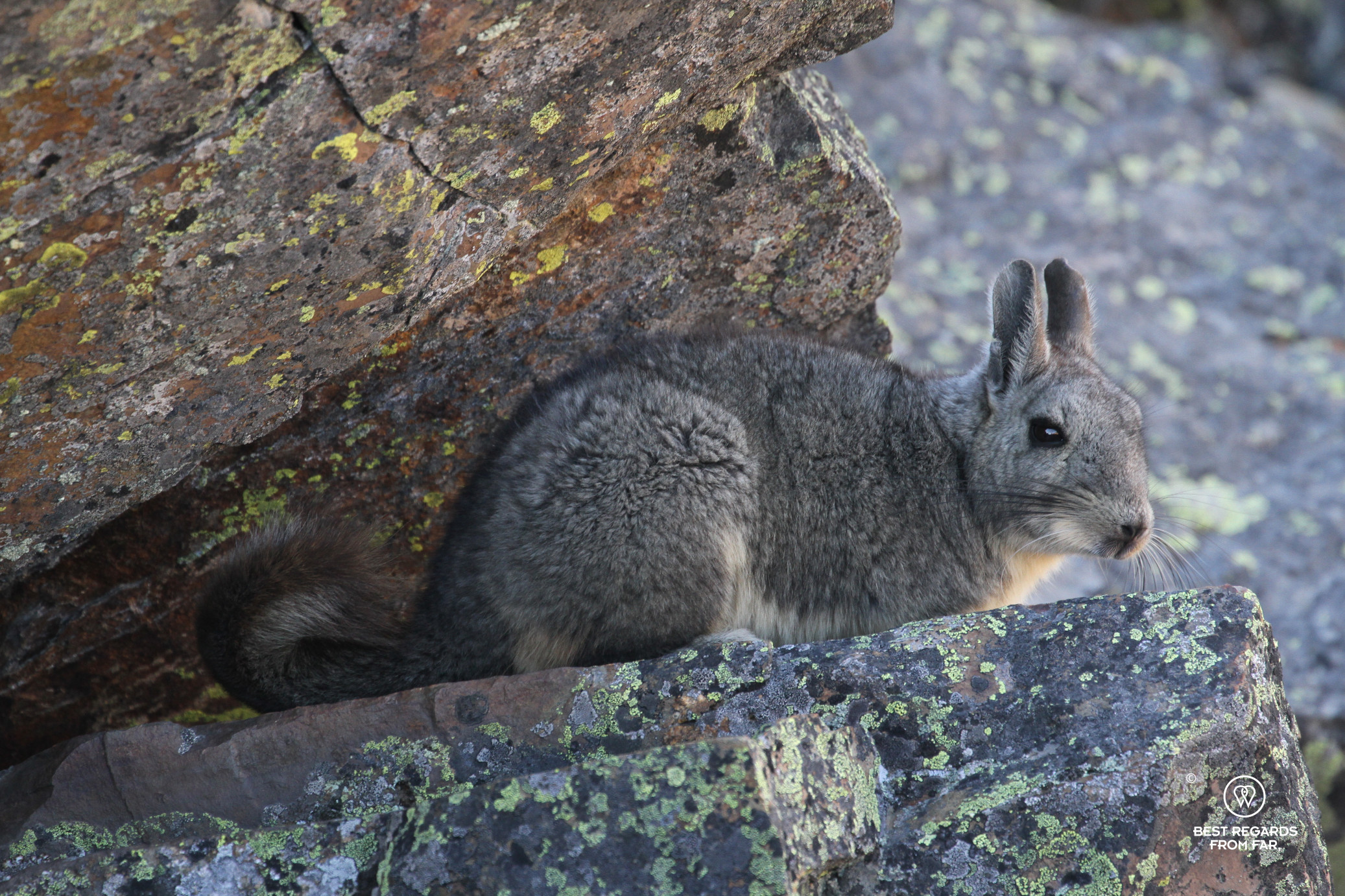
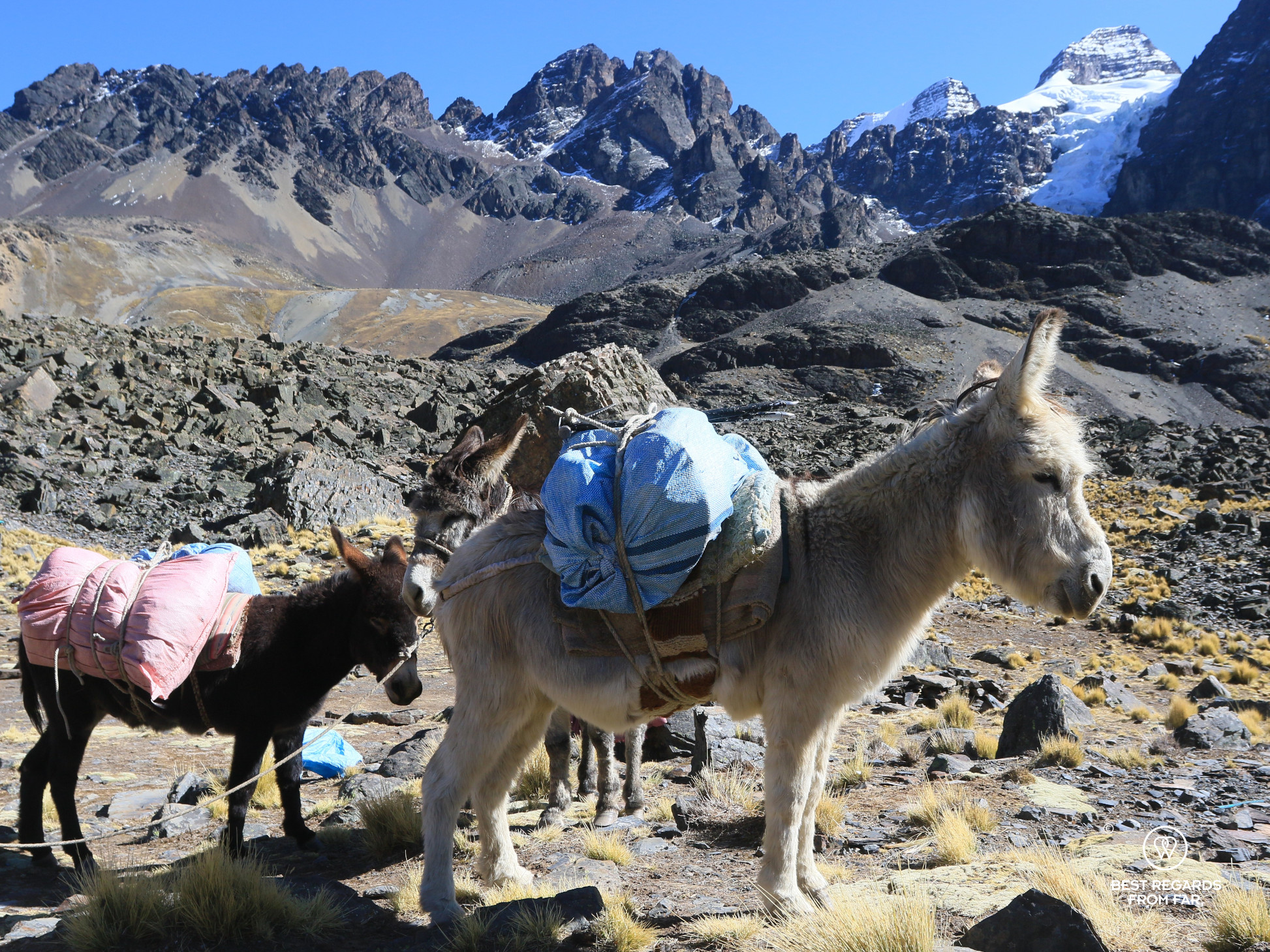
Yet the world continues along a narrow path. Our journey takes us along streams and mineral landscapes while the snow comes and goes. As we approach the Condoriri Base Camp, a few shy viscachas—rabbit-like critters, cousins of the chinchilla—curiously peer at us from the rocky outcrops. Alpacas graze nearby, blissfully unaware of our presence. The snow stops falling when we pitch our 4-season Freetime tent under the observing eye of some curious donkeys that helped us carrying the gear that we will need up here for the next few days. As the camp seems ready and Nolberto is pitching the last peg of his cooking tent, the clouds lift revealing Pico Austria, Tarija, and the famous Condoriri Peak in all their majesty. Taking it all in, we marvel at the breathtaking scenery, alone in this majestic and rugged landscape, and picture the routes we will take the following days to reach new heights.
As soon as the sun has set, the already cold temperature drops drastically, and we rush into the cooking tent. Vicky is preparing a soup with fresh vegetables and some pastas on a gas stove that warms up the common tent. Grateful for a lovely meal, we settle in for the night under a blanket of stars.
***
Day 2
Summiting Pico Austria (5,327m / 17,477ft)
The blanket of stars has silently transferred into a blanket of snow that gently covers our bright orange tent as we wake up. At the break of day, we take in the landscape with its fresh layer of powder and eagerly join Nolberto and Vicky in the cooking tent to warm up, hardly ever been so happy to find scrambled eggs, warm bread rolls, coffee and coca tea already prepared!
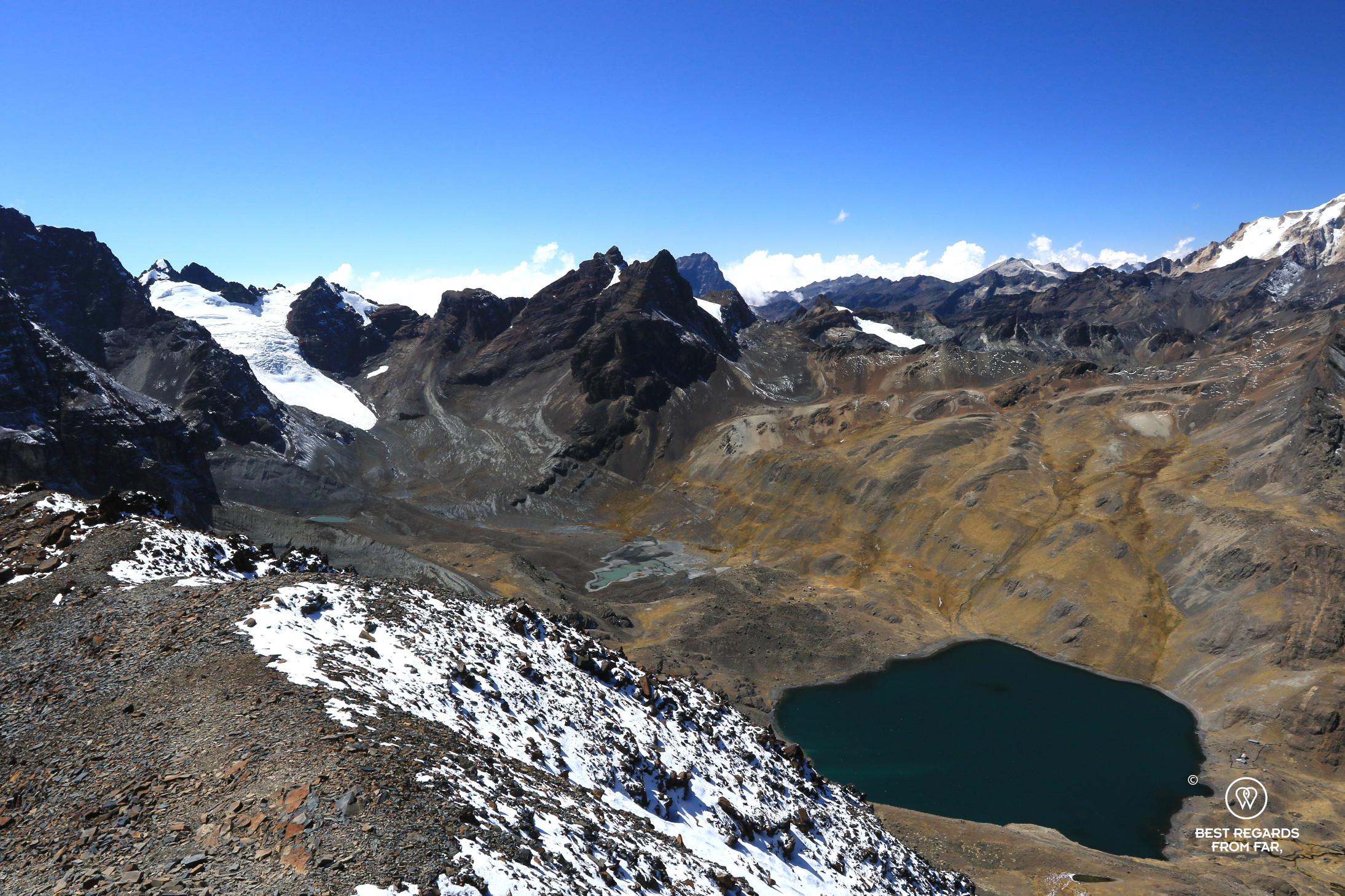
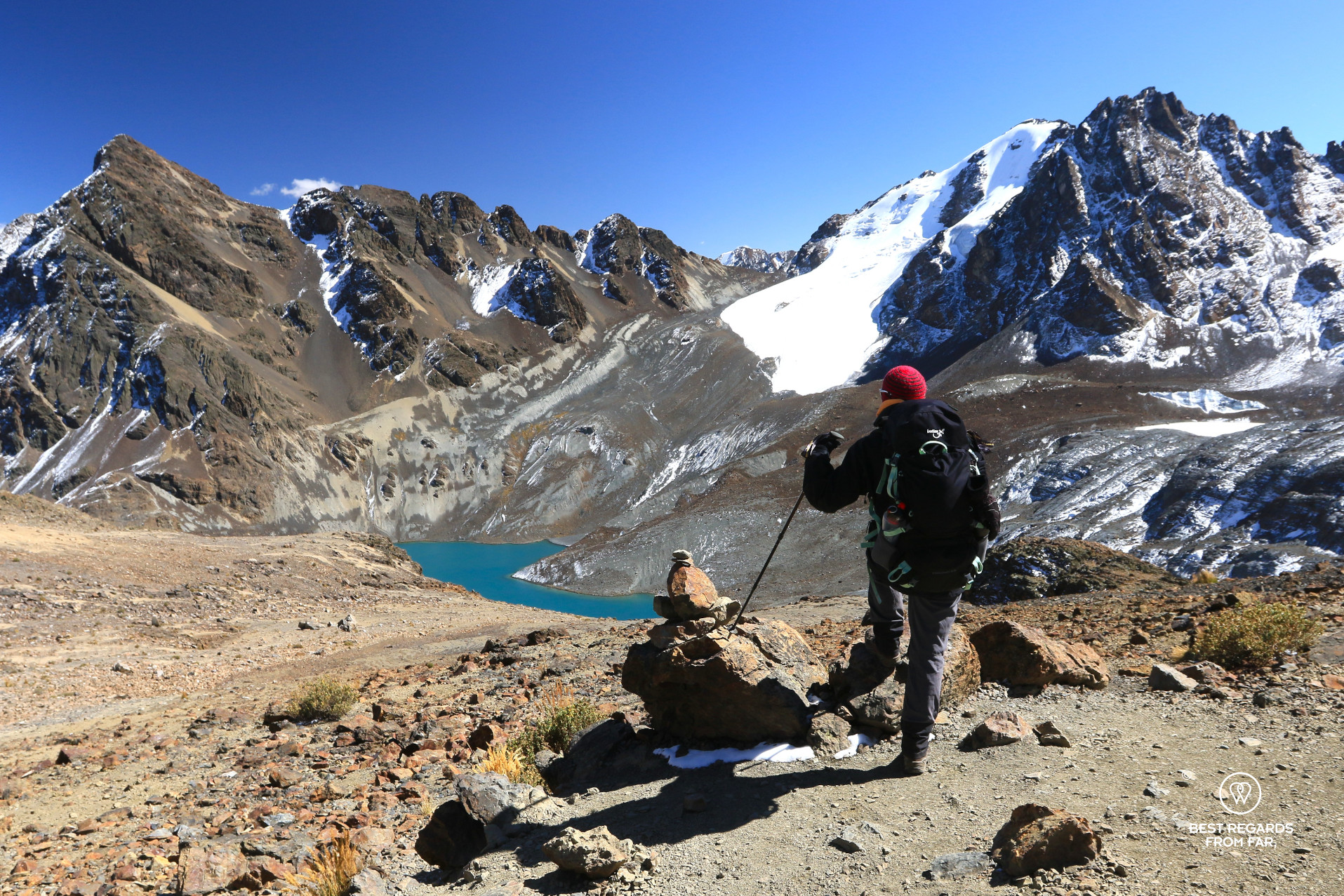
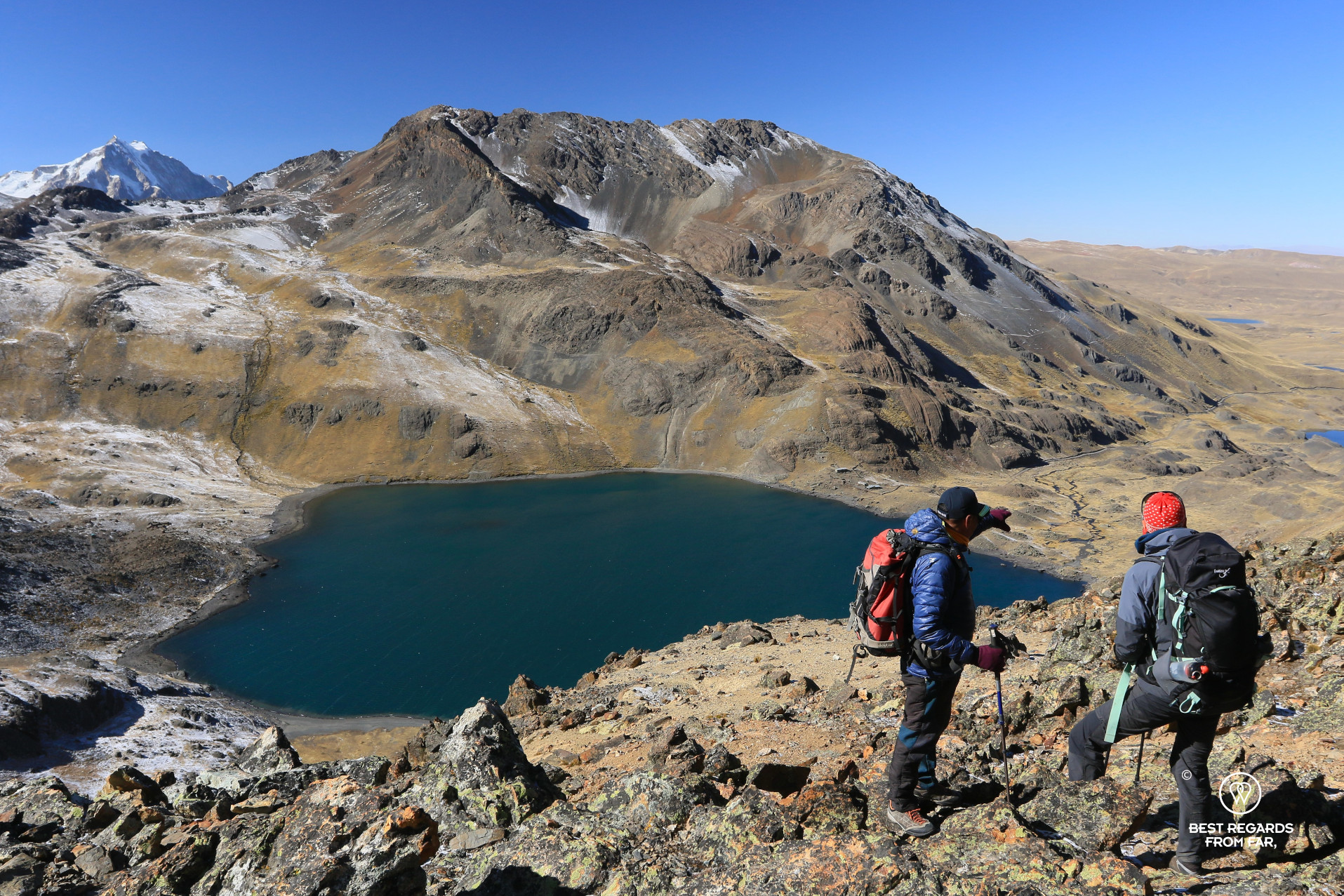
Soon after, we are on our way to summit Pico Austria. The snow crunches under our feet as we make our way across the pristine landscape. The view is breathtaking, with Huayna Potosi—one of the most famous peaks in Bolivia—in the distance. As we ascend past the 5,000-meter-mark (16,404ft) an hour or two later, the ice-cold wind picks up, chilling us down when taking photographs. The spectacular vistas on the high-altitude lakes, surrounding peaks, and our base camp below that looks so small and gives us a sense of scale make it all worth it.
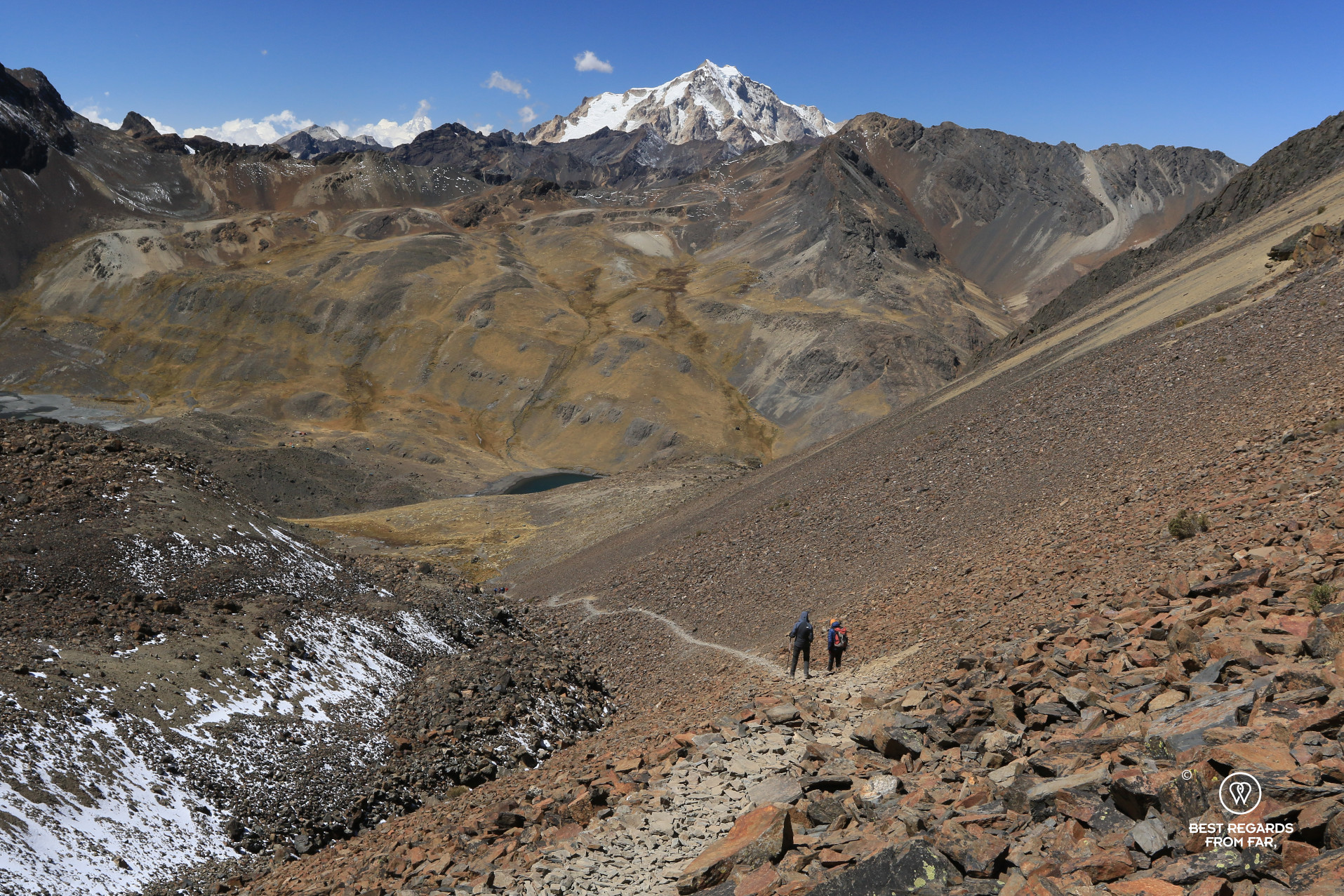
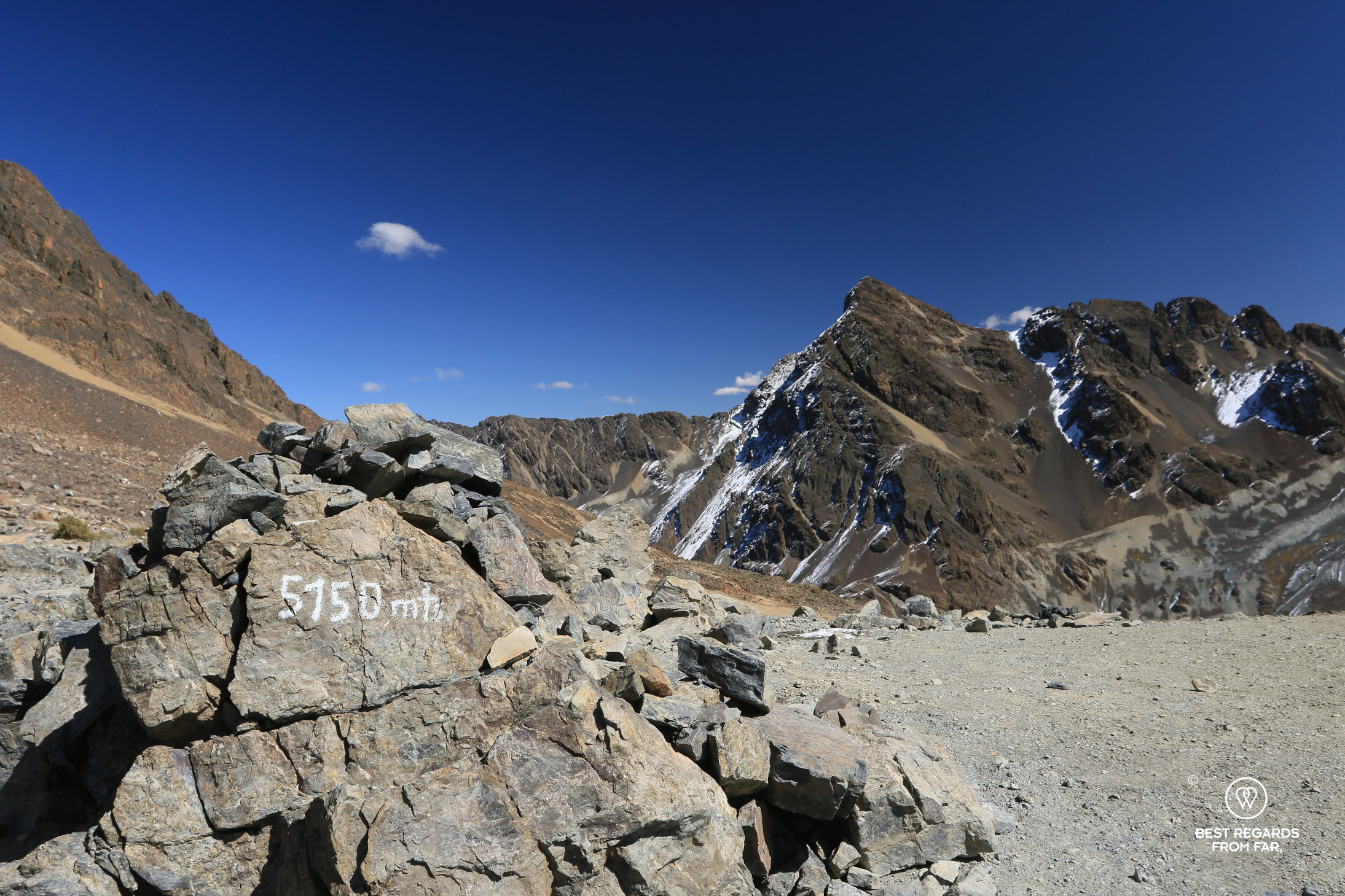
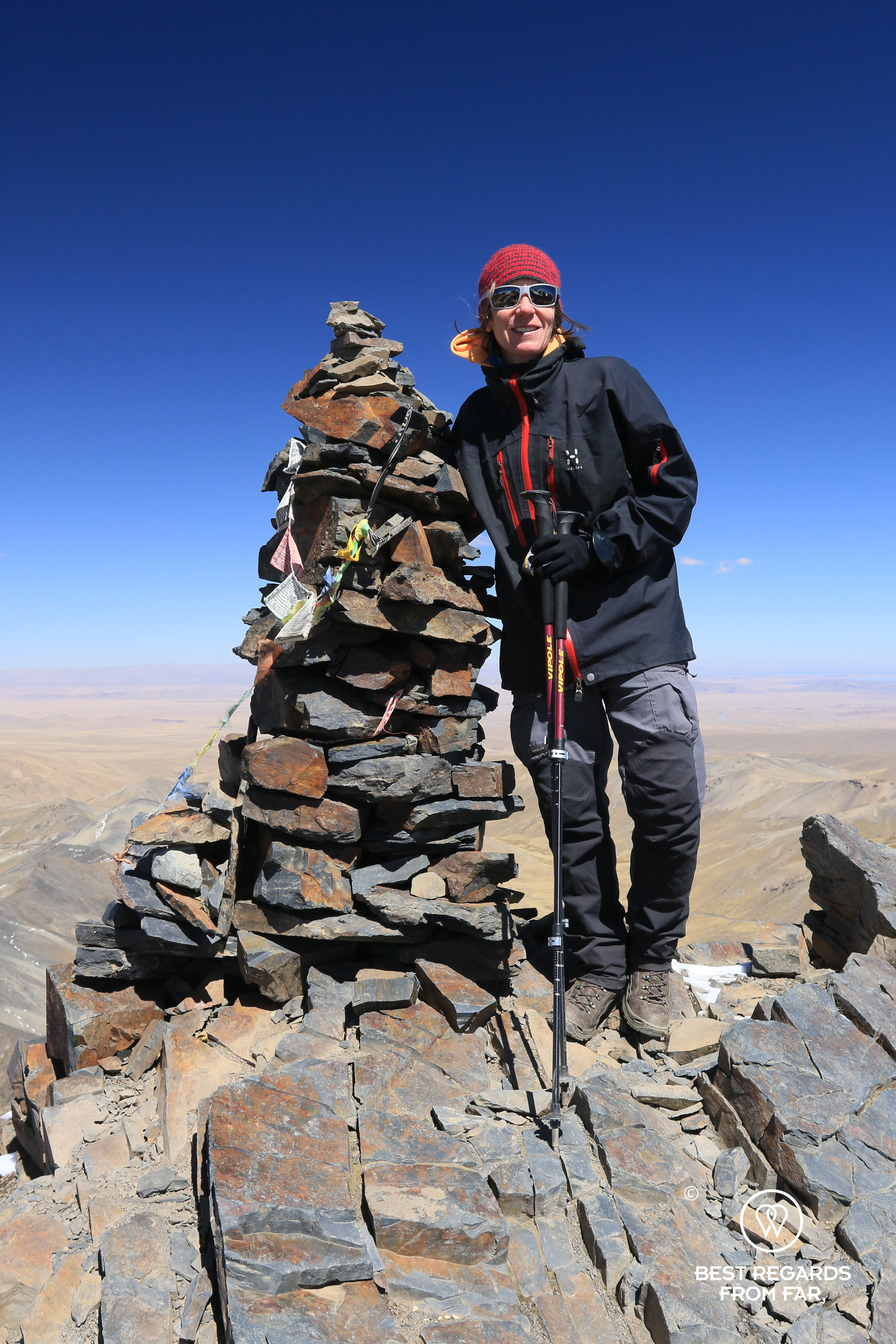
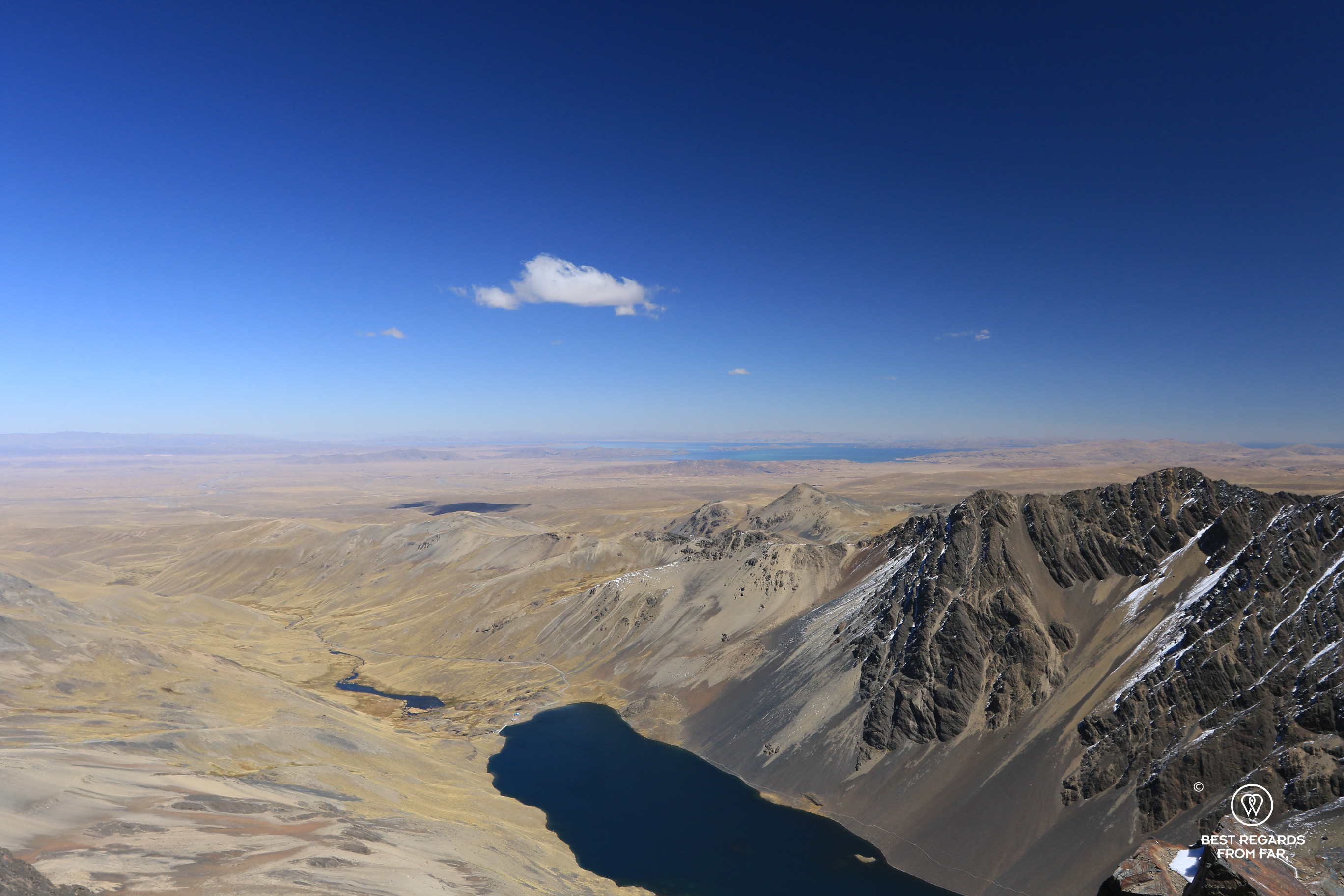
At 5,327 meters (17,477ft), we reach the summit of Pico Austria. From the top, we can see the legendary Lake Titicaca and more snow-capped peaks stretch out in all directions. The wind is fierce, and the cold forces us to head back down, but not before we take a moment to appreciate the view and assess our goal for tomorrow: the snow-capped Tarija. Just as the way up, the way down through the mineral landscape is non-technical and the perfect high-mountain adventure to acclimate.
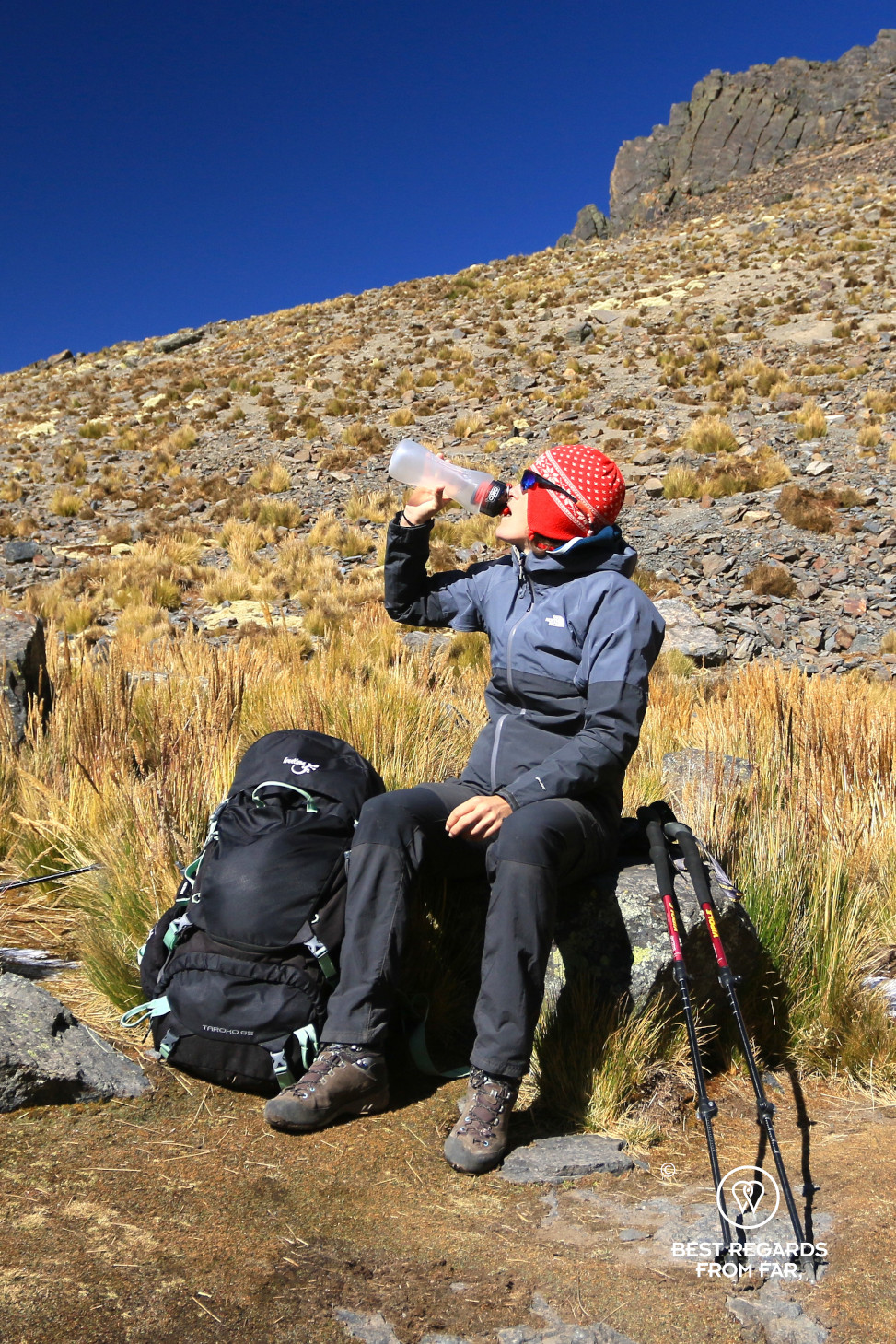
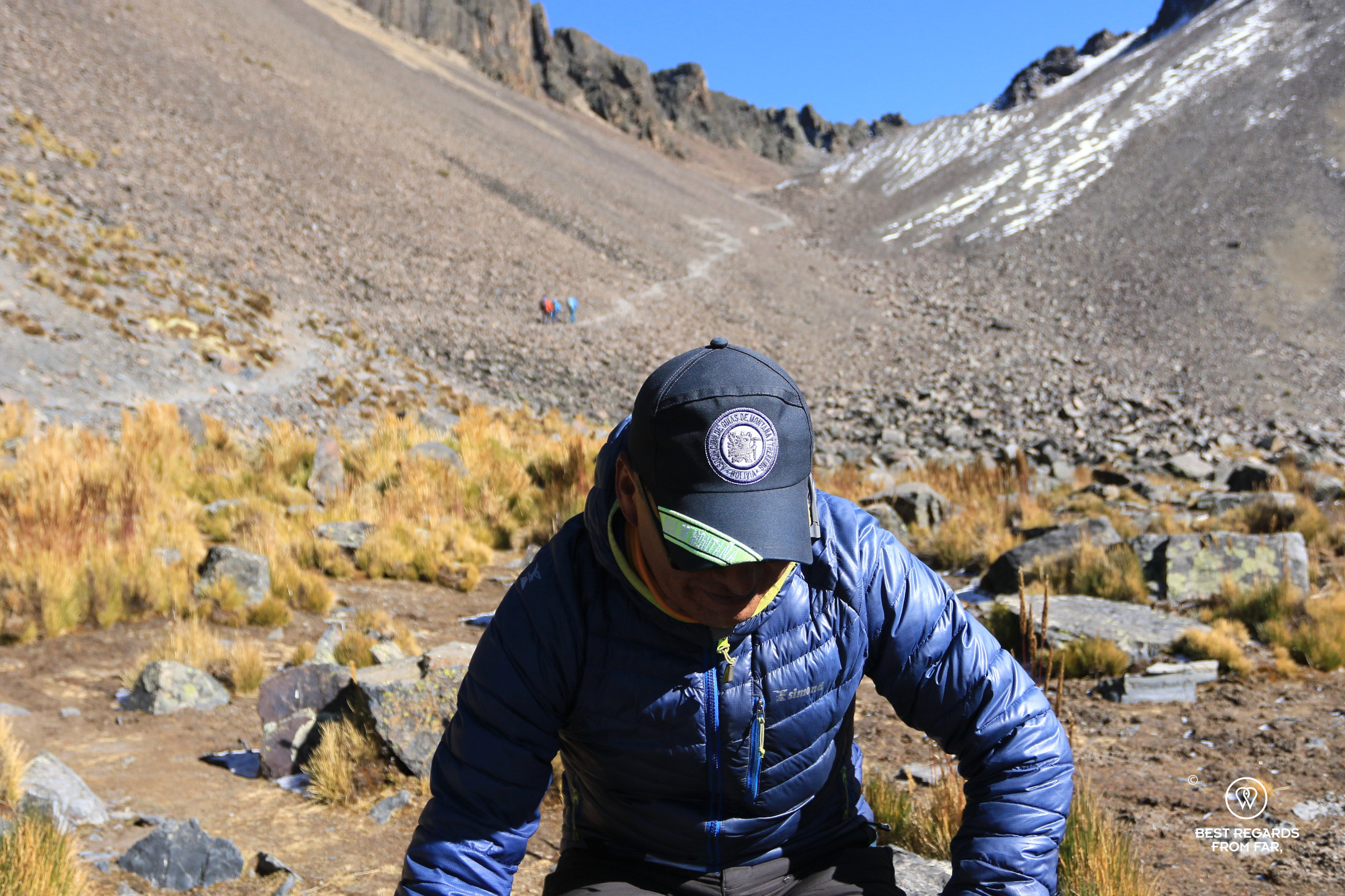
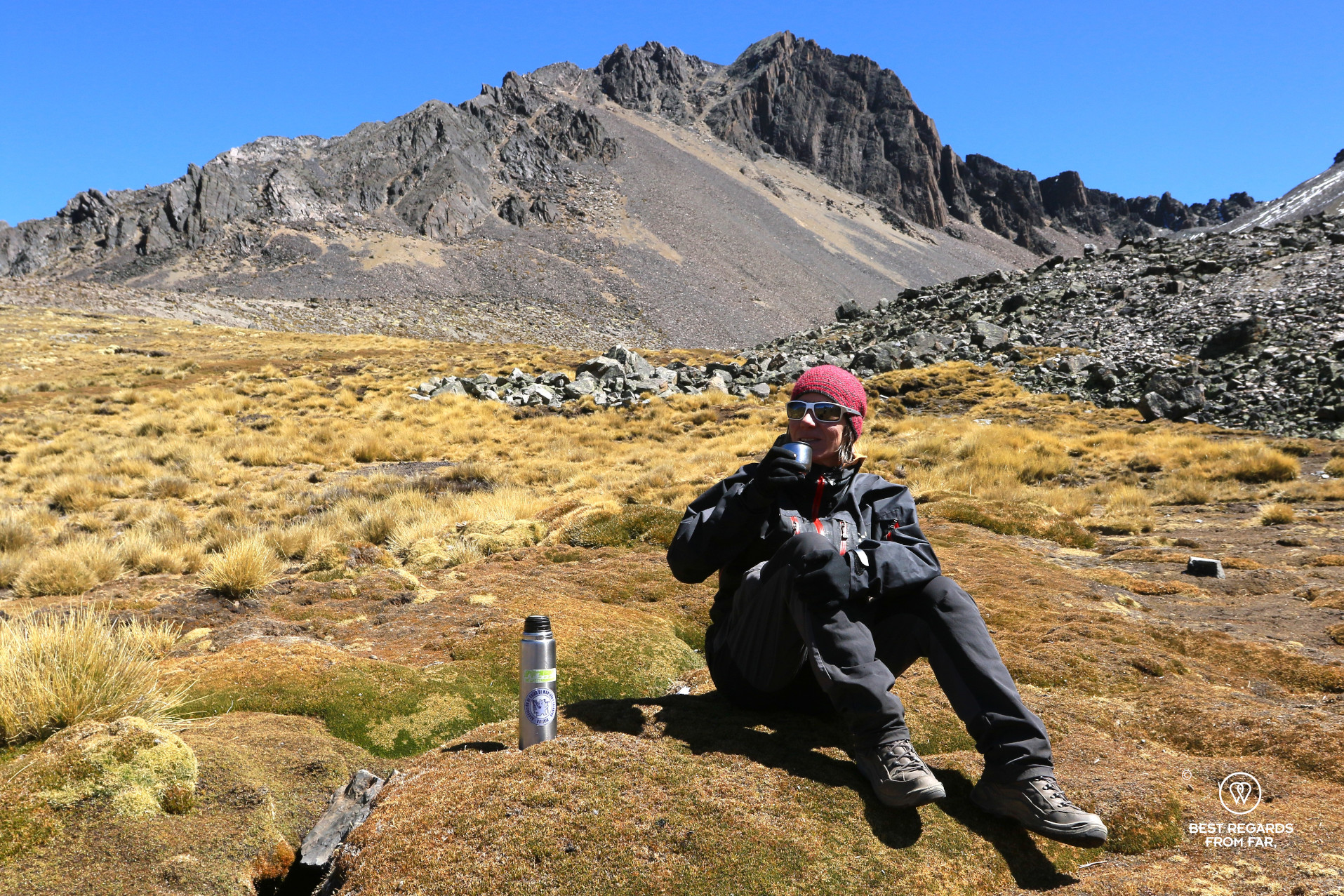
From base camp, Vicky was keeping an eye on us, also communicating with Nolberto by walkie-talkie, and a warm soup and beefsteak with potatoes and rice await. From the warm shelter of the cooking tent Nolberto shares his passion for the mountains and his story about how he became a certified high-mountain guide. Starting as a cook on high-altitude expeditions, he worked as a porter for a couple more years. One day, he found himself summiting Cabeza del Condor by himself at a dazzling 5,648-meter above sea level (18,530ft) before rushing down and cooking an early breakfast for his guests! It was then that he realized his true calling: guiding. Humble, he is well-aware of the dangers of the mountains that he greatly respects. This is why, instead of taking the easy path to some extra cash as a guía trucho (or fake unqualified guide), he saved every boliviano he could to put himself through a proper high-mountain guide education. Talking about mountaineering, we stay warm sipping coca tea while the ever-increasing wind storm is howling and seems to disrupt our plans for tomorrow’s ascent…

Storms & Surprises
…As we are about to rush from the cooking tent to our tent, Nolberto opens the discussion setting expectations for the next day, given the wind storm we are facing. We agree that our plan to wake up at 2 AM to start our ascent and summit Tarija at sunrise seems no longer an option. Disappointed, we cannot change the weather conditions and safety is top priority. We lose a summit and win a long and good night rest, feeling a little relieved to not have to brave the unbearable wind.
I crawl into my warm sleeping bag while the temperature drops way below freezing. While the wind violently shakes the tent, I can only imagine what the glacier and summit might look like.

***
Day 3
It is 4 AM when I notice a flashlight approaching our tent. Other than hearing footsteps it is quiet outside. Unexpectedly, the storm has passed! Nolberto has been keeping an eye on the weather conditions and has already instructed Vicky to prepare some warm snacks for us. Tarija is a go! We quickly and eagerly jump into extra warm pants, down jackets and cross over to the cooking tent. Maybe Vicky’s smile warms us up more than the welcoming coffee at this early hour. After a last gear check, we head out in the darkness of this cold, starry night following Nolberto’s sure foot with our Prolutech head lamps that we charged on solar the day before as batteries drain very fast at these temperatures.
Climbing the Tarija Glacier to the Peak (5,340m / 17,520ft)
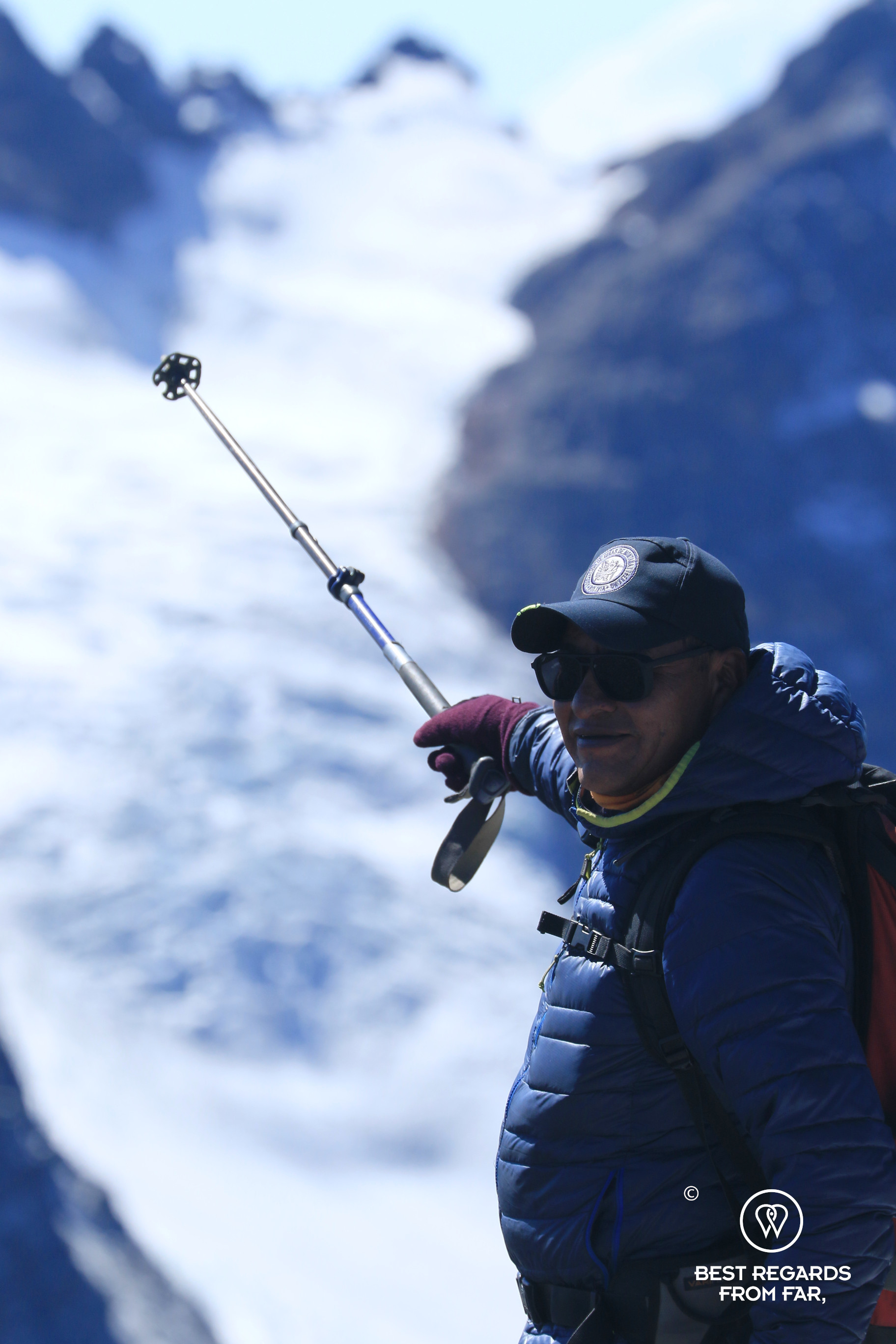
After an hour of following Nolberto’s sure and steady pace, we reach the foot of the glacier. We gear up, strapping on crampons and securing helmets. With no trail visible and the ice conditions on the glacier ever-changing, Nolberto’s qualification and experience are a pledge of safety.
As we climb, the sun begins to rise, casting a golden glow on the surrounding peaks. The slope becomes steeper, the air thinner, and the wind colder. The glacier is clearly alive, its surface cracking beneath our feet, but Nolberto guides us expertly through the crevasses, also knowing when to rest with a last hot coffee before the summit.
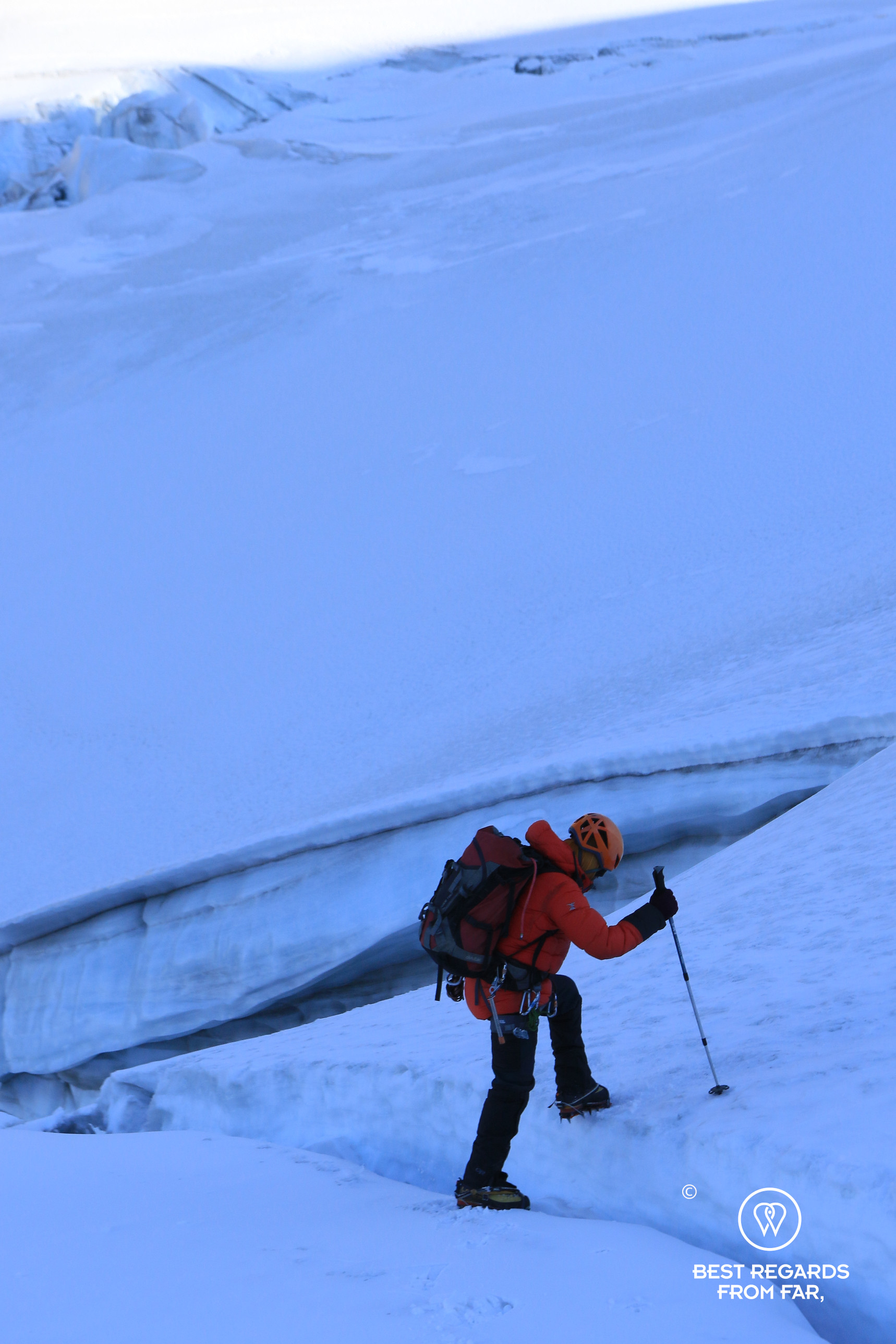
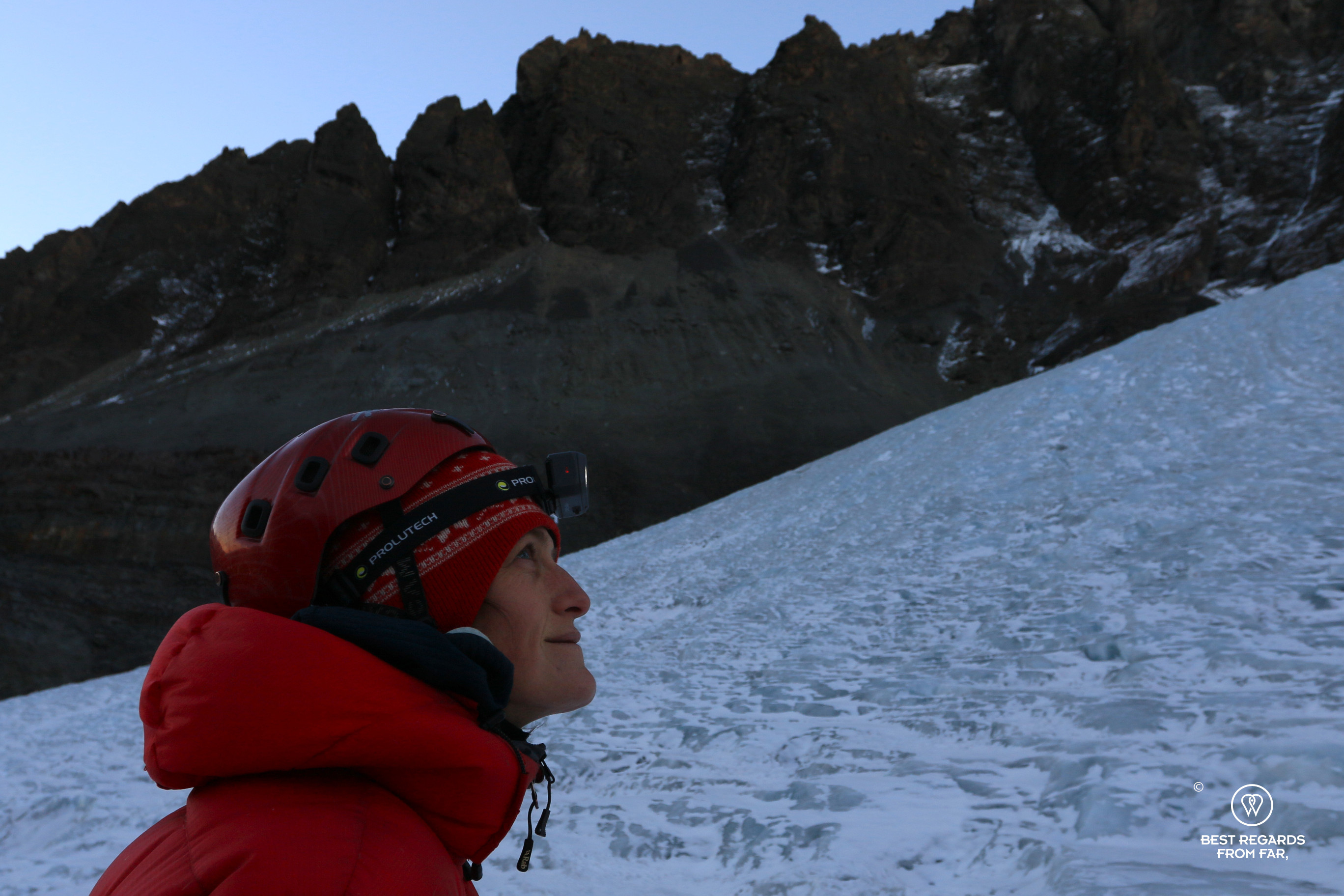
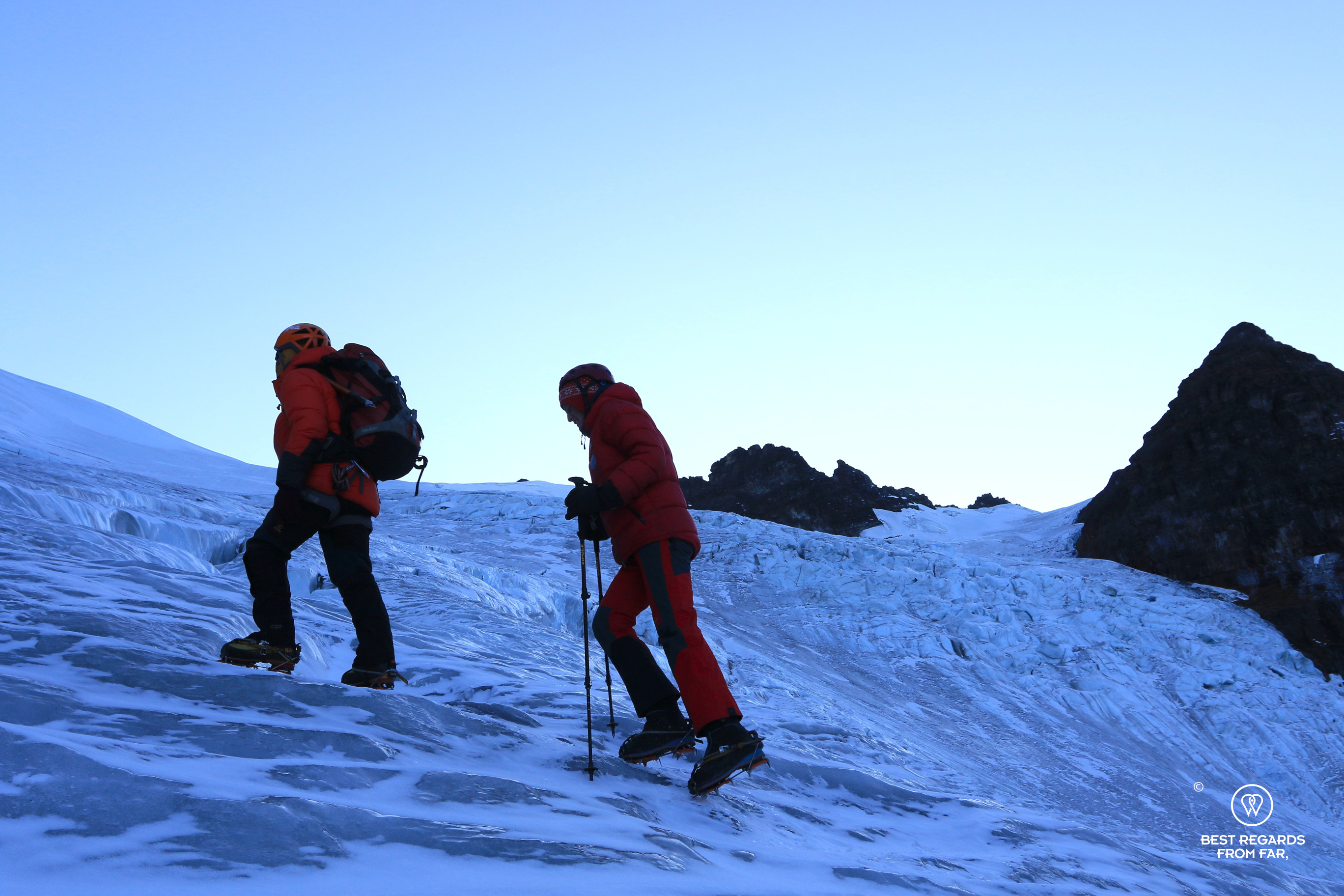
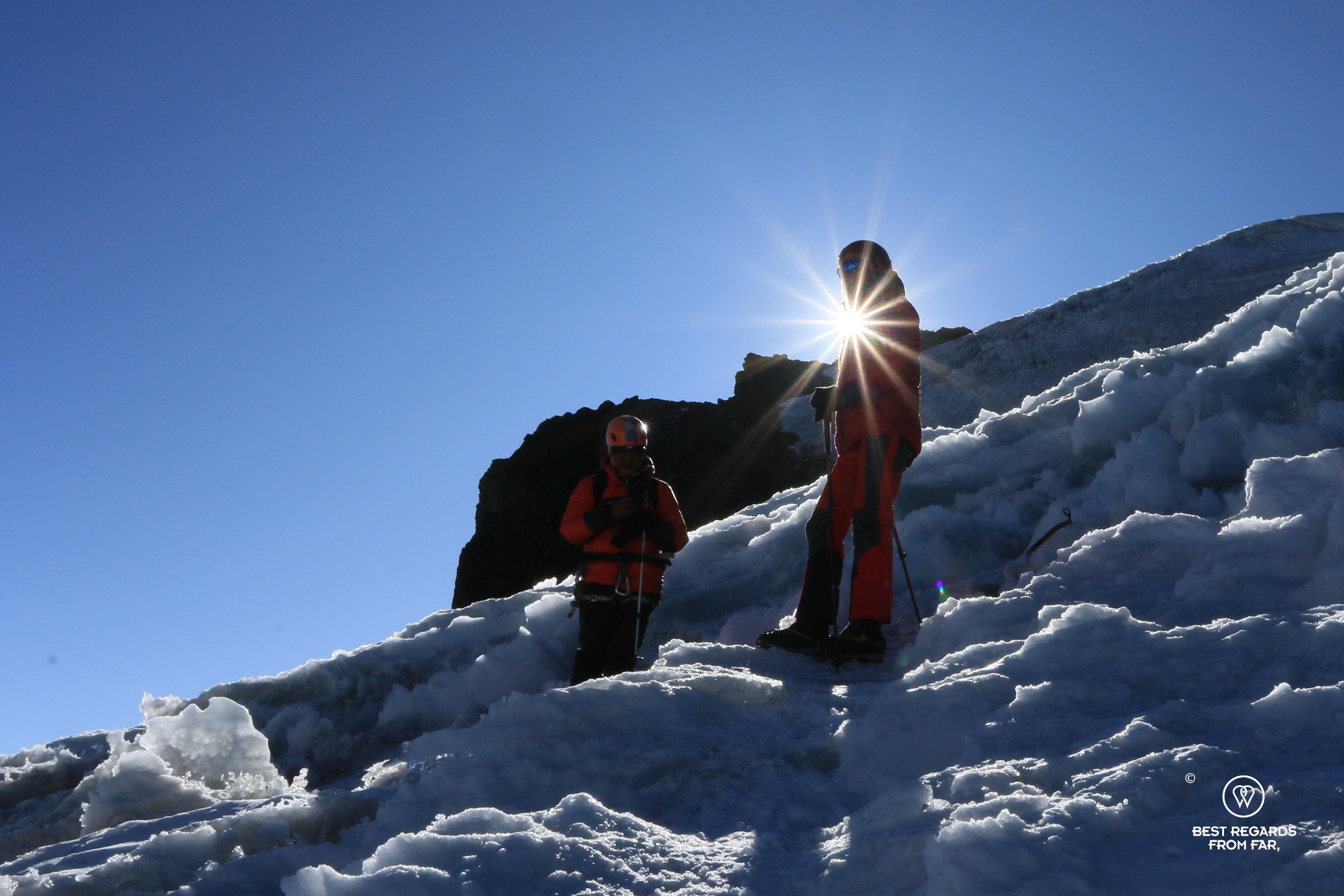
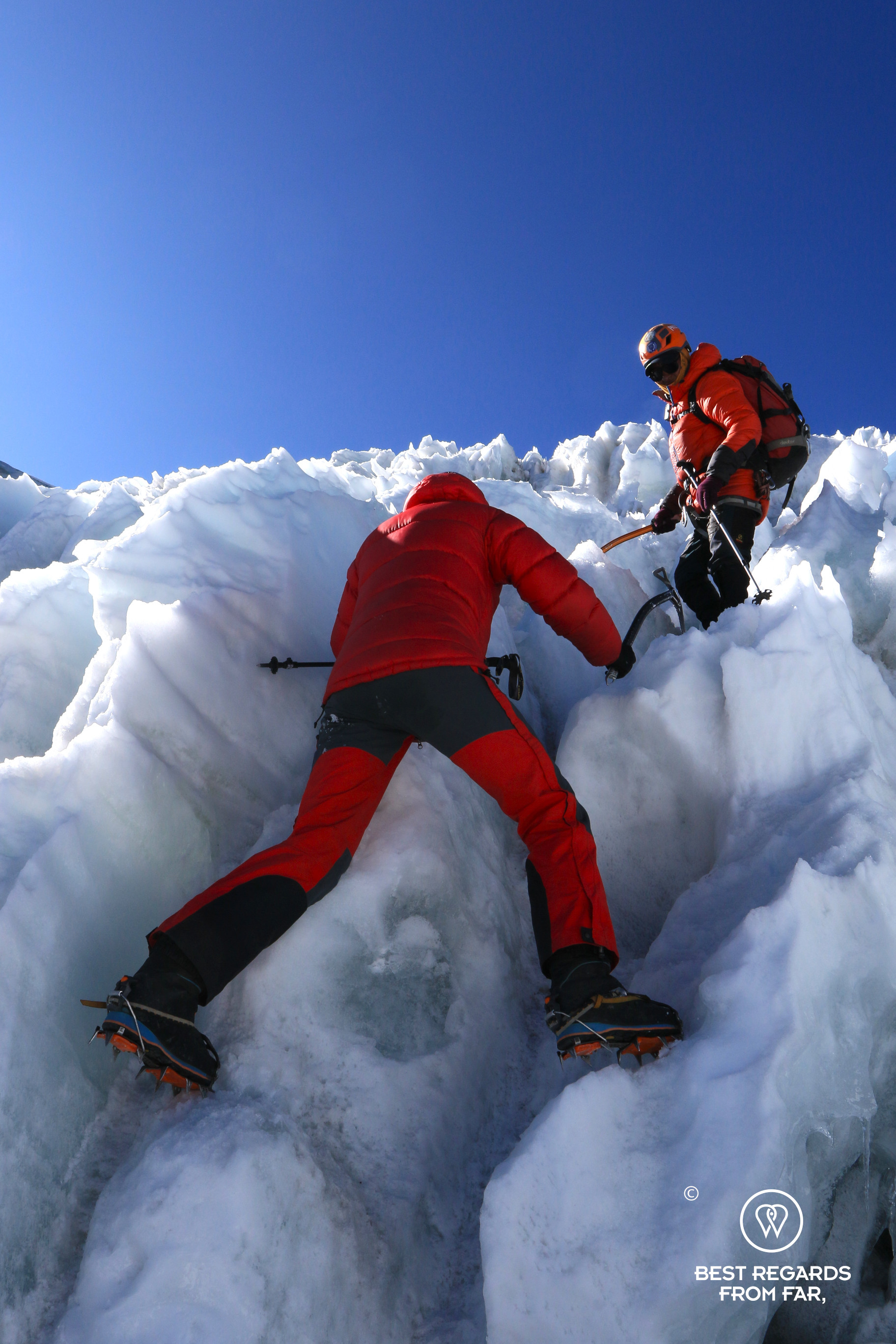
We reach the blue surreal world of ice pinnacles that become more challenging as we gain altitude, using axe and crampons. After this final technical climb, we eventually reach the summit! We hug each other at the peak of Tarija, and humbly take in the view from the top. Wide grins lit up our faces, and while Nolberto has climbed this summit many times, his happiness and passion are intact.
After capturing this moment with our pro Canon cameras that feel much heavier than usual at this altitude, we head back down: with changing weather patterns all over the planet that affect even more the extreme climate areas, it is critical to head back down early enough to avoid the dangers of the warming ice. Small clouds that Nolberto monitors start packing in the distance above the rainforest that counter-intuitively is actually quite close by. The technical downhill is challenging, but we make it back to base camp where a warm soup and a perfectly cooked chicken with its comforting sides are thoroughly enjoyed.
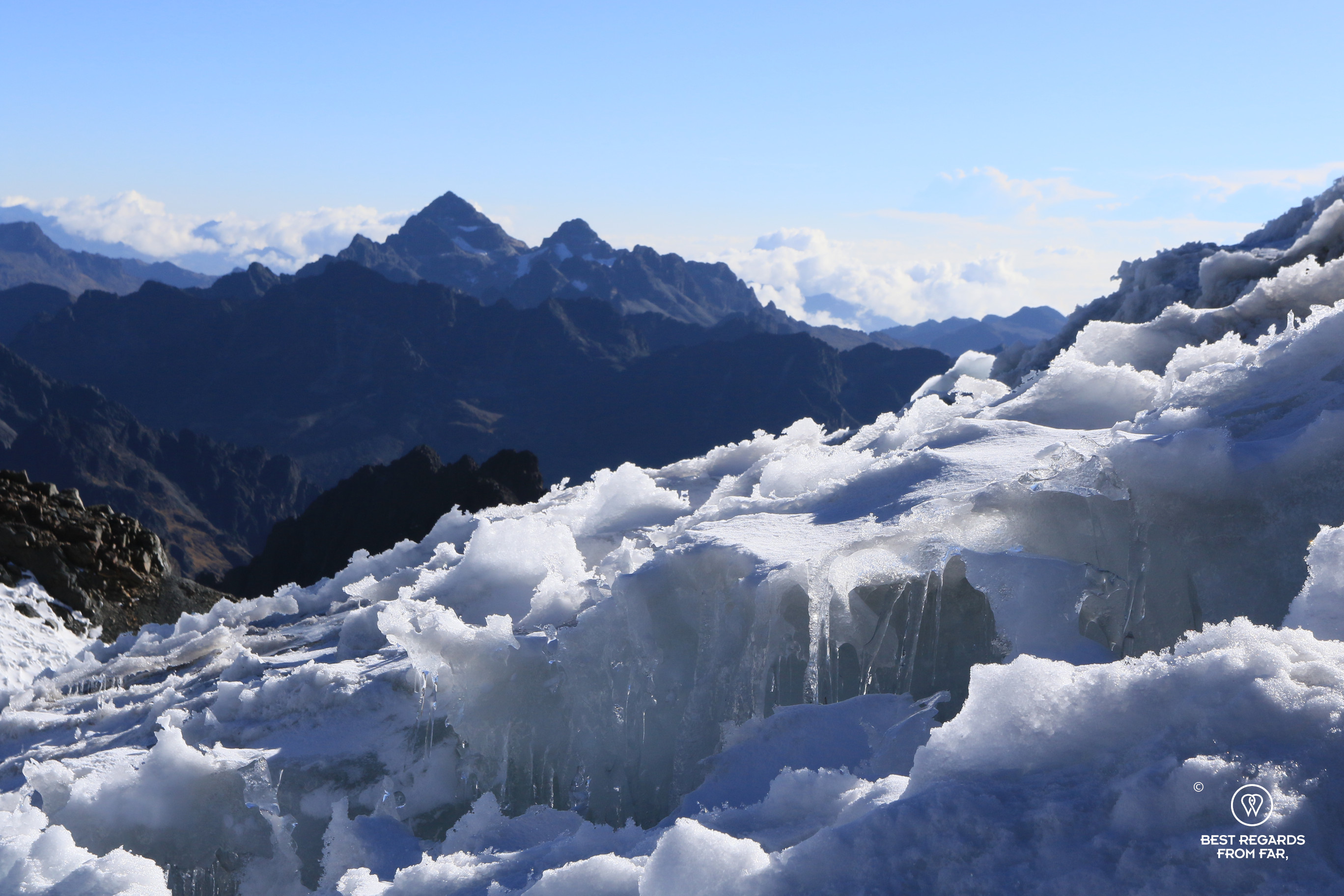
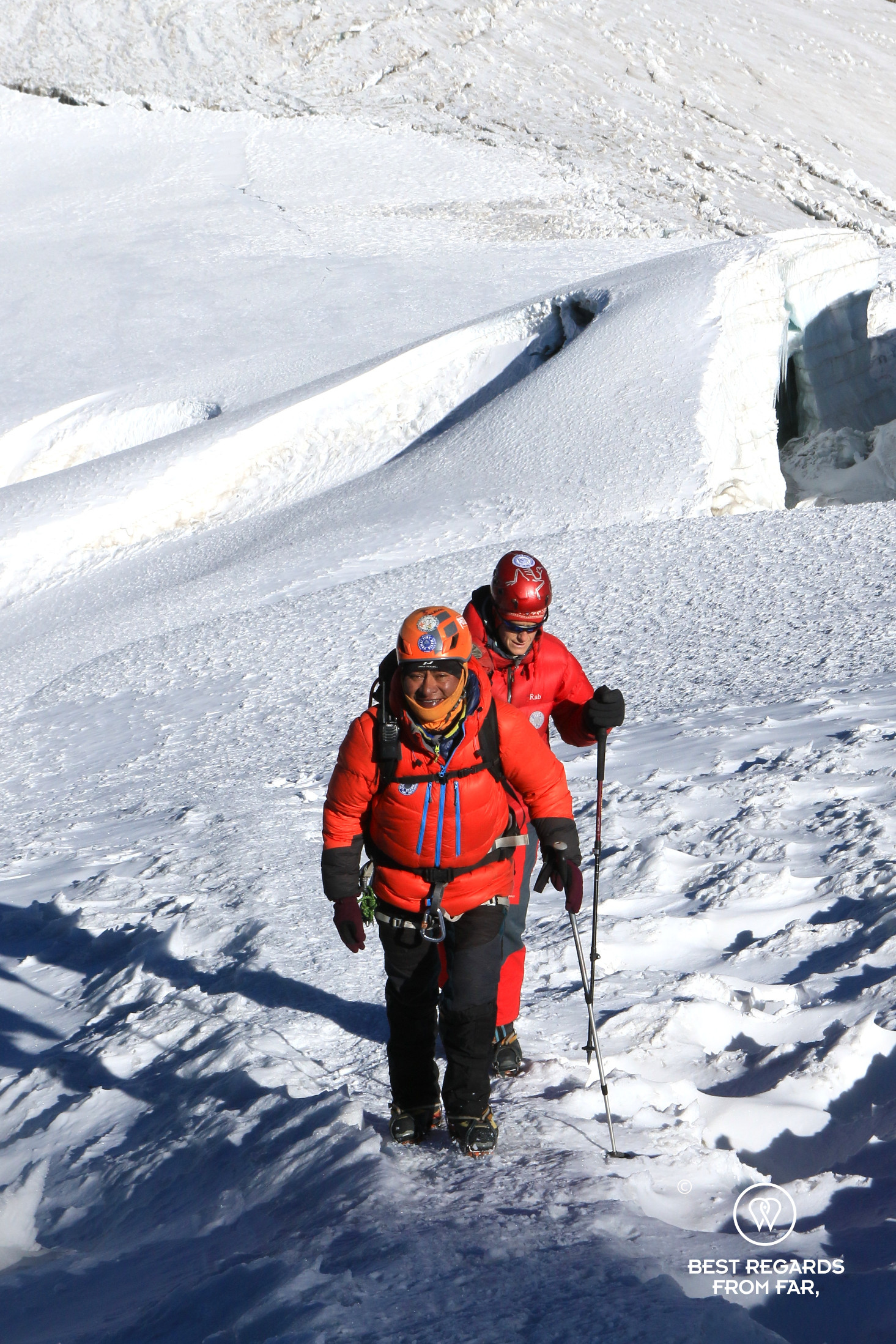
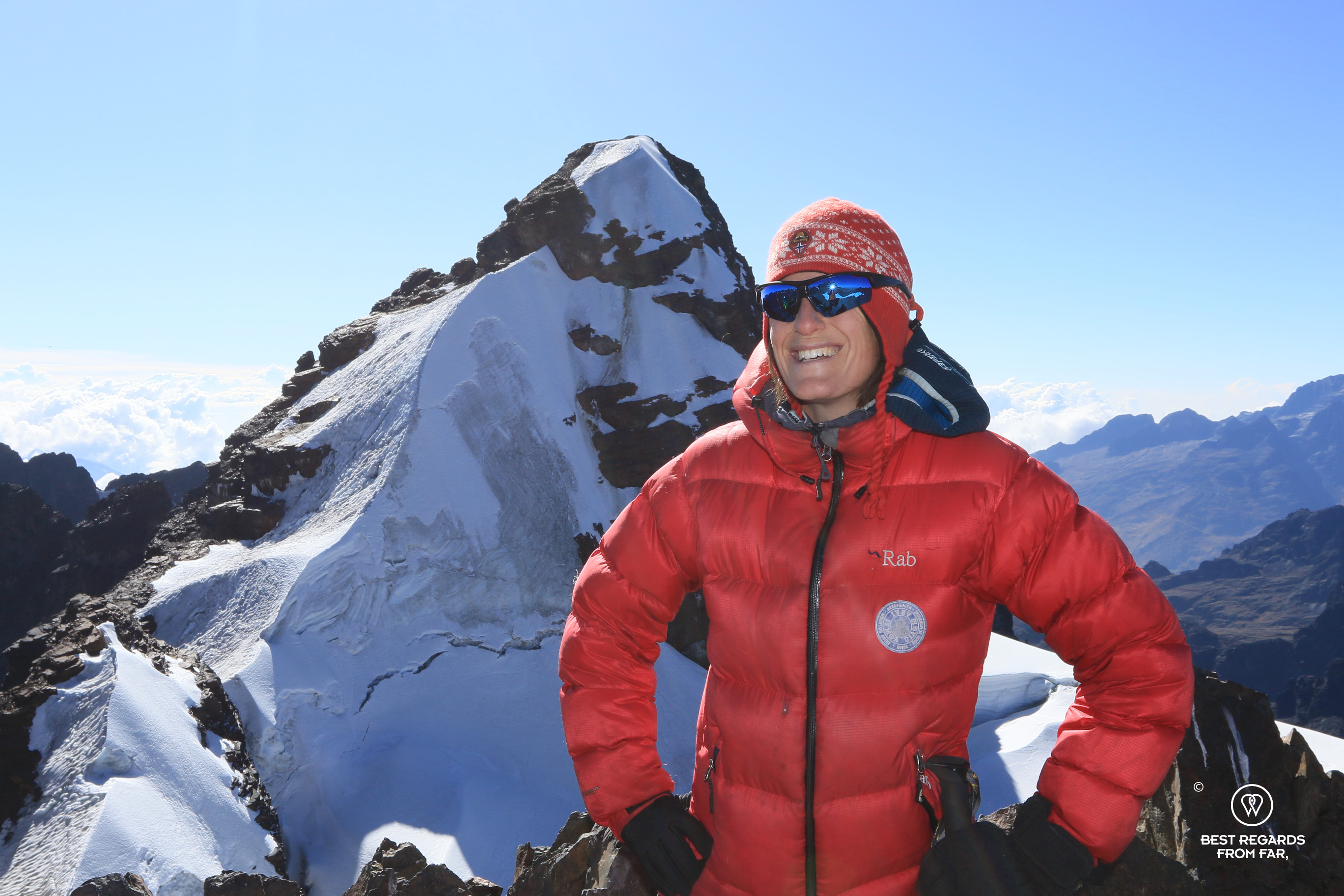
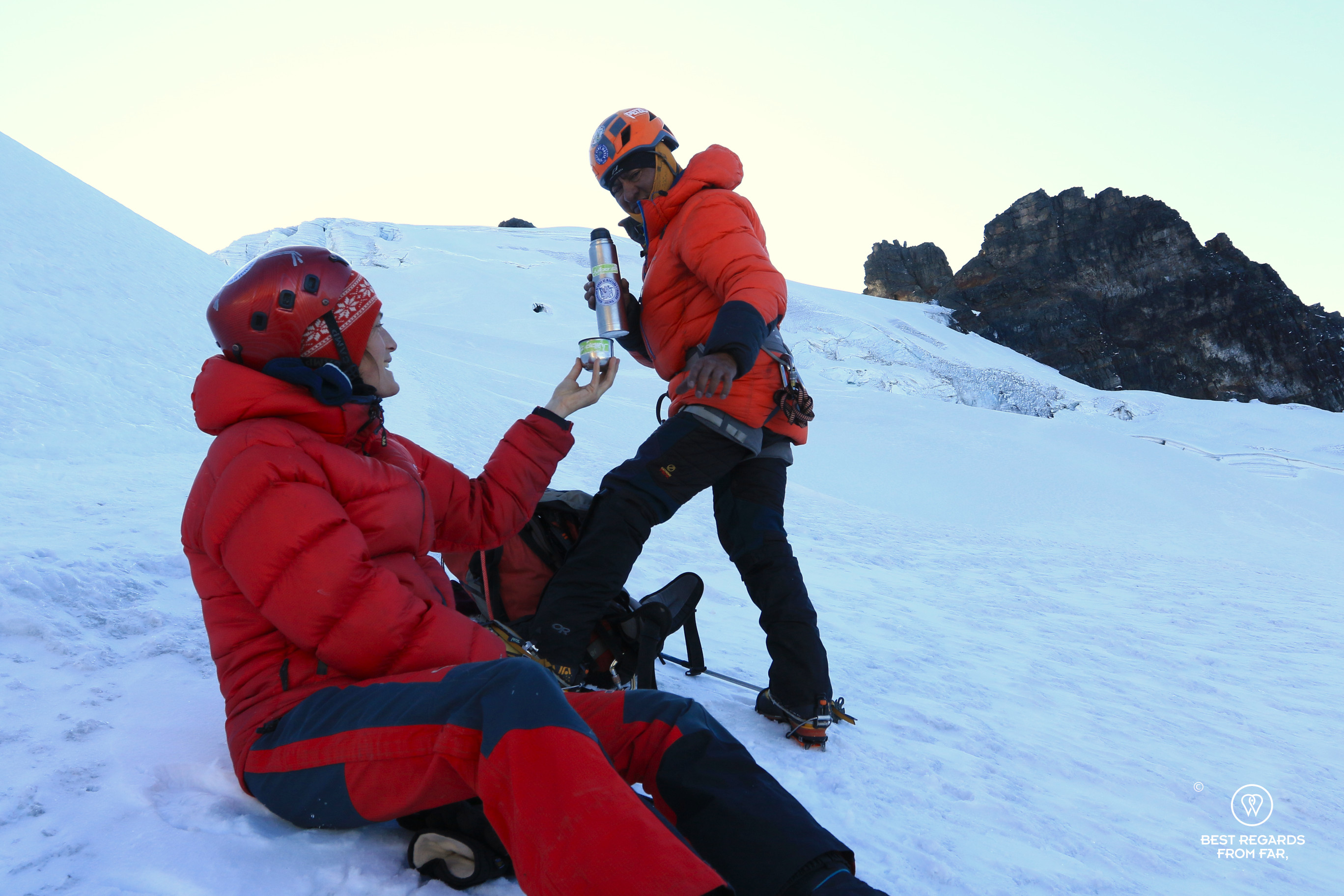
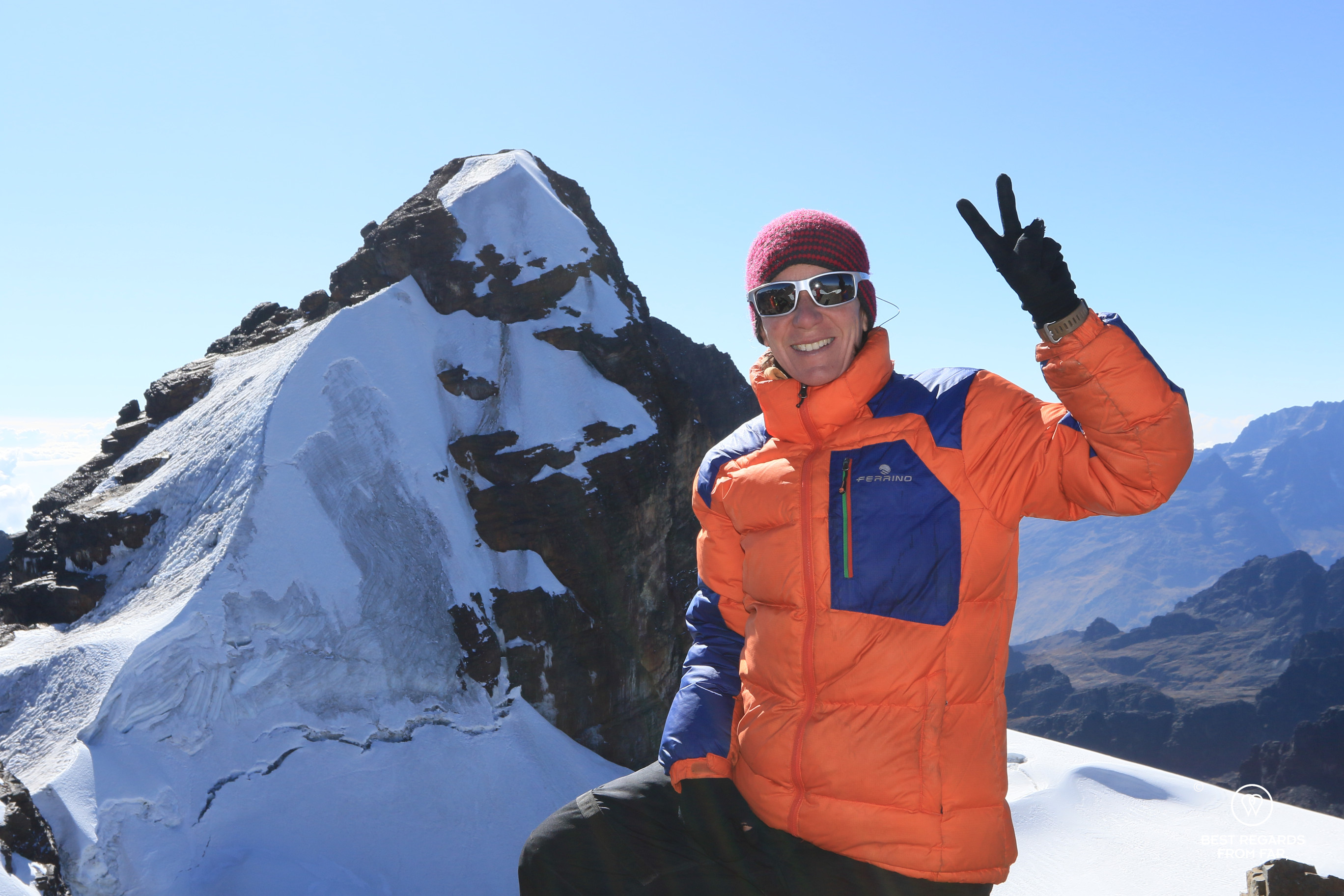
We take a moment to relax by our tent, taking in the raw beauty of the Cordillera Real. As unexpectedly as the storm laid down overnight, the Tarija Peak gets covered in a thick mist. Nolberto was right. The solitude here is unmatched, and the mountains make us feel more alive than ever.
***
Day 4
The Return Journey
After a comfortable night, packing up to leave feels bittersweet.
Condoriri has proven to be the perfect spot for acclimatizing at an altitude of 4,700 meters (15,420ft), offering a variety of hiking and mountaineering options suited to all skill levels.
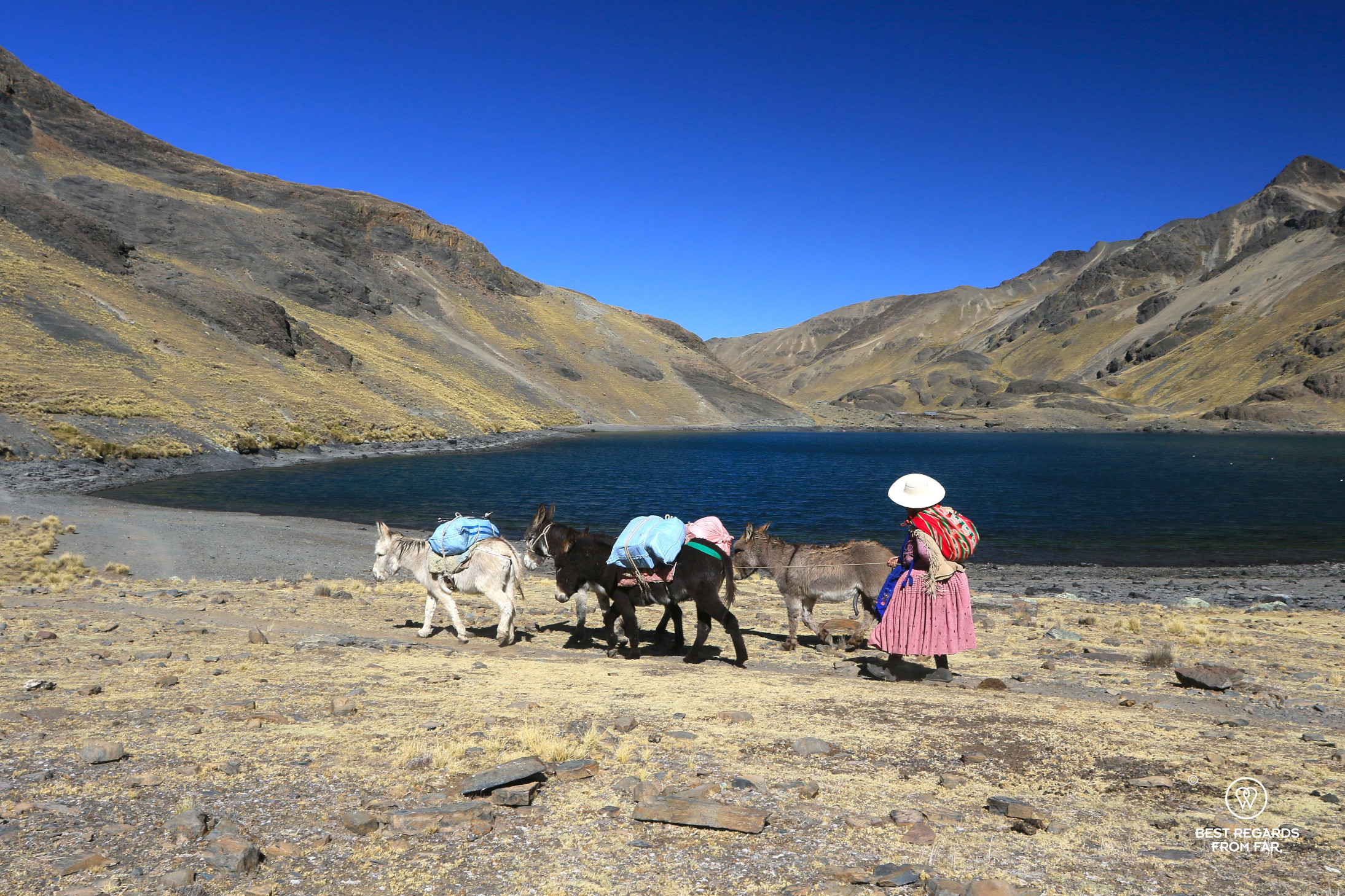
The majestic Cordillera Real is hard to say goodbye to, but as we make our way back down, donkeys in tow, the blue-altitude lakes, and the towering snow-capped peaks will stay with us forever. There is something extremely humbling about these wild and inhospitable heights. Once they have been conquered, at least partially, there is also a sense of connection with nature that only very few places on Earth offer.
Travel tips:
- Always climb with a CERTIFIED guide: The Tarija Glacier and other high-altitude peaks require experience, expertise, and acclimatizing. Nolberto Soliz with NolSolizAdventures is an excellent and professional certified guide who can also supply you with high-mountain gear and exclusively uses good quality equipment.
- Please be aware that many “cheap” guides flood La Paz. Ask for the certification by the “Asociación de guía de montaña y trekking de Bolivia”. Be aware that a professional guide will insist on a proper acclimatization—your safety is key, and your success depends on it—while a “fake” guide will shoot for a quick job.
- Huayna Potosi in mind? Despite its fame and fake advertisement, Huayna Potosi is NO easy climb. Proper preparation and acclimatization are critical, and a certified high-mountain guide is a must. The adventure described in this article is the ideal way to get ready for Huayna Potosi that can also be reached on foot from Condoriri Base Camp (enquire with Nolberto Soliz). Be aware of unqualified guides who often do not have the proper gear themselves and purposely push their clients too fast so that they abandon the climb, missing the summit—unfortunately a common practice in Bolivia.
- In La Paz, Casa Fusión Hotel Boutique is a locally-owned boutique hotel with a homey feel and interesting art exhibits. One of the best bakeries in town is also located on the premises!




- Check out our interactive map for more in the area (black pins lead to an article):
For more in Bolivia, click on these images:



 Best regards from far,